Your Feedback Backlog is a Triage Problem

Walk into any B2B SaaS company and ask to see the customer feedback. You will be shown a pile: a Slack channel, a spreadsheet, a tagging system in the support desk, maybe a portal with a few hundred votes. The pile is usually well tended. Someone owns the labels. Someone reports on volume. And almost none of it has changed a product decision in the last quarter.
That gap has a name in every other discipline that deals with incoming streams of variable urgency: a triage failure. Hospitals do not treat patients in arrival order, and they do not let the waiting room grow indefinitely while they build a better intake form. They assess, route, and dispose of every case against explicit rules. Customer feedback management deserves the same seriousness, because the cost of getting it wrong compounds quietly. The insight decays and the customer who gave it churns. Meanwhile the Product team keeps making decisions on whoever shouted most recently.
Collection is a solved problem. Disposition is not.
Most teams invested in collection years ago and still describe feedback as something they struggle with. The struggle has simply moved downstream, from capturing the signal to deciding what each piece of it means for the product.
Collection tooling is mature. Widgets, integrations, portals, and AI summarizers all exist, and most product stacks have several. The numbers go up: more feedback captured this quarter than last, more sources connected, more tags applied. Measured by inputs, the system looks healthy.
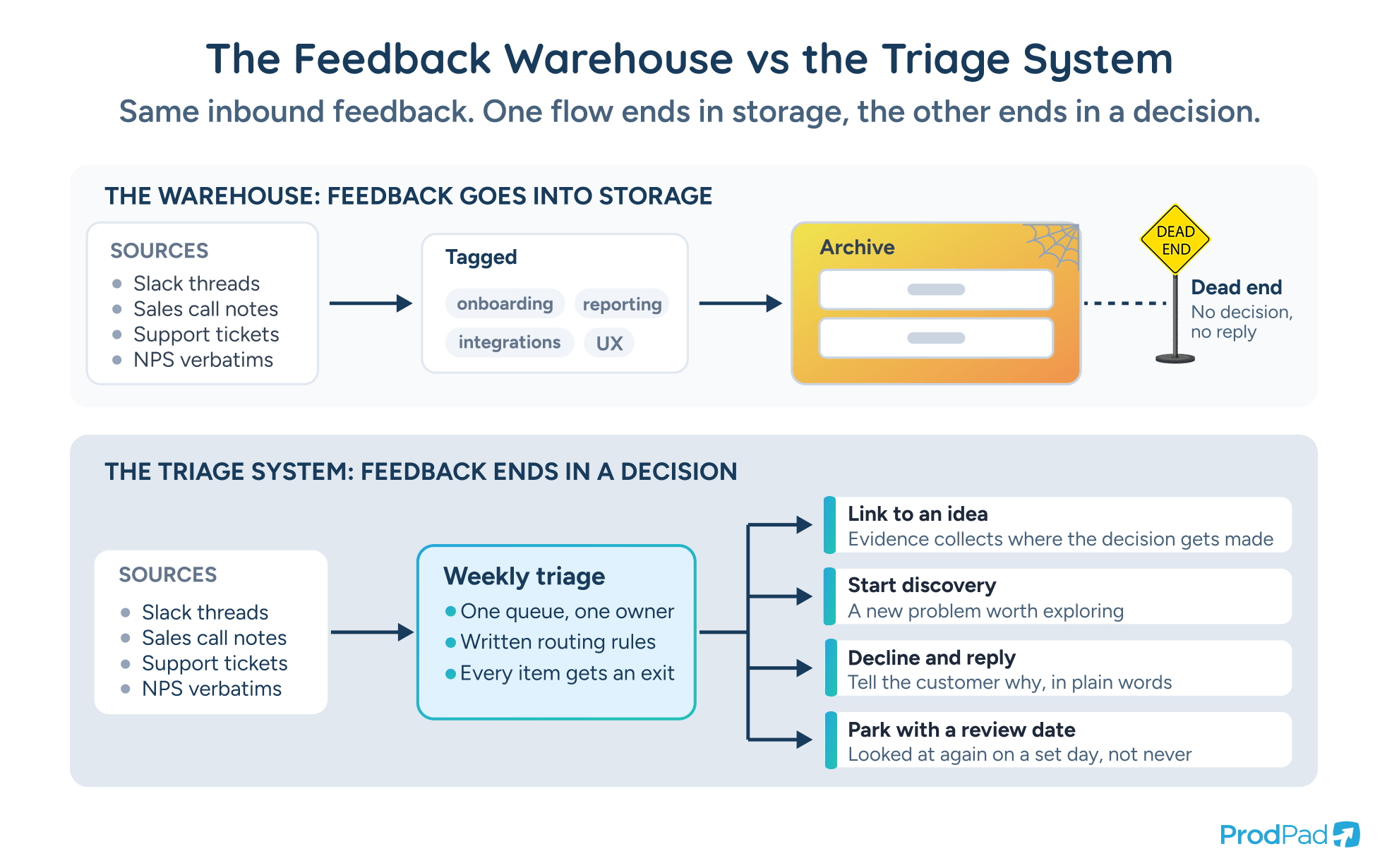
Measured by decisions, it usually is not. The test is simple to run. Take the last ten pieces of feedback that arrived and ask what happened to each one. If the honest answer is “it was tagged,” the system is a warehouse. Tagging is storage, and storage is where feedback goes to die quietly. The team that captured it feels productive and the customer who gave it assumes someone is reading. The roadmap carries on untouched by either.
A backlog of untriaged feedback also lies to you about coverage. A thousand unprocessed items feel like a thousand data points. Until someone has routed them, they are a thousand unknowns, and the loudest hundred will dominate any skim-read of the pile. Vote counts make this worse rather than better, because voting samples the customers who like voting, not the customers who represent your strategy.
Feedback piling up faster than you can read it? ProdPad’s sandbox has a pre-loaded feedback inbox you can practice triaging today
What triage means in customer feedback management
Triage is a discipline with three properties: every item gets a disposition, the disposition follows explicit rules, and the rules encode consequence rather than arrival order or volume. Transplanted to feedback, those three properties are the whole system.
Every item gets a disposition. A piece of feedback that has been read but not routed is still untriaged. There are only four legitimate exits. Link it to an existing idea as evidence, or open a new problem to explore. Decline it and tell the customer why, or park it with a date for another look. “Tagged” is an inventory state. It is not an exit.
The rules are explicit. The moment triage depends on one person’s judgment call per item, it stops scaling and starts drifting toward whoever processed the queue that week. Written rules sound bureaucratic, and they take about a page. They cover which customer segments map to which strategic priorities and which requests get a standard decline. They also set the evidence threshold that moves a theme from “noted” to “worth discovery.” A Product Manager applying a page of rules is consistent on Tuesday and consistent in December. Twelve people applying instinct are twelve different roadmaps.
Consequence beats volume. A single piece of feedback from a strategic segment describing a workflow collapse outranks forty requests for a cosmetic preference. Triage rules exist precisely to make that ranking survivable in public, because the forty will always be more visible than the one. This is where feedback triage connects to strategy rather than operations: your rules are your strategy, restated as routing logic. Teams that keep discovery running against a clear outcome have an easier time writing these rules, because the outcome tells you which opportunities count.
A useful definition to pin on the wall: customer feedback management is the operating process that turns raw customer input into product decisions, with a known disposition for every item and a feedback loop back to the customer who raised it. Everything upstream of a decision is logistics.
See how ProdPad links every piece of feedback to ideas, initiatives and objectives, so triage always ends in a decision
Why feedback rots: the system dynamics
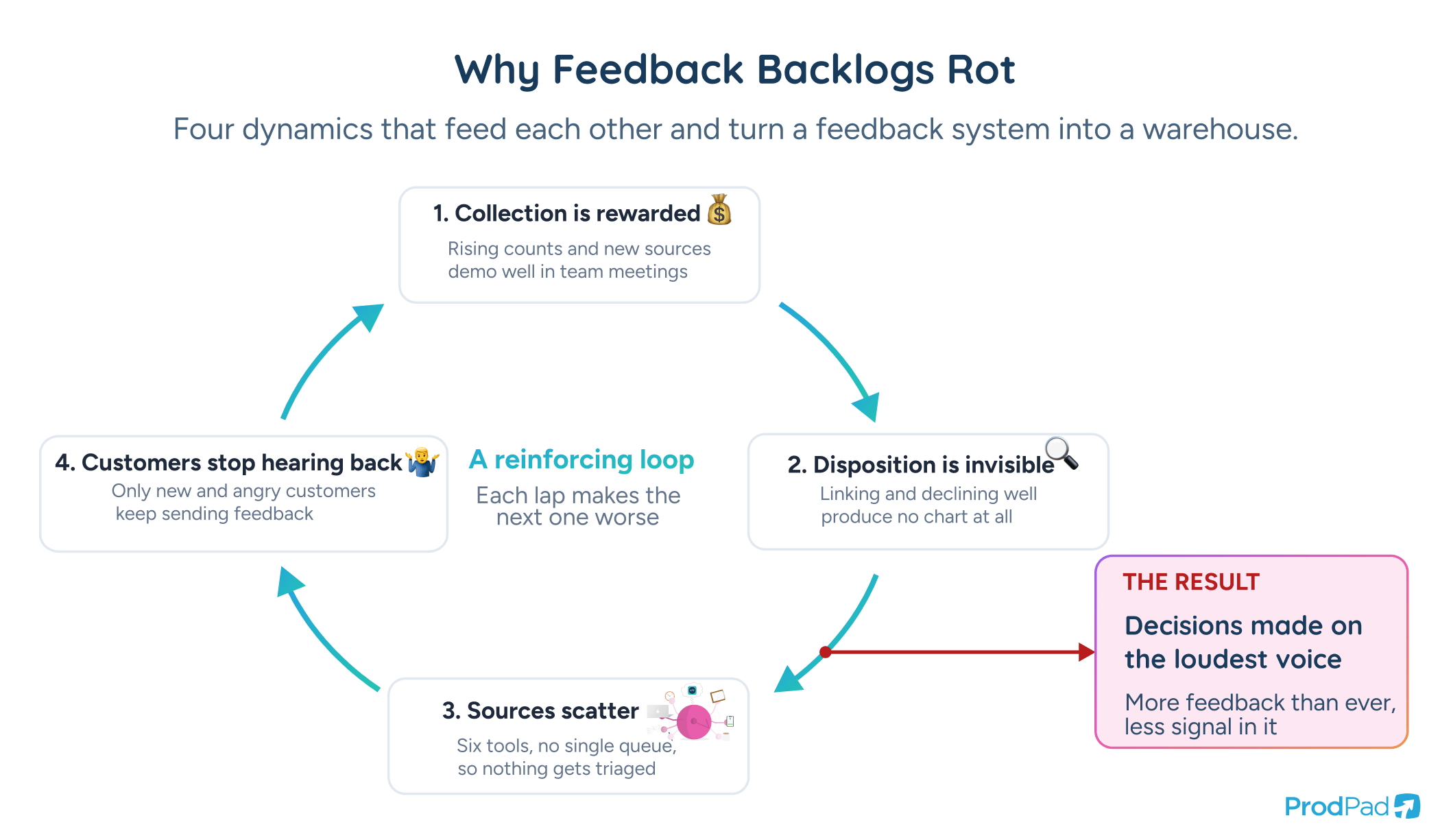
Feedback backlogs do not rot because teams are lazy. They rot because the default system rewards collection and punishes disposition, and most organizations never notice the asymmetry.
Collection is legible work. A connected source, a rising count, a weekly volume chart: all of it demos well in a team meeting. Disposition is nearly invisible. Declining a request well takes judgment and an awkward customer message; linking five pieces of feedback to one idea produces no chart at all. Any system where the visible metric is inputs will optimize for inputs, and the behaviors your tools make visible are the behaviors you get.
Scatter does the rest. Feedback that lives in six tools has no queue, and a queue is the precondition for triage. The Slack thread, the sales call note, the support ticket, and the NPS verbatim are each individually ignorable, so each individually gets ignored, and the composite picture they would have formed never exists anywhere. Meanwhile insight decays: feedback is context-stamped, and a six-month-old complaint about onboarding describes a product that may no longer exist. The warehouse model treats feedback as an appreciating asset. It is a perishable one.
There is also a quieter failure: the missing reply. When customers hear nothing back, they stop submitting, and the feedback stream skews toward new customers and angry ones. The silence is self-selecting your evidence base, which is how teams end up less aligned with their customers than they think while holding more feedback than ever.
See how ProdPad customers close the loop automatically
A weekly triage ritual that actually holds
The fix is operational and small. One queue, one weekly session, explicit exits, and a reply to the customer. Teams overestimate the volume problem and underestimate how fast a rule-based pass moves once the rules exist.
One queue, however many sources
Keep collecting from everywhere; route everything into a single inbox that one named person owns for the week. Ownership rotates fine. What cannot rotate is the definition of done: the queue returns to zero dispositions-pending, which is different from zero items. Thirty minutes twice a week handles most B2B SaaS volumes once the rules below exist, and the first session is the slowest you will ever run.
Dispositions, not discussions
The weekly session is not a prioritization meeting. Each item gets one of the four exits, and anything that provokes a debate longer than two minutes becomes its own discovery question rather than holding the queue hostage. Linking matters more than deciding here: ten pieces of feedback attached to one idea is evidence accumulating where the decision will eventually be made, which is exactly what a roadmap conversation needs when a stakeholder asks why something is in the Now column of your Now-Next-Later roadmap.
Close the loop or lose the stream
Every disposition generates a message, even the declines. Especially the declines; a reasoned no is the strongest signal a customer ever gets that feedback is read by someone with authority. Teams that reply see submission quality rise within a quarter, because customers write differently when they know a human reads it. The reply is also where product earns credibility with Sales and Success, who stop treating the feedback process as a black hole and start routing better evidence into it.
Review the rules quarterly
Triage rules encode strategy, and strategy moves. A quarterly pass over the routing rules, against current objectives and current segment priorities, keeps the system honest. If a rule has produced no linked feedback in a quarter, the rule is dead weight; if one theme keeps arriving and keeps getting parked, the strategy conversation is overdue, and the triage log is your evidence for raising it upward.
I walk through the AI workflows I run in ProdPad, step by step, and you get the prompts free with the recording. Watch now 🎥

Where AI belongs in feedback triage
AI has made the collection side of feedback effectively free, which means the pile grows faster and the triage discipline matters more, not less. Used precisely, AI also makes the disposition side dramatically cheaper. The precision matters.
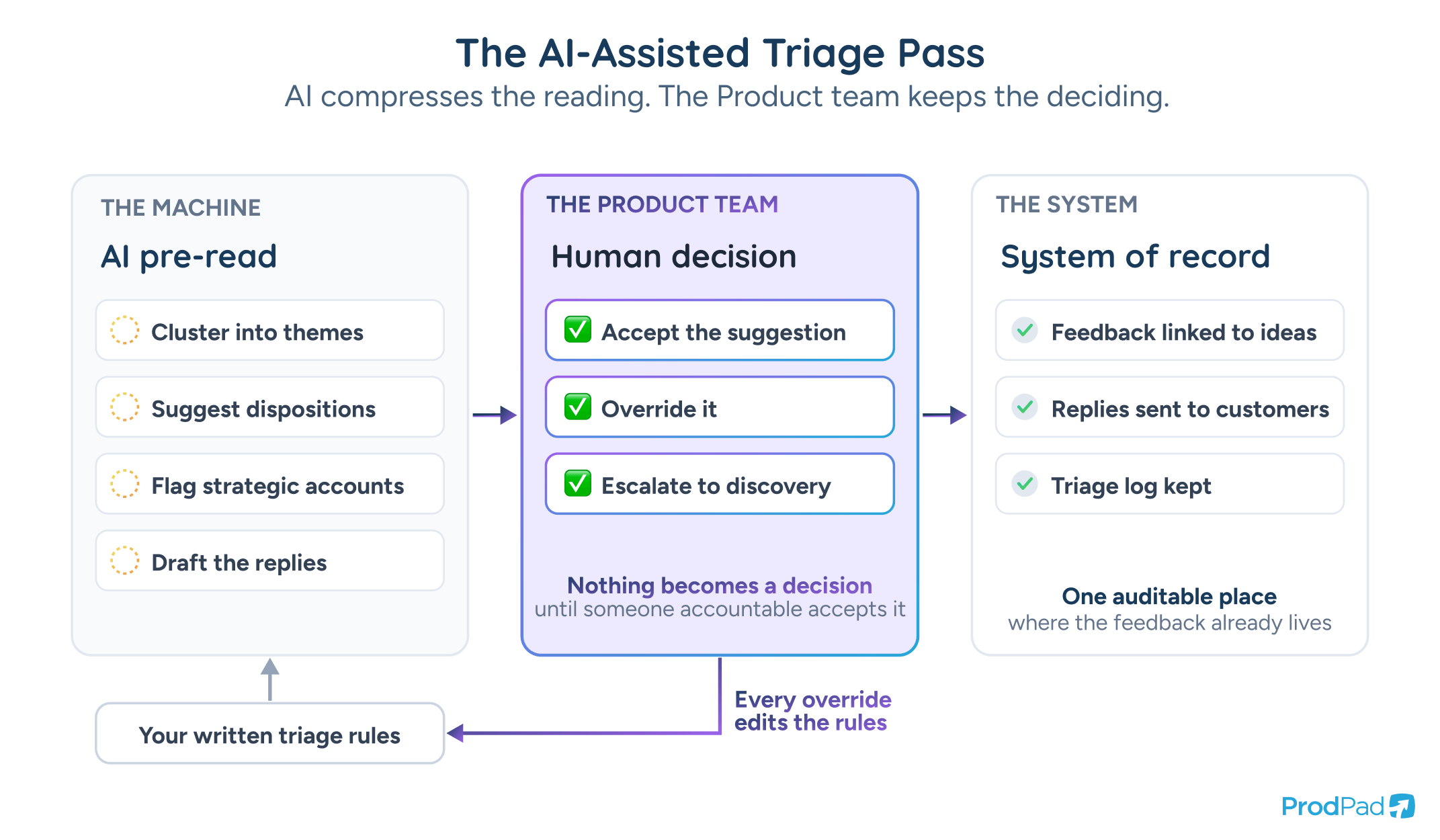
The work AI does well is the pre-read: clustering a week of feedback into candidate themes, drafting a suggested disposition per item against your written rules, flagging items from strategic segments, and drafting the reply messages. That compresses the weekly session from reading time into decision time. A structured brief beats a vague prompt here; an assistant handed your actual triage rules, segment definitions, and current objectives produces dispositions you can mostly accept, while an assistant asked to “summarize the feedback” produces a book report.
The work AI cannot do is the authority. A suggested disposition only becomes a decision when someone accountable accepts it, and the acceptance is the step that keeps your routing rules honest, because every override is a signal the rules need editing. This is the practical meaning of human in the loop for product work: the human is in the loop at the point of consequence, and the machine handles everything either side of it. Teams that let the assistant decide silently discover their roadmap six months later reflects their prompt quality rather than their strategy.
Wiring matters as much as the prompt. An assistant that reads your feedback where it already lives, and writes its suggested dispositions back into the same system through something like ProdPad’s MCP connection, keeps the triage log in one auditable place. An assistant that works in a chat window and pastes summaries into Slack is building you a second warehouse.
ProdPad Signals does the pre-read, grouping your live feedback into themes every day so you can link each one to an idea
Decisions are the output of feedback
A feedback system is working when you can name the last five product decisions it changed, and the customers involved know it. Volume collected, sources connected, and tags applied are logistics metrics, and logistics exist to serve the one metric that counts.
Triage is the unglamorous machinery that makes that possible: one queue, explicit rules, four exits, a reply every time, and now an AI pre-read that removes most of the labor without removing the judgment. The teams that run it do not have smaller backlogs. They have backlogs that end in decisions, roadmaps they can defend line by line, and customers who keep writing because someone visibly reads. The pile was never the asset. The disposition always was.