Now-Next-Later Roadmap

The Now-Next-Later roadmap was created by ProdPad co-founder Janna Bastow as an alternative to timeline roadmaps that make promises product teams can’t keep. Putting features in dated columns turns every date into a commitment, and when priorities shift, those commitments break.
What is a Now-Next-Later roadmap?
A Now-Next-Later roadmap is an outcome-focused product roadmap that organizes work by levels of confidence instead of fixed dates. These columns act as confidence horizons.
Now holds what the team is actively working on, Next covers problems being validated, and Later captures strategic bets still under consideration. The format keeps teams focused on outcomes rather than output.
The structure does two things at once. It sets honest expectations about certainty, since the work in Now is well understood and the work in Later is not. It also frames work as problems to solve rather than features to ship, leaving room for discovery instead of locking in solutions too early.
How is a Now-Next-Later roadmap structured?
A Now-Next-Later roadmap organizes Initiatives across three confidence horizons: Now, Next, and Later. As work moves toward Now, confidence increases, uncertainty decreases, and the team gets closer to delivering measurable outcomes.
A Now-Next-Later roadmap is not a queue of work moving toward delivery. It is a system for reducing uncertainty through discovery.

Now
Now is the work in motion. These are validated Initiatives the team is actively working on, where the problem is well understood and the focus has shifted to the solution.
Discovery in Now is solution discovery: refining experiments, shipping changes, measuring outcomes, and learning what works. Confidence is highest in Now because the work has been shaped enough to deliver measurable progress toward an OKR (Objectives and Key Results).
Next
Next is where opportunities get sharper. The big bets from Later are broken down into smaller problems, discovery narrows the options, and solution exploration begins.
Customer conversations, problem framing, and early experiments help the team understand what to build and why. An Initiative moves toward Now when the team has enough confidence to commit to a direction and deliver measurable progress against an OKR.
The common mistake is treating Next as a priority queue. It works better as the space where teams actively refine what comes next.
Later
Later holds the big bets: strategic problem areas the team cares about but has not yet shaped into something workable.
Discovery in Later is broad and exploratory, shaping opportunities and testing whether they are worth pursuing at all.
Confidence is lowest here, and that is intentional. Many items will change or disappear as the team learns more.
Discovery runs through every column of a Now-Next-Later roadmap. What changes is what it works on.
Putting Now-Next-Later into practice?
Learn why timeline roadmaps fail, how to implement Now-Next-Later, and how to align your team around outcomes instead of dates.
What are the benefits of a Now-Next-Later roadmap?
The format earns its place by protecting two things most roadmaps lose: strategic focus and credibility with the rest of the business. Framing work as problems keeps the roadmap useful even when plans change.
Honest expectations. Stakeholders can see what is certain and what is still being figured out, so nobody mistakes a Later bet for a Q3 commitment.
Adaptability. Teams are able to change priorities as they learn without turning roadmap updates into broken promises.
Faster decisions. Confidence horizons make trade-offs visible. Moving an Initiative from Later to Now becomes a deliberate decision.
Outcome focus. Framing entries as problems keeps the team aimed at customer and business value, not a fixed feature list.
How to build a Now-Next-Later roadmap
Building one starts with your strategy, not your backlog. The format follows a few steps:
- Capture the problems worth solving as Initiatives, framed as outcomes rather than features.
- Place each Initiative in the horizon that matches your current confidence, so Now holds validated work and Later holds bets you have not yet explored.
- Link each Initiative to the OKRs it supports, so the commitment lives on the objective.
- Prioritize within each column, then keep moving work between horizons as discovery reduces the uncertainty.
If you are moving across from a dated roadmap, ProdPad has a step-by-step guide to convert a timeline roadmap to Now-Next-Later without throwing away the work you have already done.
How does a Now-Next-Later roadmap compare to other roadmap types?
The defining difference is what organizes the columns. A Now-Next-Later roadmap organizes by confidence and problem priority, while most other formats organize by time or by feature. There are many product roadmap formats, and the right one depends on your audience and how much certainty you can honestly claim.
| Roadmap type | Organized by | Best when |
|---|---|---|
| Now-Next-Later | Confidence horizon and problem priority | You want outcome focus and honest expectations about certainty |
| Timeline / Gantt | Calendar dates | You have genuine fixed deadlines and high certainty |
| Feature-based | Features in priority order | You are tracking a known, committed set of features |
| Goal-based / theme-based | Objectives or themes | You want outcome focus, and often pair it with Now-Next-Later |
A feature-based roadmap can sit inside Now-Next-Later columns, but if it is built around features rather than problems, it is a feature board wearing the format’s clothes. The Now-Next-Later format adds the confidence horizon on top, so the roadmap communicates certainty as well as intent.
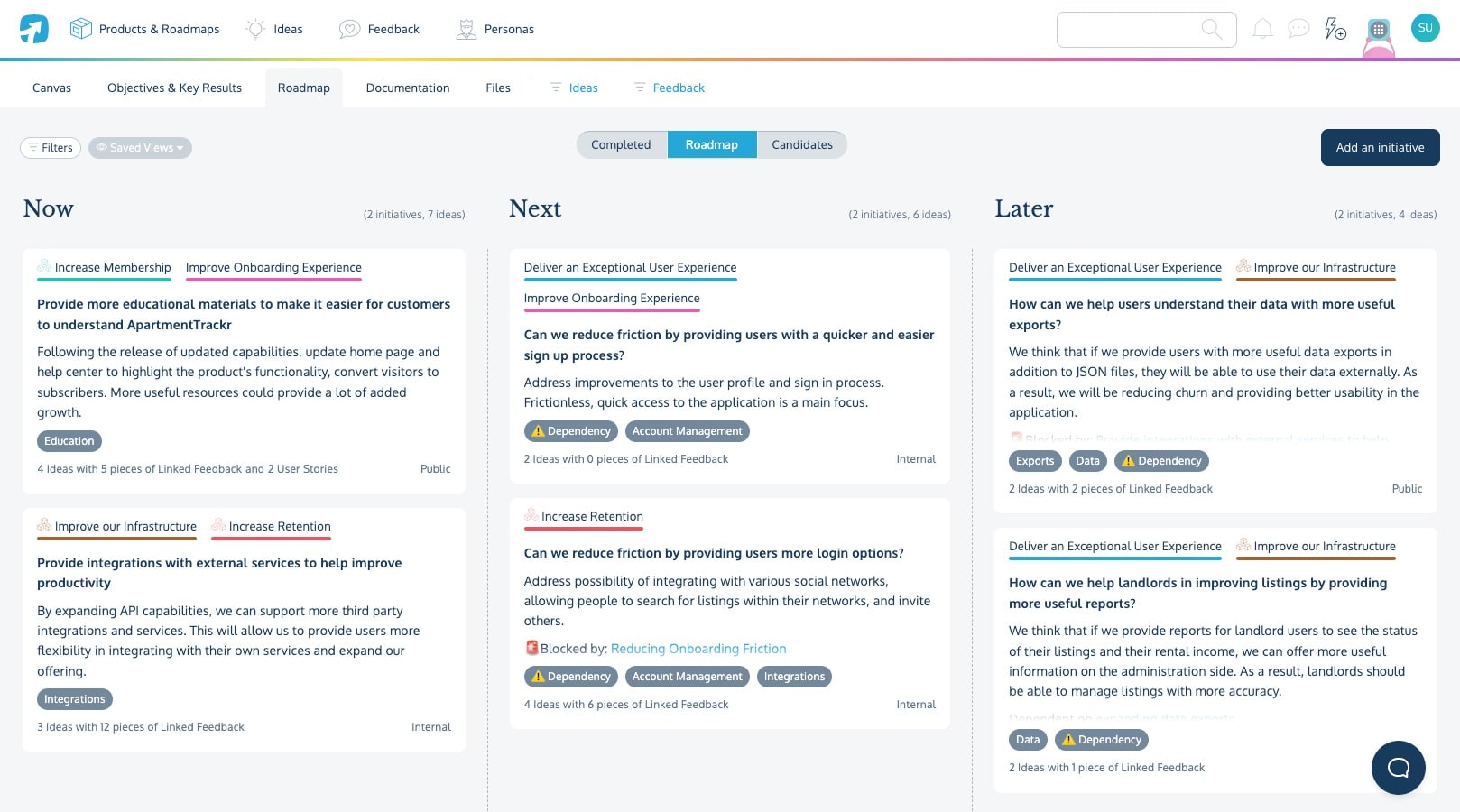
| Now | Next | Later |
|---|---|---|
| Provide more educational materials to make it easier for customers to understand ApartmentTrackr. Provide integrations with external services to help improve productivity | Can we reduce friction by providing users with a quicker and easier sign up process? Can we reduce friction by providing users more login options? | How can we help users understand their data with more useful exports? |
Now-Next-Later vs timeline roadmap
The timeline roadmap is the format Now-Next-Later was built to replace, swapping dated columns for confidence horizons.
| Timeline roadmap | Now-Next-Later roadmap |
|---|---|
| Organized by dates | Organized by confidence |
| Encourages commitments | Encourages learning |
| Feature-focused roadmapping | Outcome-focused roadmapping |
| Assumes certainty | Embraces uncertainty |
Now-Next-Later vs feature roadmap
A feature roadmap answers what you will build. A Now-Next-Later roadmap answers which problems you are solving and how confident you are about each.
| Feature roadmap | Now-Next-Later roadmap |
|---|---|
| Lists features to build | Frames problems to solve |
| Locks the solution early | Validates before committing to a solution |
| Tracks output shipped | Tracks outcomes achieved |
| Uniform detail for every item | Detail scaled to confidence |
Ready to leave timeline roadmaps behind?
Learn how to switch to a Now-Next-Later roadmap.
Common mistakes with Now-Next-Later roadmaps
The format is simple, which makes it easy to adopt the columns while keeping old habits. Most problems come from treating Now-Next-Later as a relabeling exercise rather than a shift in how work is framed.
- Treating the columns as Q1, Q2, Q3. Confidence horizons are not time buckets in disguise. The moment Later becomes “the back half of the year,” the false-precision problem returns.
- Filling columns with features instead of problems. Entries should describe the outcome you want, not the solution you have assumed. Solutions belong in discovery, captured as Ideas under each Initiative.
- Overloading Now. A long Now column is a sign of weak prioritization. Now should hold what the team can realistically focus on, and the whole roadmap should fit in a scroll or two.
- Putting artificial dates on the cards. A hard deadline does not make work ship faster. It usually just lowers the quality of what ships. Dates belong on the roadmap only when they are real, externally driven, or strategically important, and overusing them quietly turns the roadmap back into a timeline.
How should you handle dates on a Now-Next-Later roadmap?
A Now-Next-Later roadmap is not anti-date. Unlike a timeline roadmap, it does not imply a date for every item. Dates appear only where they carry genuine meaning.
When you add a date, make it a real one: an externally driven deadline, a strategic commitment, or a milestone that matters. Keep exploratory work in Next and Later free from artificial deadlines so teams have space for discovery.
Regulated industries such as fintech, healthtech, and govtech often have genuine dates for audits, compliance windows, or contractual commitments. In those cases, the roadmap still shows the plan while OKRs and deadlines hold the commitments.
A useful rule of thumb: roadmaps communicate direction, while OKRs communicate commitment.
Need to show dates without reverting to timelines?
Now-Next-Later roadmaps let teams add dates only where they truly matter with the right level of precision.
Who should use a Now-Next-Later roadmap?
A Now-Next-Later roadmap works for any product team that needs to communicate strategy without making premature commitments about dates. The format is especially useful when priorities change frequently, discovery is ongoing, or multiple stakeholders need visibility into what comes next.
Startups use Now-Next-Later roadmaps to stay flexible as they search for product-market fit and learn from customers.
Scale-ups use them to align growing teams around outcomes while avoiding the overhead of maintaining timeline roadmaps.
Enterprise companies use them to communicate priorities across multiple teams and stakeholders without turning roadmap items into fixed promises.
B2B SaaS teams use them to balance requests from sales, customers, and leadership without committing to delivery dates they cannot yet stand behind.
Product teams practicing Agile use Now-Next-Later roadmaps because they allow priorities to evolve as teams learn, without rewriting the entire plan.
A Now-Next-Later roadmap is less about company size and more about uncertainty. If your roadmap changes as you learn, it is likely a better fit than a date-driven roadmap.
Start with our interactive template, complete with worked examples, sample Initiatives, and practical guidance.
FAQs
- Should a Now-Next-Later roadmap have dates?
A Now-Next-Later roadmap can have dates, but only where they are real. The format does not force a date onto every item the way a timeline does, so most entries stay undated to avoid creating false expectations. When a date is genuine, externally driven, or strategically important, attach it to an objective, a milestone, or a deadline rather than scattering dates across the roadmap.
- Where do dates and deadlines go on a Now-Next-Later roadmap?
Dates and deadlines in a Now-Next-Later roadmap belong on objectives, milestones, and genuine commitments, not on every roadmap item.
The roadmap communicates priorities and confidence, while OKRs capture the commitments the team is working toward. Stakeholders can see which Initiatives support each objective and how close they are to delivery.
- Is a Now-Next-Later roadmap an agile roadmap?
Yes. A Now-Next-Later roadmap is an agile roadmap because it adapts as teams learn rather than locking work into fixed long-term commitments.
Unlike timeline roadmaps, it organizes work by confidence horizon rather than dates, allowing priorities to change as new evidence emerges.
Teams can move Initiatives between Now, Next, and Later without rewriting the roadmap, making the format particularly well suited to Agile product management
- What is the difference between a Now-Next-Later roadmap and a timeline roadmap?
A Now-Next-Later roadmap organizes work by confidence horizon, while a timeline roadmap organizes work by dates. The former communicates priorities and uncertainty; the latter communicates schedules and commitments. This allows a Now-Next-Later roadmap to evolve as the team learns, without turning roadmap changes into broken promises.
- How many items should be in Now Next and Later?
There is no fixed number, but a Now-Next-Later roadmap should fit on one or two screens or slides. The right count depends on your team structure, delivery capacity, and how much work you can realistically progress at once.
If the roadmap does not fit, either raise the level of abstraction or split it by team. In general, fewer, higher-level Initiatives communicate strategy better than detailed feature lists.
- What goes into the Now, Next, and Later columns?
The Now column contains work in progress, Next contains validated opportunities being explored, and Later contains strategic bets with lower confidence. Items move between horizons as teams learn more and reduce uncertainty.
- Does a Now-Next-Later roadmap replace Jira?
No. A Now-Next-Later roadmap does not replace Jira because the two tools serve different purposes. A roadmap manages strategy, discovery, and outcomes, while Jira manages delivery and execution.
Many teams use both together: the roadmap answers “why” and “what next,” while Jira answers “how” and “when.”
- Who invented the Now-Next-Later roadmap?
Janna Bastow and Simon Cast created the Now-Next-Later roadmap in 2012 while building ProdPad, after years of seeing timeline roadmaps create false expectations.
Read Janna Bastow’s account of why she invented the Now-Next-Later roadmap for the full story. - Can enterprise companies use a Now-Next-Later roadmap?
Yes. Enterprise companies use Now-Next-Later roadmaps to create strategic alignment without forcing teams into premature commitments.
Unlike timeline roadmaps, a Now-Next-Later roadmap makes uncertainty explicit, reducing the risk of teams treating roadmap items as fixed promises. This creates a more honest conversation about priorities, dependencies, and change across the business.
Visit our Enterprise page to learn how enterprise product teams use ProdPad to manage strategy, discovery, and delivery at scale.