Product Led Growth

Product-led growth (PLG) has emerged as a transformative strategy in the software industry. It flips the traditional playbook by making the product itself the primary engine of customer acquisition, conversion, and expansion. In a product-led approach, companies let a great user experience and built-in value do the heavy lifting – attracting users organically and turning them into loyal advocates. This model has gained traction as modern buyers increasingly prefer to self-serve and try before they buy, rather than endure long sales cycles or demos.
What is Product Led Growth?
Product-led growth is a go-to-market strategy where the product’s own merits drive user acquisition, retention, and revenue growth. In this model, users can typically start using the product immediately, often via a free trial or freemium version, and experience its value firsthand without relying on a salesperson. The idea is that if your product is intuitive and valuable enough, it will essentially “sell itself” by hooking users through direct experience. Instead of conventional marketing or sales pushing a customer along, the product’s usability and utility take center stage in converting free users to paid customers and in driving ongoing growth.
In practice, this means removing friction from the user journey and focusing on delivering a remarkable first-hand experience. Users are encouraged to sign up, explore features, and reach an “aha!” moment of value quickly. A classic example is how Slack or Dropbox gained adoption – individuals and teams could start using the product for free, discover its benefits, and only later did upgrades or larger purchases naturally follow. The end-user becomes the focus in product led growth, and their success with the product becomes the company’s primary growth lever.
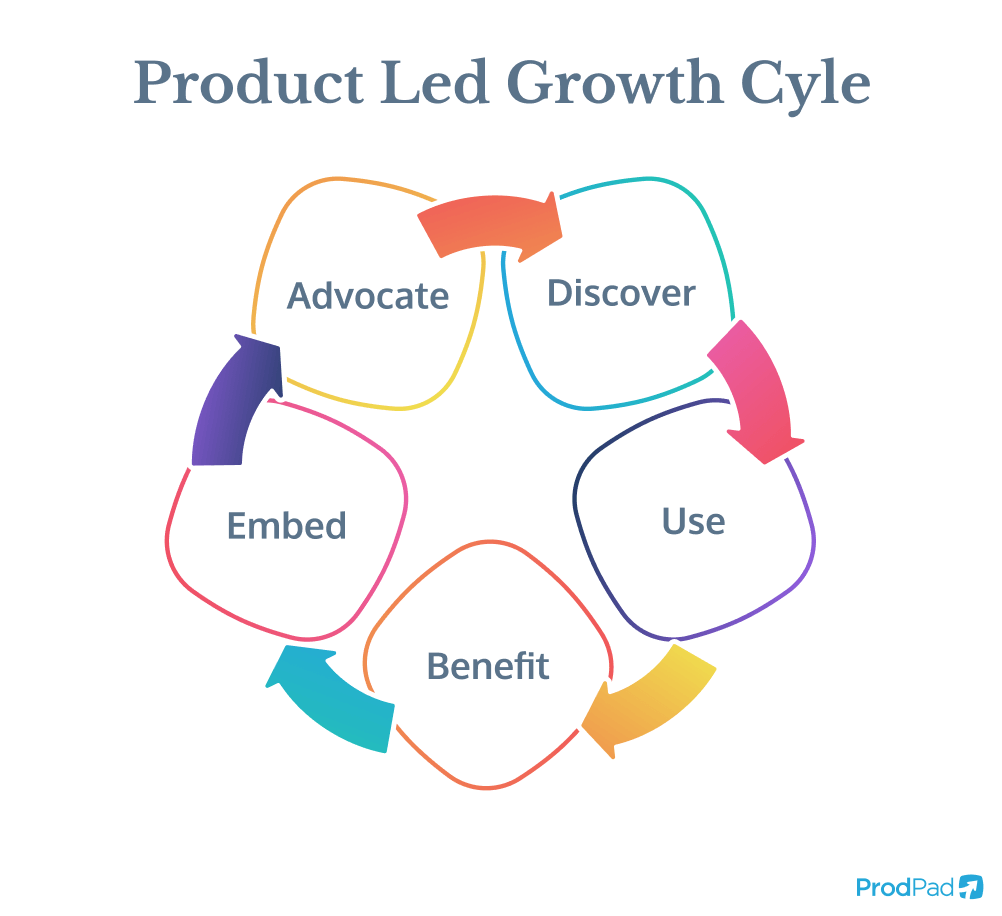
See How to write a kick-ass product-led growth strategy for a practical exploration of self-serve product-led models
What are the benefits of product-led growth?
Every company touting product led growth is chasing a similar promise: faster, more cost-effective growth driven by delighted users. There are several compelling benefits to adopting product-led growth:
Lower Customer Acquisition Cost (CAC)
By letting the product do the talking, product led growth companies spend less on expensive ad campaigns or large sales teams. Users enter through free trials or freemium tiers, converting to paid when they’ve already seen value. This self-service funnel means you acquire customers without the heavy upfront costs of traditional sales outreach, improving your unit economics.
Faster Time-to-Value
In a product led growth model, users can start using the product within minutes or hours of discovering it. This shortens the sales cycle dramatically. The quicker a user experiences a meaningful outcome, their “wow” moment, the quicker they’re likely to become a paying customer. An intuitive product with easy onboarding can thus convert users in days, not weeks or months.
Better User Experience
Product-led companies are forced to build with the end-user in mind. Since the product must win users over on its own, it tends to have a cleaner, more user-friendly design and smoother onboarding flow. Users can explore at their own pace, which often leads to higher satisfaction. They don’t need high-pressure sales calls to understand the value; they live the value through using the product.
Higher Revenue per Employee & Scalability
A strong product led growth motion can scale revenue without a proportional scale in headcount. Successful examples like Ahrefs reached ~$40M ARR with less than 50 employees by leveraging a self-serve model. Because the product and automation handle much of the growth work, companies can grow quickly (“always open” 24/7) without being bottlenecked by the size of their sales force.
Wider Market Reach
A frictionless product that’s open to try will attract a broad range of users. Product led growth offerings often serve all segments from individual users and small teams up to enterprise departments, because anyone can start using the basic product. This can expand your total addressable market. For example, Atlassian famously let small teams use its tools free (e.g. up to 10 users) which seeded enterprise-wide adoption later.
Built-in Retention
When users only pay after already experiencing value, they are more likely to stick around long-term. By the time a free trial ends or a free tier user considers upgrade, they’ve often grown dependent on the product for their workflow. This “try before you buy” dynamic bakes retention into the model – customers have essentially pre-qualified themselves. As ProdPad’s team puts it, a sticky product that truly solves a pain will have users “loath to give it up” once they’ve used it, yielding naturally higher retention rates.
Viral Growth and Word-of-Mouth
A great product-led experience turns customers into evangelists. Users who love the product will tell colleagues and friends, driving organic referrals. Many product-led growth products also get better when more people use them together (think collaborative tools like Slack or Miro), creating network effects that encourage users to invite others. This viral loop can significantly amplify growth without additional spend. Word-of-mouth becomes a powerful acquisition channel in product led growth, as happy users promote the product on the company’s behalf.
In short, product-led growth aligns the success of the customer with the success of the business. When done right, it creates a positive feedback loop: a great product experience → more users → more feedback & improvement → even better product. That virtuous cycle leads to compounding growth.

The fundamental difference between product-led and sales-led growth lies in who (or what) is guiding the customer through the journey. In a sales-led growth (SLG) model, the process is driven by people. Sales representatives nurture leads, give demos, and close deals. In product-led growth, the process is driven by the product. Users guide themselves through a trial of the product, and the product’s value convinces them to convert.
Some key distinctions include:
Customer Engagement
In a product led growth approach, customers try before they buy. They often get immediate access to a free tier or trial, engaging with the software hands-on from the start. With sales-led growth, by contrast, a prospect’s first real interaction with the product might only come after a lengthy sales process (e.g. during a live demo or even post-purchase). Product led growth companies reduce this barrier by letting the product itself be the trial and demo.
Delivering Value
Product-led growth aims to deliver value up front. The product is designed so that users quickly hit meaningful milestones on their own – for example, Canva’s free templates letting a new user complete a design in minutes. Sales-led growth, in contrast, often delivers perceived value through promises and sales pitches; the actual product value is realized only after the sale. In short: product led growth shows, sales led growth tells.
Buying Process
Product led growth favors a self-service buying process. Users can often upgrade to a paid plan with a few clicks when they’re ready, without ever talking to a rep. Sales-led models favor a high-touch sales process. Think RFPs, custom quotes, and negotiations led by an account executive. One quick litmus test: truly product-led companies rarely have a “Book a demo” wall on their website, whereas sales-led companies almost always do.
Target User and Market Entry
Product-led strategies typically target end users or teams directly. The product is marketed to users who can adopt it and spread it within their organization bottom-up. Sales-led approaches traditionally target decision-makers (CIOs, managers) top-down, since those stakeholders control budget. Product led growth flips this. Adoption often starts with small teams or individual champions proving the tool’s worth internally.
Integration and Ecosystem
Product led growth products tend to play nicely with others. They often have open APIs and integrations, making it easy for users to slot the product into their existing workflows. Sales-led products (especially older enterprise software) have historically been more siloed and all-in-one. Modern PLG companies embrace being part of a wider ecosystem of tools (for example, Grammarly integrating into Google Docs, or ProdPad integrating with Dropbox and Github to fit into your workflow).
Team Alignment
Internally, a product-led growth organization operates differently. Rather than siloed departments tossing leads over the fence, product led growth requires cross-functional alignment. Marketing, product, engineering, customer success, and even sales all work together to improve the product and user journey. Traditional sales-led orgs often have more segregated teams with separate goals (e.g. sales focuses on quotas, product focuses on features), whereas product led growth teams share product-centric success metrics.
It’s important to note that these models aren’t mutually exclusive. Many successful companies blend both approaches. For instance, a company might use product-led tactics to land a large base of self-serve users, then employ a sales team to engage the biggest or most complex opportunities (a common “hybrid” model). Early on, Atlassian famously grew without a sales team by being purely product-led, but even Atlassian eventually added enterprise sales for their largest customers – without abandoning their PLG core. The right mix depends on your product and market. Complex, high-ticket products often need some sales help, while simpler SaaS products can go further with pure product led growth.
For a deeper comparison of Product-Led Growth and Sales-Led Growth, see our blog which breaks down the trade-offs, hybrid approaches, and where each model works best.
How do product teams practice product-led growth?
Adopting product-led growth isn’t as simple as offering a free trial and walking away. It requires real changes in how product teams work and how a company designs its product experiences. Here are some of the core practices and cultural shifts that real product teams embrace under a product led growth approach:
User-Centric Product Design
Product-led teams double down on understanding user needs through research and continuous discovery. The product must solve an acute problem and be so easy to use that users can get started without instruction. This means investing heavily in UX, onboarding flows, and in-app guidance. For example, product led growth companies build robust in-app product tours, tooltips, and knowledge bases so users can educate themselves. Every new feature is designed with self-service in mind – if it’s too hard to figure out without a sales rep, back to the drawing board.
Cross-Functional Alignment around Product
In a product led growth model, every department plays a role in improving the product experience. Marketing might shift focus to driving signups and nurturing users inside the product (via lifecycle emails or tutorials), rather than just generating outside leads. Sales teams, if they exist, start looking at product usage data to prioritize which accounts are “product-qualified” and already showing intent. As Allan Wille (CEO of Klipfolio) put it, every team asks how they can leverage the product to do their job – marketing seeks a demand flywheel through the product, sales uses the product itself to qualify leads, success teams aim to deliver value via the product interface. This shared focus on product forces cultural alignment and breaks down silos.
Rapid Iteration & Data-Driven Improvements
Product-led growth thrives on continuous learning. Teams instrument the product with analytics (e.g. tracking user onboarding steps, feature usage, conversion funnels) and run experiments to improve these metrics. When Citrix observed through product analytics that certain trial behaviors led to higher conversion, they revamped their onboarding flow to steer users to those features resulting in a 28% bump in trial conversions. This is a classic product led growth move: use data from the product to iterate and increase activation rates. Product managers in product led growth orgs act a lot like growth PMs, constantly A/B testing in-app changes, tweaking free-to-paid upgrade prompts, and optimizing the user journey to drive adoption.
Obsessing Over the “Aha Moment” (Time to Value)
Real product teams map out the key actions that correlate with a user realizing the product’s value, and they relentlessly optimize the path to that moment. This might involve guided onboarding checklists, pre-filled templates, or interactive tutorials to ensure new users quickly accomplish something meaningful. Reaching this outcome faster (short TTV) not only improves conversion but also user satisfaction. For example, a project management app might find that a user invites 3 teammates and completes 2 projects in the first week are far more likely to stick; the team would then build onboarding triggers to encourage exactly those actions.
Freemium and Transparent Pricing Strategies
Most product led growth companies employ a free trial or freemium model to get users in the door. Deciding what to give away for free versus what to charge for is a delicate art. Product teams experiment with different limits (e.g. free tier with limited projects or storage, or time-limited trials that convert to paid). The key is to provide enough value for free that users become truly engaged, while reserving enough additional value that upgrading to paid feels natural once they hit a limit. Equally important is being transparent about pricing and upgrade options. Users shouldn’t be shocked by a paywall. Successful product-led growth products often include in-app upgrade prompts at logical points, upgrade comparison pages, and perhaps a reverse trial (starting users on a fully featured trial that downgrades if they don’t pay).
Viral Loops and Sharing Built In
Product-led growth often leverages the product’s usage to drive more adoption. Product teams intentionally bake virality into the product when possible. This could mean enabling easy sharing (e.g. a “sent from my [Product]” signature or the ability to invite team members from inside the app). Each time someone sends a Calendly link or a Notion page, for instance, they’re passively introducing new people to the product. Many product led growth successes like Slack and Zoom grew via this bottom-up propagation. One person brings it in, others join, and soon it spreads across the org. Designing features that encourage users to invite others (multi-player collaboration, referral rewards, etc.) is a common product led growth tactic.
Customer Success through Product Success
In traditional models, a customer success manager might train or onboard customers. In product led growth, the product team asks “how can the product itself help customers be successful?” That leads to things like extensive self-help resources, chatbots or support baked into the app, and continuous engagement (feature tips, usage tips, etc. delivered in-app). The product should function as a “customer success” agent on autopilot. For instance, if data shows users aren’t using a key feature, a product-led team might add a contextual tooltip or email to educate them (rather than a CSM making a call).
Real-world product teams practicing product led growth often create a tight feedback loop: usage data informs product decisions weekly if not daily. They hold regular “growth experiments” meetings rather than annual roadmap reviews. And as usage grows, they remain keenly aware of when a human touch might be needed for high-value accounts or to gather qualitative insights. The product may lead, but savvy product led growth organizations still listen to users and support them; they just try to do it at scale via the product experience.

What are the challenges of product-led growth?
While product-led growth has many advantages, it’s not a magic bullet. Implementing product led growth comes with its own set of challenges and potential pitfalls that product leaders should be mindful of:
High Bar for Product Quality & Investment
Product led growth demands an exceptional product experience from the start. There’s no hiding behind sales promises. If the product isn’t immediately valuable and easy to use, customers will churn before you ever talk to them. This often means significant upfront investment in R&D, design, and infrastructure. Building a robust free tier that can handle potentially thousands of free users (who may never convert) can strain resources. As one analysis notes, companies must be ready to invest in user experience, onboarding design, and scalability to make product led growth work. Not every startup can afford this level of investment early on, which can make product led growth a challenging strategy to execute properly.
Team Alignment & Cultural Shift
Adopting product led growth can fail if the organization isn’t fully on board. All departments such as Product, Engineering, Marketing, Sales, Customer Success, need to align around shared metrics and goals (e.g. activation rate, retention, NPS) rather than traditional departmental KPIs. If marketing is still only focused on MQLs and sales on quarterly quota, a product led growth initiative might clash with existing incentives. Ensuring every team is rowing in the same direction (delighting the user!) is hard and requires strong leadership. Companies lacking this alignment might see conflicting priorities and missed opportunities, such as salespeople pushing for deals that aren’t right for the user or marketing promising features the product team can’t deliver.
See our blog for a deeper comparison of Product-Led Growth and Sales-Led Growth, which breaks down the trade-offs, hybrid approaches, and where each model works best.
Not One-Size-Fits-All
Product-led growth works best for certain types of products, especially those that can be easily adopted via self-service and have a broad base of potential users. If your product is highly complex, enterprise-oriented, or requires customization, a pure PLG motion might stall out. High-touch industries or big-ticket B2B sales often still need a sales-led component. Product led growth also may not suit products that don’t have an “aha moment” until after significant setup. It’s important to recognize if your market expects a concierge sales approach; forcing a product-led model on a product that isn’t a fit could frustrate customers. Many companies ultimately adopt a hybrid approach (product-led plus sales assist) once they hit a growth ceiling with pure self-serve.
Scaling Support & Infrastructure
Success in product led growth can lead to a tidal wave of users, which is both a blessing and a challenge. Supporting thousands of free users (who have expectations for a good experience too) can strain your support team and infrastructure. You’ll need to invest in robust customer support channels (like in-app chat, comprehensive help centers, community forums) because those users won’t be talking to account managers. Additionally, scaling the backend systems to handle a large user base (many of whom aren’t paying yet) is a technical challenge. Outages or performance issues will immediately erode trust, and unlike enterprise customers, free users have little loyalty if things go wrong early.
Continuous Iteration (Need for Agility)
Product led growth is not a “set and forget” strategy. It requires a mindset of constant optimization. Companies with rigid processes or slow release cycles will struggle to realize product-led growth gains, because you must respond quickly to user feedback and usage data. For example, if you discover users are dropping off during onboarding, you need to deploy an improved flow rapidly. Waiting for a quarterly roadmap update might be too late. Organizations that are unwilling to iterate or that stick to a fixed annual plan can find their product-led efforts stagnating. Embracing an agile, experiment-driven culture is crucial; being too slow to adapt is a major product led growth pitfall.
Misinterpreting “Product-Led” (No Silver Bullet)
Some companies misread product-led growth as “if you build it, they will come.” In reality, product-led growth does not mean zero marketing or sales. It means those functions play a different, supportive role. You still have to drive awareness to get users in the door, even if through content or viral features instead of big ad spends. And you might still need sales for certain deals or upsells. Product led growth also isn’t “growth without effort”. It requires as much strategizing as any approach, just with the product as the centerpiece. It’s important not to assume product led growth is automatically cheaper or easier; the work is simply focused more on product improvements and user happiness than on outbound selling.
The good news is that none of these challenges are insurmountable. Companies that recognize the hurdles can address them proactively. For example, setting up cross-functional “growth teams” to maintain alignment, or running a robust customer community to support scale. Many firms start with a pilot product led growth project on one product or segment to learn what works before rolling it out broadly. And plenty of traditionally sales-led companies have gradually introduced product led growth elements successfully (e.g. HubSpot adding a free tier and then transitioning to a product led growth + sales hybrid model). The key is to go in with eyes open: product-led growth changes how your organization operates, and it demands excellence in product execution.
How is success measured in product-led growth?
Measuring success in a product-led growth model means focusing on user-centric and product-centric metrics. Traditional sales metrics (like number of deals closed or lead conversion rate) become less important than metrics that indicate users are finding value, sticking around, and spreading the product. Key performance indicators for product led growth typically include:
- User Acquisition Rate: How quickly are new users signing up or activating? This is the top-of-funnel volume – essentially tracking the growth of your user base over time. A healthy PLG product will show a steady (or accelerating) influx of new signups, driven by marketing, virality, or word-of-mouth. If this is flat, it may indicate issues with awareness or an unappealing value proposition.
- Activation Rate: Of those new users, how many actually reach a key value milestone? Activation is usually defined by a specific action or set of actions that correlate with a user “getting” the core value (for example, creating and saving one design in a design tool). It’s a crucial product led growth metric – a high activation rate means the product is effective at delivering on its promise quickly. A low activation rate shows where users are getting stuck or dropping off early, indicating a need to improve onboarding or first-run experience.
- Engagement & Active User Metrics: Daily Active Users (DAU) or Monthly Active Users (MAU) gauge ongoing product engagement. In product led growth, it’s not just about getting users in, but keeping them using the product. Tracking DAU/MAU (and the ratio between them) can tell you how “sticky” your product is. A growing base of active users means people are finding continual value. Other engagement metrics like session length, frequency of key feature use, or depth of feature usage can add insight into how compelling the product experience is.
- Retention & Churn: Churn rate measures the percentage of users (or customers) who leave or stop using the product over a given time. In a product led growth funnel, you’d look at retention of free users (do they keep coming back each week/month?) as well as retention of paying customers (do they renew their subscriptions). Strong retention is a hallmark of product-led growth because if the product truly “sells itself,” users will keep themselves onboard. If churn is high, it indicates a gap between initial promise and ongoing delivered value.
- Conversion Rate (Free-to-Paid): For freemium models or free trials, a critical metric is what percentage of users convert to a paid plan. This metric ties the user-focused world to revenue. A low conversion rate might mean the free offering is too generous (people can get what they need without paying), or that the premium features aren’t compelling enough. It could also signal a mismatch in who is signing up (e.g. lots of curiosity users outside your target). Optimizing this involves experiments in packaging, pricing, and upsell prompts.
- Customer Lifetime Value (CLV/LTV): In PLG, many customers start small (maybe a single team or a small subscription) and then expand. CLV measures the total value a customer brings over their lifetime. If your product lends itself to land-and-expand (which many PLG products do), you want to see CLV increasing over time as users upgrade or add more seats. A rising CLV suggests that once users adopt, they’re growing with the product – a great sign of embedded value.
- Net Promoter Score (NPS): NPS measures how likely users are to recommend your product to others. It’s a direct gauge of user delight and organic advocacy. High NPS in a PLG setting often correlates with strong word-of-mouth growth (your users become your marketers). Tracking NPS and the qualitative feedback behind it can uncover what drives love for the product or where improvements are needed.
- Product-Qualified Leads (PQLs): Many product led companies replace or supplement the concept of a “marketing qualified lead” with a product qualified lead. A PQL is typically a free user (or team) whose product usage indicates a high likelihood to convert to paid. The exact definition is product-specific – it could be hitting a usage threshold, using a premium feature trial, or multiple team members engaging. Tracking the number of PQLs and how many convert to customers is key for product led growth businesses, especially those that do layer in some sales. It bridges product metrics with sales outcomes.
See ProdPad’s blog on product-led GTM for a closer look at how product usage signals inform go-to-market execution.
In essence, Product Led Growth metrics center on user behavior and outcomes. They tell the story of how people are discovering the product, what they do with it, and whether it becomes indispensable to them. Benchmarks will vary by industry, but as a rule of thumb in product led growth you want to see high activation, strong retention, growing engagement, and a steady flow of referrals or invites (a sign of virality). Monitoring these indicators guides product teams on where to double down. For instance, if activation is lagging but once activated users retain well, the priority is clear: improve that onboarding.
It’s also worth noting that in hybrid models (product-led + sales), you’d track a mix of these product metrics alongside some traditional ones. The alignment between product metrics and revenue metrics becomes a north star. For example, if increasing weekly active users correlates with higher expansion revenue, that validates the PLG approach. Modern analytics tools and dashboards often bring these together so teams can see, say, an uptick in NPS alongside growth in paid subscriptions. That holistic view is vital to ensure the PLG engine is actually driving business outcomes, not just free usage.
How do tools and processes support product-led growth?
The shift to product-led growth often goes hand-in-hand with a shift in the tools and processes a team uses. Traditional product management and go-to-market tools were built with sales-led or output-driven mindsets, whereas newer tools are emerging to better support a PLG, outcome-driven approach. Here’s how tooling can influence (and enhance) a product-led strategy:
From Timeline Roadmaps to Outcome-Focused Roadmaps
In many older organizations, product plans are managed on timeline-based roadmaps where features A, B, C scheduled months in advance to satisfy sales or deliver big launches. This approach optimizes for predictability (giving Sales something to promise) but can conflict with the adaptability PLG needs. Product-led teams are increasingly ditching rigid timelines in favor of Now-Next-Later or OKR-driven roadmaps. These formats, popularized by tools like ProdPad, focus on problems to solve and outcomes to achieve, rather than specific features on exact dates. By removing arbitrary deadlines, teams can more easily pivot when user data suggests a different priority. It shifts the mindset from “we promised Feature X in Q4” to “we need to solve Customer Problem X next.” This encourages continuous learning, a core product led growth principle because the roadmap is a living thing that responds to feedback, not a contract set in stone.
Integrated Feedback and Idea Management
In a product led growth model, customer feedback and usage insights fuel the product backlog. Modern product management platforms provide a single place to collect user feedback (from in-app surveys, interviews, support tickets, etc.), analyze it for patterns, and tie it directly to feature ideas. This creates a system of record for product decisions where every idea can be traced back to actual user data. ProdPad, for example, allows teams to link customer feedback to ideas and then link those ideas to strategic objectives on the roadmap. Having this infrastructure in place ensures that product-led teams stay truly customer-centric in deciding what to build next. It guards against the old habit of the highest-paid person’s opinion dictating the roadmap; instead, data and evidence drive decisions.
Product Analytics and Experimentation Tools
Tooling for analytics is absolutely critical in product led growth. Teams rely on event analytics platforms (like Pendo, Mixpanel, Amplitude) to watch how users navigate and where they drop off. They set up conversion funnels for key actions (e.g. free account → active user → invited team → upgrade) and measure each stage. Additionally, A/B testing and feature flag tools enable a culture of experimentation – you can roll out a new onboarding flow to 10% of users and see if activation improves before committing fully. These tools embody the PLG ethos of “let’s test and learn” rather than assuming we know what will work. They also enable personalization: for instance, detecting a power user vs a new user and tailoring in-app messages accordingly. Such contextual, data-driven engagement is something traditional sales-led tooling (CRMs, etc.) doesn’t handle, but product-led growth thrives on it.
User Communication Inside the Product
Another category is tools for in-app communication. Modals, tooltips, resource centers, and so forth. These allow product teams to treat the product interface as the main channel for upselling, onboarding, and support. Instead of a salesperson emailing a user to upsell them, a product led growth approach might use a contextual in-app message: “You’ve hit your project limit. Upgrade to add more.” This is more immediate and scales effortlessly. Likewise, in-app checklists or progress trackers guide new users to become proficient (replacing what might have been a training call in a sales-led world). These product-led communication tools help automate what humans used to manually do, making the experience more seamless for the user and more scalable for the company.
Collaboration and Visibility Tools
Since product-led growth requires tight collaboration between teams (product, marketing, growth, customer success, etc.), tools that provide shared visibility are valuable. This could mean a unified dashboard where both product managers and marketers see the same activation and retention metrics, ensuring everyone is on the same page. Or a shared workspace where experiments are documented and outcomes recorded for all to learn from. Transparency in data and decisions is important so that, for example, a sales rep can look up a usage metric for an account and understand its status as a PQL. In essence, the tooling should break down silos, just as product led growth strategy does.
Outcome-Oriented Success Metrics in Tools
Traditional CRMs and sales pipelines measure leads, opportunities, and deals. In a product led growth world, you need tools that measure cohort retention, feature adoption, customer health scores, NPS trends, and make these accessible across the organization. Many companies end up building internal dashboards combining product analytics with revenue data to get a holistic view. Increasingly, some product management platforms integrate goal-tracking (like OKRs) with product delivery. For instance, you might set a goal “Increase 7-day retention to 30%” and link various product changes to that goal within your tool. This keeps everyone focused on outcomes rather than outputs.
In summary, tools can either reinforce or impede a product-led growth strategy. If you’re using a rigid project tracker and a timeline Gantt chart, you might unintentionally stick to old habits of fixed planning (and suffer the “making assumptions then sticking to them” problem). By adopting tools that emphasize agility, customer feedback integration, and outcome tracking, you bake PLG-friendly behaviors into your processes. It becomes easier to do the right things like killing a feature that data shows isn’t working, or green-lighting an experiment on a hunch because you know you can measure it quickly. The goal is not to fetishize any one tool, but to enable a culture of learning and user-focus. Tools should be configured to ask: Are we delivering value to the user? How do we know? What should we try next? The answers to those drive product-led growth forward.
The Missing Link in Modern Product Management
Shifting to product-led growth is as much about mindset and alignment as it is about tactics. Many companies enthusiastically adopt product led growth tactics like freemium plans, fancy analytics, growth experiments, yet still struggle to achieve true growth momentum. Often, the missing link is a unifying system that connects all the moving parts of product management into a coherent whole. Modern product teams need a single source of truth for decisions, feedback, and strategy. Without it, even a well-intentioned product led growth effort can fall into chaos, with insights scattered across spreadsheets and teams reverting to old habits.
The reality is that product-led growth flourishes when an organization treats product management not just as a department, but as the central nervous system of the business. That means every learning from a user, every feature idea, every piece of customer feedback, and every OKR or KPI is captured and visible in one place – a true product system of record. This system of record is what keeps customer-centric decision-making on track. It ties theory to practice: the lofty goal of “delighting the user to drive growth” turns into concrete entries in a backlog, annotations on a roadmap, and experiments with results documented for all to see.
ProdPad’s approach as a product management platform is a reflection of this philosophy. By providing a home for your product vision, ideas, user feedback, and outcome-based roadmaps, it naturally reinforces the behaviors that make product-led growth successful. Teams have a place to anchor their decisions in data and objectives, ensuring that day-to-day tasks serve the broader product strategy. When a salesperson reports that a big prospect needs Feature X, that request goes into the same system that the product team uses to weigh all ideas alongside user feedback votes and strategic goals. Nothing gets lost in email or sticky notes. Decisions become more objective, more transparent.
In essence, the missing link is connecting strategy with execution in a tangible way. It’s easy to talk about being customer-driven or experiment-driven; it’s harder to ensure every level of the organization actually behaves that way consistently. A robust product management system (whether enabled by ProdPad or similar) closes this gap.
It creates accountability. You can see which experiments succeeded or failed and what was done with those learnings. It creates continuity, where new team members can trace the history of why a feature was built or how the pricing strategy evolved from past experiments. And most importantly, it creates focus. A feedback idea or a usage insight isn’t just noise, it flows into the system and either translates into an action or is consciously set aside with reasoning.
As product-led growth becomes the norm for modern SaaS and tech companies, those who succeed will be the ones who go beyond surface-level tactics. They will build decision-making systems and cultural habits that ensure every feature developed, every campaign launched, every customer touchpoint is aligned with delivering product value. They will treat the product itself as a living system that connects to every department’s work. In doing so, they unlock the true power of product led growth. Not just growth in user numbers, but growth in organizational learning and agility. And that is the real differentiator in an era where change is the only constant: a company that learns faster will always have an edge. Product-led growth, supported by the right systems and mindset, turns your entire organization into a learning engine fueled by the product and its users. That is the ultimate promise, and the future of modern product management.
Enjoy a single source of truth for every product idea
Start a free trial and see how easy your Product Management life could be with ProdPad