Executive anxiety: Roadmaps as Security Blankets

In a quarterly review, a CEO looks at the roadmap on screen. They ask the Head of Product to add dates to the items in Next and Later. The room tightens for a second. The Head of Product adds rough dates, the CEO nods, and the meeting moves on with everyone visibly more comfortable. Nothing about what the team actually knew, or did not know, about those items changed in those ten seconds. The only thing that changed was how the future felt to look at.
That exchange repeats in product organizations every quarter, and it is almost never really about scheduling. The executive asking for dates is not running a logistics audit. They are reaching for something that makes an uncertain future feel manageable. A date is just the nearest object to hand. Understanding what they are actually reaching for is the difference between feeding the anxiety and resolving it.
What an executive is really asking for when they ask for dates
When an executive asks for dates on a roadmap, the literal request and the real request are different things. The literal request is for a schedule. The real request is for a feeling. They want the business to feel under control, the bets sound, and product in command of what is coming. The date is a proxy for that reassurance, and a poor one.
This matters because answering the literal request does nothing for the real one.You can hand over a perfectly formatted timeline and the underlying worry stays exactly where it was. That is why the same executive asks for dates again next quarter, and the one after. The anxiety is recurring because the thing that would actually settle it was never on offer. A schedule was.
Dates feel like control because uncertainty reads as incompetence
In most leadership cultures, projecting certainty is treated as a sign of competence, and admitting uncertainty is treated as a weakness. Picture an executive telling the board “we are confident about this quarter and exploring options beyond it.” They feel exposed next to a peer who presents a fully dated annual plan. The dated plan looks like command of the situation, even when it is mostly invention.
The human pull toward dates is also just how brains work under uncertainty. The planning fallacy compounds this. It is our documented tendency to underestimate how long work takes, even when we have been wrong before. So our confident date estimates run systematically optimistic. A roadmap full of dates is not a roadmap full of facts.It is a roadmap full of best-case guesses, presented with a confidence the evidence does not support. That is precisely why it feels so reassuring, and why it is so often wrong.
The most honest roadmaps still give stakeholders real forward visibility. See why Now-Next-Later is more honest than any timeline.
Why the timeline roadmap soothes the anxiety without reducing the risk
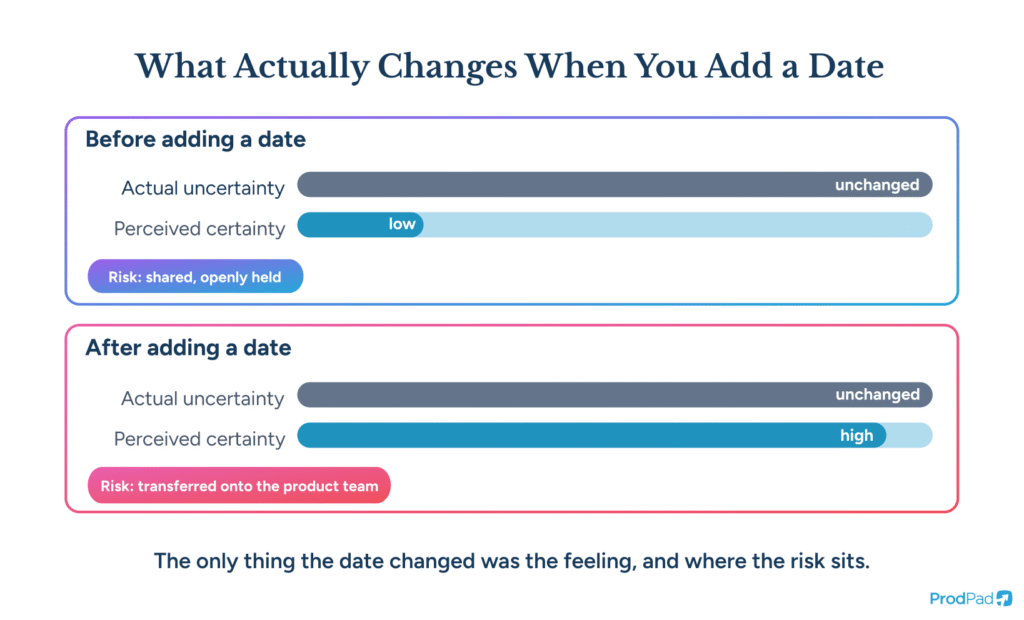
A date is a comfort object. It changes the story the executive tells themselves about the future, while leaving the future itself untouched. The engineering complexity is the same. The market is the same. The chance the team learns something in week three that reshapes the whole initiative is the same. The roadmap simply stopped showing that uncertainty, and out of sight reads as under control.
This is the core trap. The timeline roadmap does its job on the executive’s nervous system and no job at all on the actual risk. It is sedation, not treatment. And because it works so well as sedation, it gets demanded over and over. The whole organization learns to mistake the presence of dates for the presence of a plan.
Precision gets mistaken for accuracy
A specific date looks more rigorous than a rough time horizon, so it gets more trust, even though the specificity is usually fabricated. “Shipping March 14” sounds like the output of careful analysis. Most of the time it is the output of someone needing a number to put in a cell. The precision signals an accuracy that is not there, and everyone downstream plans against it as though it were real.
The damage from premature precision is not the date itself; it is the false confidence and the rigidity that follow. Once a date is committed and socialized, the team becomes emotionally and politically attached to hitting it, even as evidence mounts that the original framing was wrong. The plan stops being a tool for thinking and becomes a thing to defend.
The cost the product team absorbs to maintain the illusion
The comfort the executive gets is not free. The risk a date appears to remove does not actually leave the building; it relocates onto the product team, who are now accountable for a commitment built on a guess. This is a transfer, and the team is on the paying end of it.
When the dates slip, as the planning fallacy all but guarantees some of them will, the conversation is rarely “our shared estimate was optimistic.” It is “why did you miss the date you gave me.” The product team gave a date under pressure to soothe an executive, and then absorbs the blame when reality fails to match the comfort object. The structure sets the team up to look unreliable for participating in a fiction the organization demanded.
Maintaining the illusion crowds out the real work
Beyond the blame, the bigger cost is what the team stops doing. Energy that should go into discovery, into figuring out whether an initiative is even the right bet, gets diverted into defending and re-forecasting dates. The roadmap review becomes a negotiation about schedule rather than a conversation about whether the team is working on the right problems. Output thinking takes over, because dates are about when things ship, and a team measured on shipping dates optimizes for shipping rather than for outcomes.
A roadmap should help your team think, not just defend dates. For the deeper case on proving the value of product work, read our guide on how to demonstrate the value of product work.
What actually creates executive confidence
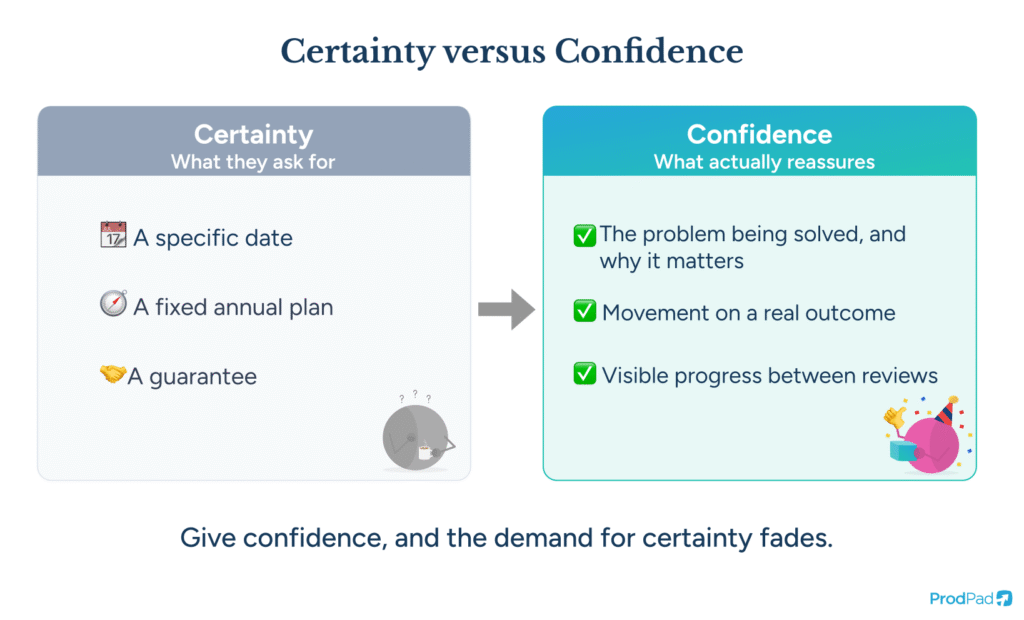
The way out is to give the executive the real thing they were reaching for, which is confidence, rather than the proxy they asked for, which is certainty. Confidence and certainty are different. Certainty is a claim about exactly what will happen and when. Confidence is a justified belief that the team is pointed at the right problems and making real progress against them. The second is both achievable and far more reassuring once an executive feels it.
Show the problems you are solving and why they matter
An executive relaxes when they understand the problem the team is attacking and why it matters to the business, because that is evidence the team is thinking clearly. Look at how your last roadmap review opened. Did it lead with what the team is shipping, or with the problems the team is solving and the value of solving them? Leading with the problem reframes the whole conversation away from dates and toward judgment, which is what the executive is actually trying to assess.
Report movement on outcomes, not just activity
Confidence grows when an executive can see the needle moving on something that matters, rather than a list of tasks completed. Reporting that activation improved four points, or that the target segment’s churn is down, tells a leader the team is having real impact, which no shipping date can convey. This connects directly to the case for holding product teams accountable to outcomes they have signed up for, where the commitment is to a result rather than to a delivery date.
Confidence comes from having outcomes worth reporting. Get a running start with our collection of product OKR examples, including a free ebook of ready-made ones to steal 👇

Make progress visible between reviews
Much executive anxiety is a function of darkness between meetings. A leader who only sees the roadmap once a quarter has to store up all their worry for that one session, which is part of why they grab for dates when they get there. When progress is continuously visible in a place the executive can check whenever the worry strikes, the quarterly review stops being the only moment of reassurance, and the pressure to manufacture certainty in that single meeting drops.
How Now-Next-Later gives security without false promises
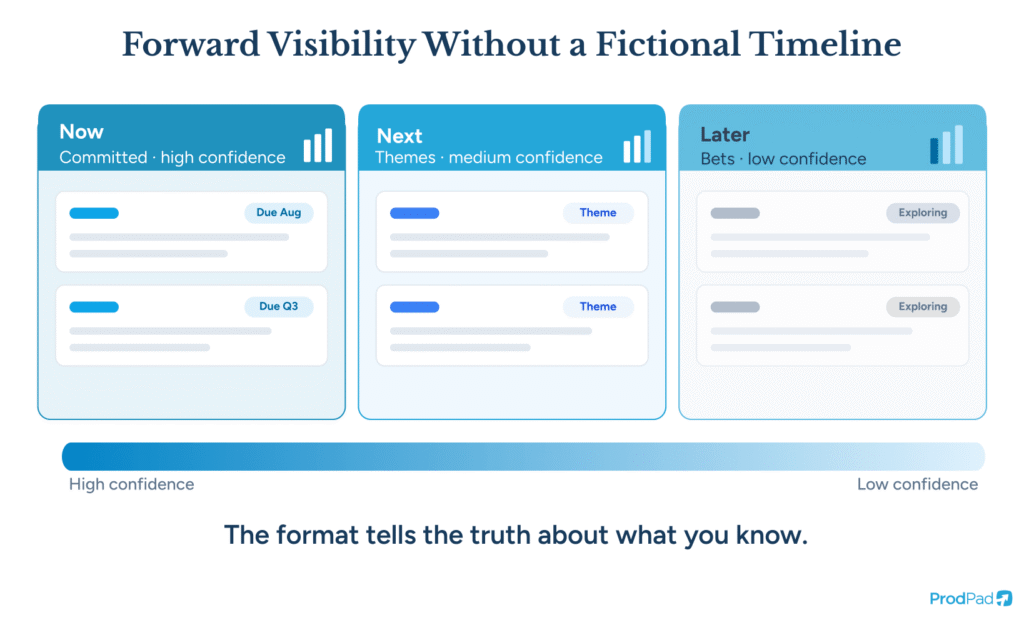
A common objection is that taking dates away leaves executives with nothing to hold, and that fear is reasonable. The answer is not to remove forward visibility; it is to give a kind of forward visibility that is honest about how certainty decays the further out you look. That is exactly what the Now-Next-Later roadmap was built to do.
Commit where you have certainty and signal where you do not
Now-Next-Later matches the confidence of the format to the confidence of the knowledge. The Now column holds committed work the team is confident about, and where a genuine deadline exists, a real date can sit right there on it. The Next and Later columns communicate direction and intent without pretending to a precision the team does not have yet. The executive gets a clear, honest picture of the whole horizon, firm where firmness is earned and appropriately loose where it is not, which is a sturdier thing to hold than a row of invented dates. The mechanics of making that shift are laid out in our guide on converting a timeline roadmap to Now-Next-Later.
Make the switch without starting from scratch. Our free Now-Next-Later roadmap template and toolkit bundles an interactive template with a stakeholder buy-in deck built for exactly these conversations.
Give every audience the view that calms them, from one source
Different stakeholders need different views, and recreating each one by hand is where a lot of date-driven anxiety management goes to die. A published roadmap solves this by letting you generate the right view for the board, for sales, for the wider team, all from the same underlying plan, so the reassurance you give each audience stays consistent and true. ProdPad’s roadmap publishing exists for exactly this, and treating the roadmap as a communication tool, a prototype for your strategy, is what makes a single source able to calm many audiences at once.
Why confidence is what executives actually need
An executive who keeps asking for dates is telling you they do not yet feel safe about the future of the product, and the date is just the only lever they know how to pull. Handing over the dates answers the lever and ignores the fear, which is why the request comes back every quarter like clockwork. The product leaders who escape that loop are the ones who learn to address the fear directly.
Real confidence comes from a clear view of the problems being solved, honest movement on the outcomes that matter, and progress an executive can see whenever they go looking for it. Give a leader those three things and the grip on dates loosens on its own, because the underlying need has finally been met. The security blanket was always a substitute for something the organization could not otherwise feel. The work of the product leader is to provide the real version, so the blanket is no longer the only warm thing in the room.
Give your stakeholders confidence instead of dates. Build a Now-Next-Later roadmap everyone can read.