Proving Product ROI: How to Demonstrate the Value of Product Work

A Head of Product I was talking to last month summed up her situation in one sentence: “My team shipped 47 features last year, and the CFO still asks me what Product actually does.”
That stung, because I’ve heard versions of it from hundreds of Product leaders over the years. And the painful part is that her team probably did create enormous value. They just had no system for making that value visible. The features shipped. The metrics moved (or didn’t). And nobody connected those two things in a way that the business could evaluate.
Proving the ROI of Product work is the single hardest communication challenge a Product leader faces. Sales has revenue attribution. Marketing has pipeline. Engineering has velocity and uptime. Product has a backlog of things that got done, a roadmap that was “mostly” delivered, and a vague sense that retention is better now than it was.
The problem runs deeper than dashboards and reporting. Most product organizations have inherited operating models that make it nearly impossible to draw a clear line from Product decisions to business outcomes. And until that changes, Product will keep fighting for budget, headcount, and credibility using anecdote instead of evidence.
Why Product Struggles to Show Its Value
Product Management occupies an unusual position in most companies. It sits at the intersection of customer needs, business goals, and technical possibility, which means its value is diffused across nearly every metric the company cares about. Revenue growth? Product contributed, alongside Sales and Marketing. Retention? Product helped, but so did Customer Success. Cost savings? Engineering shipped the code, even if Product defined the problem.
This diffusion makes it tempting to retreat into output metrics. Features shipped. Stories completed. Velocity maintained. These are easy to count and easy to report. They feel productive. But they tell the business absolutely nothing about whether the work mattered.
The output trap is a system design problem
The reason so many Product teams default to output measurement is that their tools and processes are designed around output. When your primary system of record is a delivery tool like Jira, every piece of work is defined as a ticket. Progress means tickets moving from “To Do” to “Done.” Success means the sprint was completed. The entire information architecture of the system pulls attention toward what was built, with no native concept of why it was built or whether it worked.
Marty Cagan has written extensively about the difference between empowered product teams and feature teams. The distinction matters here because it reveals a measurement problem hiding inside an organizational design problem. Feature teams, by Cagan’s definition, are given solutions to build and measured on whether they delivered those solutions on time. Empowered product teams are given problems to solve and measured on outcomes. You cannot prove ROI in a feature team model because ROI requires connecting work to results, and the feature team was never asked to produce results in the first place. They were asked to produce output.
This creates a vicious cycle. Product leaders who can’t demonstrate value get less trust. Less trust means less empowerment. Less empowerment means more prescribed solutions handed down from stakeholders. More prescribed solutions mean even less ability to demonstrate value, because the team is building what they were told to build rather than solving the problems that would actually move metrics.
Ready to connect your product work to business outcomes? See how OKRs, roadmaps, and feedback connect in one system.
The Missing Layer Between Strategy and Delivery
Most companies have a strategy (even if it lives in someone’s head) and a delivery system (Jira, Linear, Azure DevOps). What they lack is the layer in between: the place where strategic intent gets translated into measurable bets, where customer evidence informs prioritization, and where outcomes get tracked back to the initiatives that produced them.
This missing layer is where Product ROI actually lives. Without it, the best a Product leader can do is tell stories after the fact, trying to reconstruct a narrative of value from scattered data sources.
Explicit connections between objectives and initiatives
OKRs provide the structure for defining what the business is trying to achieve and how success will be measured. But OKRs alone are insufficient. The critical piece is the initiative layer that sits between an Objective and its Key Results: the specific product bets the team is making to influence those results. Without this connection, OKRs become a quarterly goal-setting exercise that runs in parallel to the actual work rather than driving it.
When an initiative on your product roadmap is explicitly linked to an Objective, you create the foundation for ROI measurement. The question becomes answerable: “We invested six weeks in this initiative. The Key Result it was targeting moved from X to Y. Here is the evidence that our work contributed to that movement.” That sentence is the atomic unit of Product ROI.
Evidence trails from customer to decision to outcome
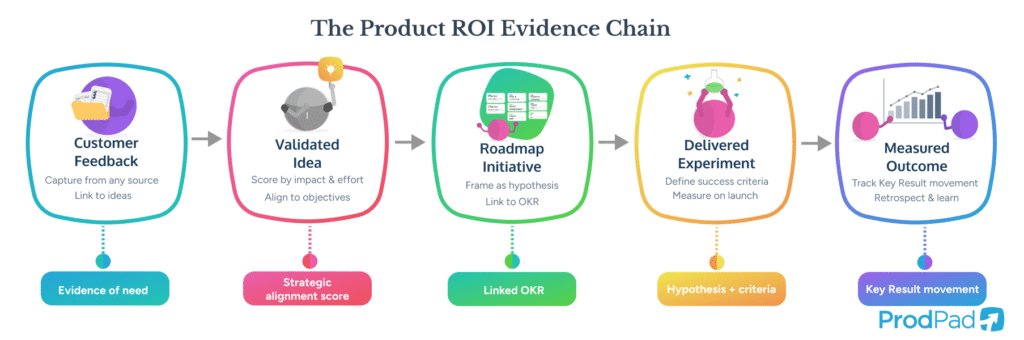
The second requirement is traceability. A Product leader who can show that an initiative started with customer feedback, was validated through product discovery, was prioritized based on strategic alignment, and produced a measurable outcome has a fundamentally different conversation with the CFO than one who can only say “we built what was on the roadmap.”
This traceability requires that feedback, ideas, roadmap initiatives, and goals live in a connected system rather than scattered across spreadsheets, slide decks, Slack threads, and Jira tickets. John Cutler has written about the paradox that teams with the least situational awareness are the ones least likely to invest in improving it, because without seeing the value of better decision-making, the case for investing in better decision-making feels abstract.
Retrospective measurement as a habit, not a one-off
Product teams that prove their ROI do something most teams skip: they go back and check whether their bets paid off. This sounds obvious, but in practice it’s extraordinarily rare. Teams ship a feature, maybe celebrate, and immediately move on to the next sprint. The outcome measurement never happens because nobody built the system to prompt it. Jeff Gothelf, co-author of Lean UX, argues that treating product work as a series of experiments with explicit hypotheses and success criteria fundamentally changes how teams think about value. An experiment has a predicted outcome. You run it. You measure the result. You learn. The learning compounds. Over time, the Product team builds a track record of bets placed and results achieved, which is precisely the evidence base that proves ROI.
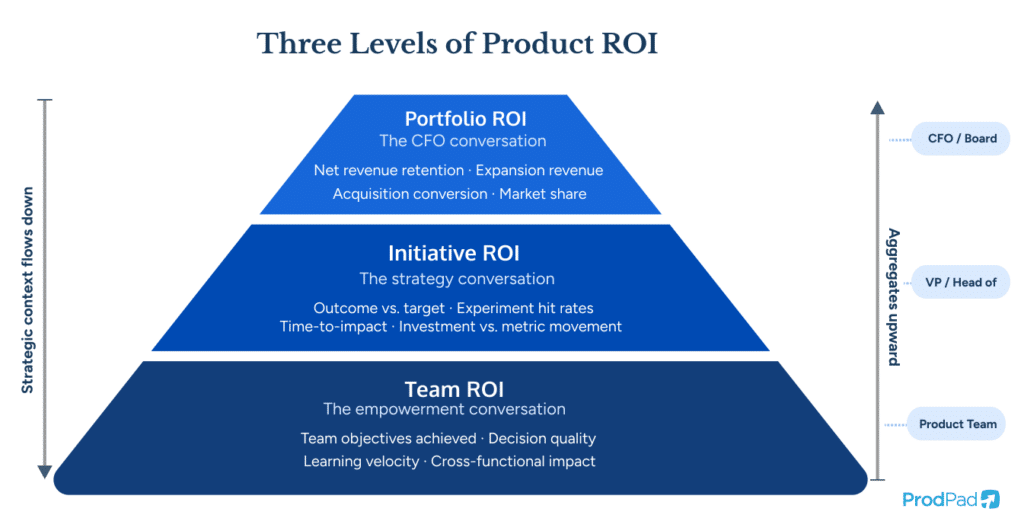
Three Levels of Product ROI
One of the reasons ROI conversations go wrong is that Product leaders and their stakeholders are often talking about different things. The CFO wants to know whether the Product org justifies its cost. The VP of Product wants to know which initiatives created the most value. A Product Manager wants to know whether a specific experiment moved a specific metric. These are all valid ROI questions, but they operate at different levels.
Level 1: Portfolio ROI
Portfolio ROI answers the question the CFO is asking: “Is our product investment generating returns for the business?” This requires connecting product-level metrics (retention, expansion revenue, activation rate, time-to-value) to business-level outcomes (revenue growth, margin improvement, market expansion).
Product leaders who succeed at this level tend to work backwards from the business metrics that the C-suite already cares about. If the board is focused on net revenue retention, the Product leader identifies which product initiatives are designed to influence retention and tracks them over time. If the business is in growth mode and cares about new customer acquisition, the Product leader connects product improvements to conversion rates in the trial or onboarding funnel.
Portfolio-level ROI is not about attributing 100% of a metric movement to Product. That’s neither possible nor necessary. The goal is demonstrating a consistent, evidence-backed connection between Product investments and business outcomes, quarter over quarter.
Level 2: Initiative ROI
Initiative ROI answers the strategy question: “Did this specific bet pay off?” This is where outcome-based roadmapping becomes essential. When a roadmap initiative is framed as a problem to solve with a measurable outcome rather than a feature to ship, you create the conditions for evaluating its ROI.
An initiative framed as “Build dashboard export feature” has no built-in success criteria beyond “did we build it?” An initiative framed as “Reduce time Product leaders spend creating stakeholder reports by 50%, measured by user research and usage data” has a clear outcome that can be evaluated after launch. The initiative either achieved its target or it didn’t. Either way, the team learned something, and the Product leader has evidence to share.
Level 3: Team ROI
Matt LeMay made a compelling argument in a ProdPad webinar on showing the ROI of Product work that thinking about ROI at the team level can actually be more liberating than thinking about it at the feature level. When a team has clear objectives and is measured on outcomes, they have the freedom to pursue whatever approaches will move the metric, including approaches that might not look like traditional “product work” at all. Maybe the biggest ROI comes from fixing an internal process, improving documentation, or running a training program for customer-facing staff.
Team ROI shifts the conversation from “did you ship the thing” to “did you achieve the result.” That shift is where real accountability, and real credibility, emerges.
Want to see how OKRs connect to roadmap initiatives in practice? Download the free Product OKR Course: 5 lessons delivered straight to your inbox.
The Systems That Make ROI Visible
Proving Product ROI is not a presentation problem. A Product leader who spends the last week of every quarter frantically assembling a narrative about the team’s impact is fighting a losing battle. The evidence needs to accumulate continuously, as a byproduct of how the team works, rather than as a separate reporting exercise layered on top.
Connected product management as an ROI engine
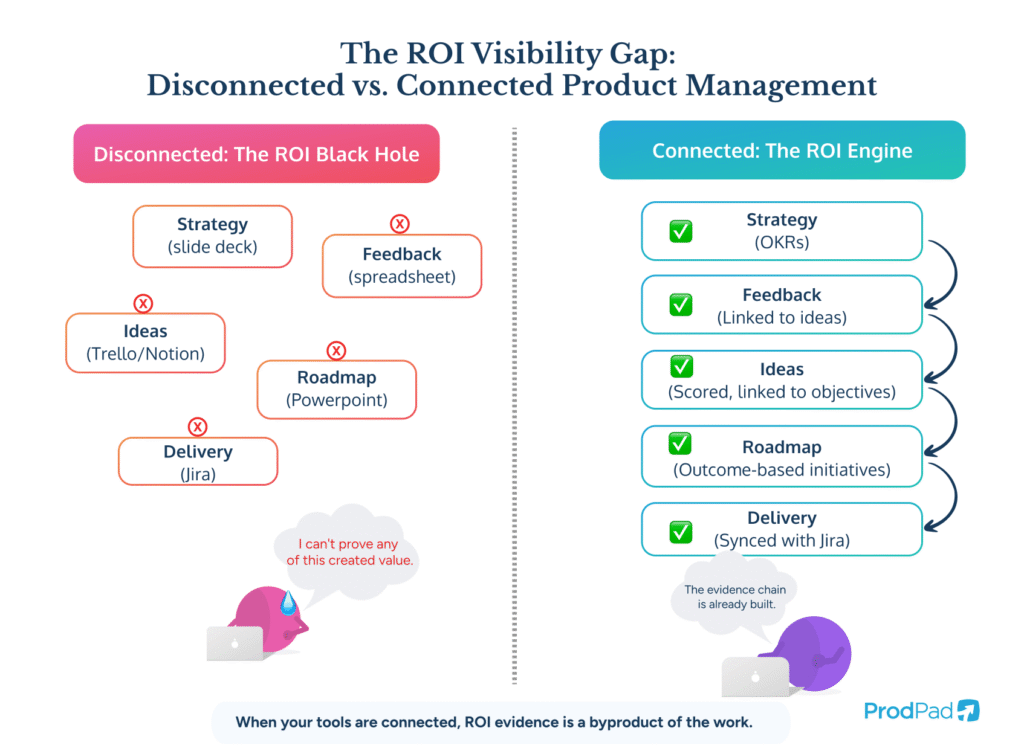
The companies that demonstrate Product ROI most effectively share a common trait: they use connected systems where customer feedback flows into ideas, ideas connect to roadmap initiatives, initiatives link to strategic objectives, and outcomes are measured and recorded in the same place. This end-to-end traceability is what transforms ROI from a storytelling exercise into a system output.
When a customer submits feedback that gets linked to an idea, and that idea gets developed into a roadmap initiative tied to an OKR, and the Key Result movement is tracked after launch, you’ve created an evidence chain that tells itself. The Product leader doesn’t need to reconstruct it from memory at quarter end. It’s already there.
This is one of the reasons why bolting strategy onto a delivery tool produces such poor ROI visibility. Jira is excellent at tracking what Engineering is building. It is not designed to answer the question of why something was built or whether it worked. The information architecture of a delivery tool optimizes for throughput. And learning, specifically learning whether your product bets are paying off, is the foundation of ROI measurement.
Building the habit of outcome retrospectives
Teresa Torres, in her work on continuous discovery habits, emphasizes the importance of regular touchpoints with customers and regular reflection on what’s been learned. The same principle applies to outcome measurement. Teams that build a habit of reviewing initiative outcomes, even informally, develop a much richer understanding of what creates value and what doesn’t.
A practical approach is to add an outcome review to existing retrospective cadences. Two or three months after an initiative launches, the team returns to the original hypothesis and evaluates whether the predicted outcome materialized. If it did, that’s ROI evidence. If it didn’t, that’s still valuable: it’s evidence of learning and adaptation, which builds credibility over time because it shows the team is honest, self-correcting, and improving its hit rate.
Christina Wodtke, author of Radical Focus and a leading voice on OKRs, has discussed with ProdPad how even simple rituals like weekly celebrations of progress and end-of-quarter reflections on whether objectives were met can dramatically shift how a team thinks about its own impact. The celebration part matters: teams that only measure ROI when they’re under threat never develop the muscle memory for ongoing value demonstration.
See connected product management in action. ProdPad links feedback, ideas, roadmaps, and OKRs in one system, so the evidence chain builds itself
The Anti-Patterns That Destroy ROI Credibility
Some of the most common Product practices actively undermine a team’s ability to demonstrate its value. They’re worth naming explicitly, because many Product leaders don’t realize their operating model is working against them.
Measuring success by tickets closed
When the team’s primary success metric is velocity, throughput, or story points completed, the implicit message to the business is: “Our value is in how fast we move.” This invites the obvious follow-up from leadership: “Moving fast toward what?” And if the answer is “toward completing the things on the list we were given,” you’ve just described an order-taking function. Order-taking functions don’t command premium budgets or earn seats at the leadership table.
Roadmaps that promise features instead of outcomes
A timeline roadmap with specific features slotted into specific quarters creates a contract, and contracts are evaluated on whether they were fulfilled. If you delivered Q3’s features in Q3, you succeeded. If you didn’t, you failed. There’s no room in this model for the team to have learned something in Q2 that made Q3’s planned features irrelevant, or to have discovered a better solution to the underlying problem. The roadmap format itself prevents the ROI conversation from happening, because the success criteria is “did you build what you said you’d build” rather than “did you achieve the outcome you were targeting.”
This is one of the core reasons the Now-Next-Later roadmap format exists. By organizing work around problems to solve and outcomes to achieve, grouped by confidence level rather than calendar date, it creates the space for initiative-level ROI measurement. “We said we’d tackle onboarding conversion in the ‘Now’ column. We ran three experiments. Conversion improved by 12%.” That is a fundamentally more credible story than “we shipped the three features we promised.”
Disconnected strategy and feedback loops
When the product strategy lives in a slide deck, customer feedback lives in a spreadsheet (or worse, in people’s heads), and the roadmap lives in a different tool from the goals, there’s no connective tissue. The Product leader who tries to demonstrate ROI in this environment is essentially doing archaeology: digging through artifacts from different systems to reconstruct a narrative of value that was never designed to be captured.
The fix is systematic. It requires investing in how Product work gets structured before the work begins, rather than trying to measure value after the fact.
Practical Mechanisms for Proving Product ROI
The argument so far has been about systems and structures. Here’s how those ideas translate into specific practices that Product leaders can implement.
Frame every roadmap initiative as a hypothesis
Before any initiative enters the “Now” column of a Now-Next-Later roadmap, it should have a clearly stated hypothesis: “We believe that [doing this thing] will result in [this measurable outcome] because [this evidence supports the bet].” This takes thirty seconds to write and fundamentally changes the team’s relationship to the work. It becomes a bet to be evaluated, with a predicted outcome and a method for checking whether the prediction held.
The hypothesis format also gives Product leaders the language they need for ROI conversations. Instead of “we shipped a new onboarding flow,” the narrative becomes “we hypothesized that simplifying onboarding would improve activation rates. We ran the experiment. Activation improved by 15% within 60 days of launch. Based on our average customer lifetime value, that improvement represents approximately $X in additional annual revenue.”
Use OKRs as the ROI scaffolding
OKRs work best when they function as the scaffolding for ROI measurement rather than as an isolated goal-setting exercise. The Objective states what the business needs. The Key Results define how success is measured. The initiatives on the roadmap represent the team’s bets for influencing those Key Results.
When this structure is in place, the quarterly OKR review becomes a natural ROI reporting moment. The Product leader walks through each Objective, shows which initiatives were run, reports on Key Result movement, and discusses what was learned. This isn’t a separate “ROI presentation.” It’s the normal rhythm of how the team operates.
Bruce McCarthy, founder of Product Culture and co-author of Product Roadmaps Relaunched, made this connection explicit in an OKRs vs. Roadmaps discussion with ProdPad, arguing that OKRs and outcome-based roadmaps are complementary pieces of the same system. The OKR defines the destination. The roadmap shows the route. The retrospective confirms whether you arrived.
Track the “anti-portfolio” too
One of the most powerful ROI arguments a Product leader can make is about the work the team chose not to do. Every Product team has a graveyard of rejected ideas, deprioritized features, and stakeholder requests that were redirected. Most teams let these disappear without trace.
Product leaders who keep a visible record of ideas that were evaluated and deprioritized, along with the reasoning, build a different kind of credibility. When a stakeholder comes back six months later asking why their pet project wasn’t built, the Product leader can point to the evidence: “We evaluated it. The strategic alignment was low. We invested in [this initiative] instead, which contributed to [this outcome].” That’s a credibility-building conversation that most teams never get to have because the decision trail doesn’t exist.
Curious what connected product management actually looks like? Watch the webinar: How to Show the ROI of Your Product Work with Matt LeMay and Janna Bastow.
Speaking the Language of Business Value
Even with the right systems in place, Product leaders need to translate their outcomes into language that resonates with the people who control budget. This means connecting product outcomes to the financial and strategic metrics that the C-suite actually uses to make decisions.
Map product metrics to business metrics
Every Product metric ladders up to a business metric, but the connection isn’t always obvious to non-Product stakeholders. Activation rate connects to customer acquisition cost. Retention connects to lifetime value. Feature adoption connects to expansion revenue. Time-to-value connects to churn risk.
The Product leader’s job is to make these connections explicit. When presenting initiative outcomes, lead with the business metric, then show the product metric that moved it. “Net revenue retention improved by 3 points this quarter. The primary driver was a 20% improvement in feature adoption for our core workflow, which was the focus of Initiatives A and B on our roadmap.”
Build a rolling evidence base
Instead of creating a quarterly ROI presentation from scratch each cycle, maintain a running log of initiative outcomes. Every time an experiment concludes or a Key Result is updated, capture the result. Over time, this creates a compounding evidence base that makes the ROI argument stronger with every quarter.
The Product leaders who do this most effectively treat their evidence base as one of their most strategic assets. It’s what they bring to budget conversations. It’s what they share with new executives during onboarding. It’s what gives them the confidence to push back on feature requests that lack strategic alignment, because they have the track record to prove their judgment delivers results.
Show the cost of not investing in Product
ROI has two sides: the return on what you invest, and the cost of what you don’t. Product leaders who can quantify the cost of the status quo have a powerful additional argument. How much revenue was lost to churn that could have been prevented by addressing known product gaps? How many support tickets were generated by usability issues that the team has flagged but hasn’t been resourced to fix? How much Engineering time was wasted on rework because requirements were based on assumptions rather than evidence?
These “cost of inaction” arguments are particularly effective with CFOs, who tend to be more motivated by avoiding losses than by chasing gains.
See how your product OKR examples compare. 18 Product OKR Examples to Kick-start Your Goal Setting with practical examples and real business context.
How Product Earns Its Seat at the Table
The ROI challenge facing Product leaders is ultimately a credibility challenge. And credibility compounds. The Product leader who demonstrates value consistently, quarter after quarter, using evidence rather than anecdote, gradually shifts the organization’s perception of Product from a cost center to a value driver.
This shift changes everything. Budget conversations become investment conversations. Feature requests become strategic discussions about trade-offs and priorities. The CEO stops asking “what did Product do last quarter” and starts asking “what’s Product’s recommendation for how we should grow next year.”
Getting there requires more than good storytelling. It requires an operating model that generates evidence of value as a natural byproduct of how the team works. Strategy connected to goals. Goals connected to initiatives. Initiatives connected to customer evidence. Outcomes measured and recorded. Learning accumulated and shared.
The tools a Product team chooses shape the behaviors of the team. A delivery tool shapes behavior around output. A connected product management system, one that links strategy to discovery to delivery to outcomes, shapes behavior around value creation. And value creation, made visible and measurable, is how Product proves its ROI.
There’s no shortcut. No single dashboard or quarterly presentation will solve the credibility gap. But a Product leader who builds the system for capturing and demonstrating value, who makes it part of how the team operates rather than something bolted on afterward, will find that the ROI question eventually stops being a threat and starts being a strength.
When every product decision is informed by customer needs, aligned to strategic objectives, and evaluated against measurable outcomes, the ROI conversation answers itself.