Your Backlog Has a Hierarchy Problem

An idea can be anything from “should we replace our payment system” through to “could you add this button to this particular page.” When both live in the same list, treated as peer-level items competing for the same prioritization slot, you’ve already lost. The word “idea” is doing too much work, and nobody in the room realizes it.
I was talking to a Head of Product last month who described their backlog as “a graveyard with a search bar.” Over 400 items, accumulated over two years, all tagged as “ideas.” Some were multi-quarter platform bets. Some were CSS tweaks. A few were vague sentences pasted from a Slack thread. Every sprint planning session started with the same ritual: scroll through the list, argue about what matters, pick things based on whoever made the strongest case that week, and move on feeling slightly defeated. The backlog had become a performance of prioritization without any of the substance.
The root problem was structural. Every item sat at the same altitude, so every conversation about priority had to start from scratch. There was no hierarchy telling anyone whether they were comparing apples to oranges, or oranges to aircraft carriers.
The Flat Backlog Trap
Most Product teams inherit a flat backlog. It starts innocently enough: someone sets up a board or a spreadsheet, people add items, and the list grows. At 20 items, it works fine. By 200, it becomes unmanageable. Push past 500 and it’s a liability.
The structural failure here is subtle. A flat backlog implies that every item is the same type of thing, deserving the same type of evaluation. But “migrate to a new authentication provider” and “change the color of the onboarding button” are fundamentally different decisions. They operate at different altitudes. They require different stakeholders, different time horizons, different risk assessments, and different evidence thresholds. Putting them in the same list and asking a team to rank them against each other is like asking someone to choose between buying a house and buying lunch. Both are purchases. Both cost money. The comparison is still absurd.
What a flat backlog does to prioritization
When everything sits at the same level, teams default to one of three dysfunctional patterns.
Volume-based prioritization. The items with the most votes, the most customer requests, or the loudest internal advocates win. This rewards frequency of complaint over strategic importance. A minor UI friction that ten customers mention will outrank a foundational architecture decision that nobody outside Engineering even understands. Teams end up prioritizing at the idea level instead of the problem level, and the result is a roadmap that optimizes for noise.
Recency bias. Whatever was discussed most recently feels most important. The backlog becomes a queue, not a strategy tool. Items that were added six months ago decay in perceived relevance, regardless of their actual value. Teams lose track of strategic bets that need longer gestation periods, and the backlog slowly tilts toward quick fixes and reactive work.
False equivalence in scoring. Teams apply RICE or Impact vs. Effort scoring to every item equally, as though a “Reach” score for a platform migration means the same thing as “Reach” for a tooltip improvement. The math produces a number. The number creates an illusion of rigor. But the inputs are incommensurable, so the output is fiction dressed up as analysis. The Product Manager’s Guide to prioritization frameworks exists precisely because most frameworks fail when applied at the wrong altitude.
Trying to compare 400 ideas side by side? That’s a prioritization problem waiting to happen. See how ProdPad helps you prioritize at the problem level, so the right ideas surface naturally.
Flight Levels: A Thinking Model for Backlog Structure
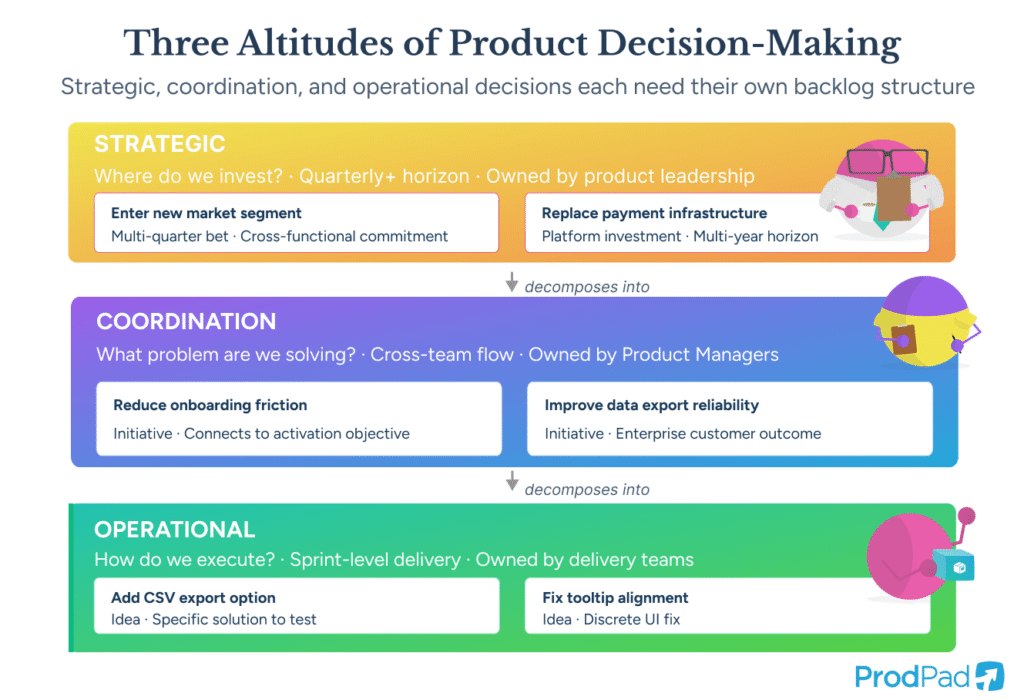
The concept of “flight levels,” developed by Klaus Leopold as a thinking model for organizational improvement, offers a useful lens here. Leopold describes three altitudes at which work is managed: the strategic level (portfolio decisions about where to invest), the coordination level (how work flows across teams to deliver value), and the operational level (how individual teams execute). Each level has its own cadence, its own decision-makers, and its own definition of “done.”
What makes the flight levels model relevant to backlog structure is the core insight that different altitudes require different types of decisions and different feedback loops. When an organization tries to manage everything at a single altitude, strategic decisions get dragged into operational conversations, and tactical improvements get treated with the same ceremony as platform bets. The result is that nothing moves at the appropriate speed.
How this maps to backlogs
Most Product teams are already making decisions at multiple altitudes. They just lack the structure to formalize it. The Head of Product is thinking about which market segments to pursue next quarter. The Product Manager is thinking about which customer problem to tackle within a given initiative. The Engineering lead is thinking about which technical approach to take for a specific feature. All three of those decisions are valid and necessary. The problem arises when they all land in the same backlog column.
A backlog that operates at a single altitude forces everyone to context-switch constantly. One moment you’re debating whether to invest in a new pricing model; the next, someone’s asking about the relative priority of a button placement change. The strategic conversation gets interrupted by operational detail. The operational detail gets inflated into a strategic debate because someone in the room has strong feelings about buttons. And the coordination layer, the part where cross-team dependencies and initiative-level trade-offs actually live, gets skipped entirely.
The Initiative Layer Most Teams Are Missing
The fix is straightforward in concept: stop treating all backlog items as peers, and introduce a hierarchy that separates strategic bets from tactical experiments from operational improvements.
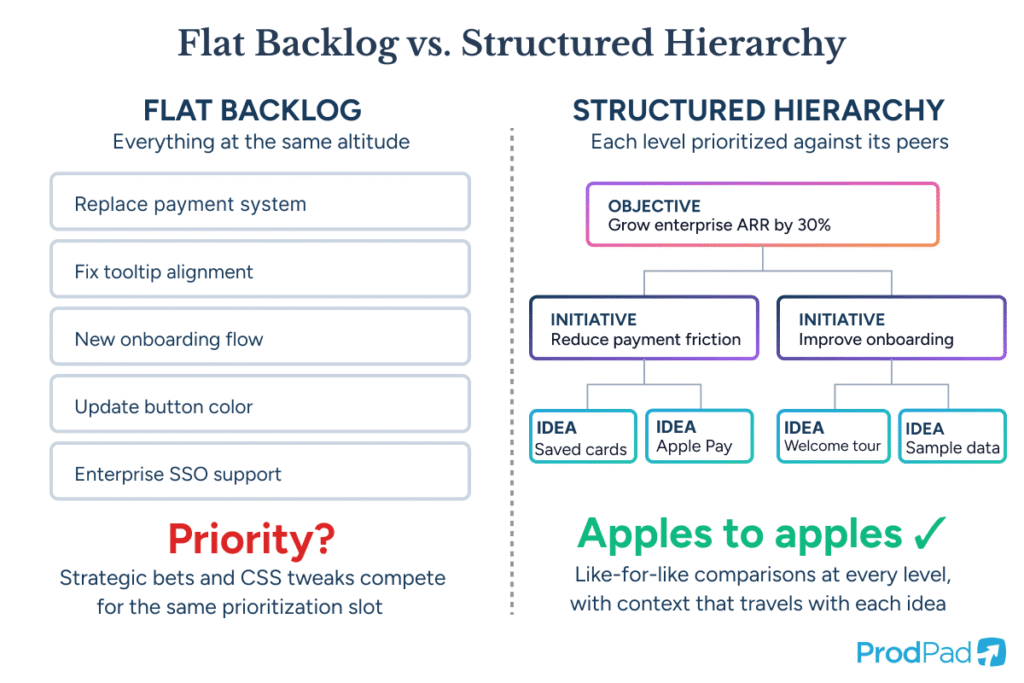
In practice, this means adding an initiative layer between objectives and ideas. An initiative represents a problem to solve or an outcome to pursue. It sits at the coordination altitude. It connects upward to a company objective or strategic theme, and downward to a collection of ideas, experiments, and user stories that represent possible ways to achieve it.
What changes when initiatives exist
When a team has an explicit initiative layer, three things shift.
Prioritization happens at the right altitude
Instead of comparing “replace the payment system” against “add a button to this page,” the team first prioritizes at the initiative level. “Reduce payment friction” competes against “Improve first-run onboarding” competes against “Support enterprise SSO requirements.” These are comparable decisions. They operate at similar altitudes, involve similar investment horizons, and can be evaluated against the same strategic objectives.Individual ideas then get prioritized within the context of their parent initiative. “Add a button to this page” competes against other ideas that might solve the same onboarding problem, not against a payment infrastructure overhaul. The comparison is meaningful because the items share a common frame of reference. This is the approach outlined in product roadmap best practices that emphasize working with high-level initiatives first and layering ideas in as solutions.
Drowning in a flat backlog? See how real teams organize ideas under strategic initiatives in a live, interactive ProdPad environment.
Context travels with the idea
When an idea is linked to an initiative, anyone evaluating it can immediately see why it exists. The initiative carries the problem statement, the strategic connection, the target outcome. A new team member looking at “add CSV export to the reports page” can trace it back to “Improve data accessibility for enterprise customers” and understand the context without a 30-minute onboarding conversation. The idea becomes self-documenting because the hierarchy provides the frame.
Saying “no” gets easier
One of the hardest parts of Product Management is saying no to a reasonable idea. When every idea exists in isolation, rejecting one feels personal or arbitrary. When ideas sit inside initiatives, and initiatives connect to objectives, the “no” has structural support. “This is a good idea, but it doesn’t serve any of our current initiatives” is a fundamentally different conversation than “I don’t think this is important.” The hierarchy absorbs the conflict that would otherwise land on the Product Manager’s judgment alone.
Why Delivery Tools Make This Worse
A significant contributor to the flat backlog problem is the tooling itself. Most teams manage their product thinking inside delivery tools like Jira, Trello, or Azure DevOps. These tools are excellent at tracking execution: tickets, sprints, story points, velocity. They are structurally terrible at managing the upstream decisions that determine what should be built in the first place.
A Jira backlog is, by design, a flat list of work items. You can add labels. Epics are available too. Stories nest under those epics.
But the tool’s fundamental model is oriented around delivery, and its hierarchy reflects that. Epics in Jira are containers for stories, grouped by scope of work. They are not strategic constructs. They don’t carry objectives, outcomes, or evidence. They’re buckets.
When teams try to use delivery tools for strategic product decisions, the tool’s structure pulls the conversation downward. Everything becomes a ticket. Everything needs a story point estimate. Strategic thinking gets compressed into ticket descriptions that nobody reads because the tool rewards moving cards across columns, not thinking deeply about whether those cards should exist at all. Rich Mironov has written extensively about how the tools teams use shape the decisions they make, and delivery tools consistently push teams toward output thinking rather than outcome thinking.
ProdPad sits upstream from your delivery tools. It’s where strategy, discovery, and evidence live, before anything becomes a ticket. Start a free trial →
The two-backlog principle
The fix is to maintain two separate backlogs with a clear handoff between them. The product backlog (or opportunity backlog, as Marty Cagan calls it) is the space for ideas, experiments, hypotheses, and strategic possibilities. It lives upstream of delivery and is organized around problems to solve. The delivery backlog (sprint backlog, development backlog) is the space for committed work, organized around stories and tasks that are ready for Engineering to pick up.
ProdPad was designed around this exact separation. Ideas live in the idea management system, organized under initiatives that connect to roadmap objectives. When an idea is validated, scoped, and ready for development, it gets pushed to Jira or Azure DevOps as a fully spec’d ticket. The product backlog stays clean and strategic. The delivery backlog stays focused and actionable. Nobody is scrolling through 400 mixed-altitude items trying to figure out what matters.
The Scoring Trap
It’s worth lingering on why scoring frameworks fail in flat backlogs, because the failure mode is instructive.
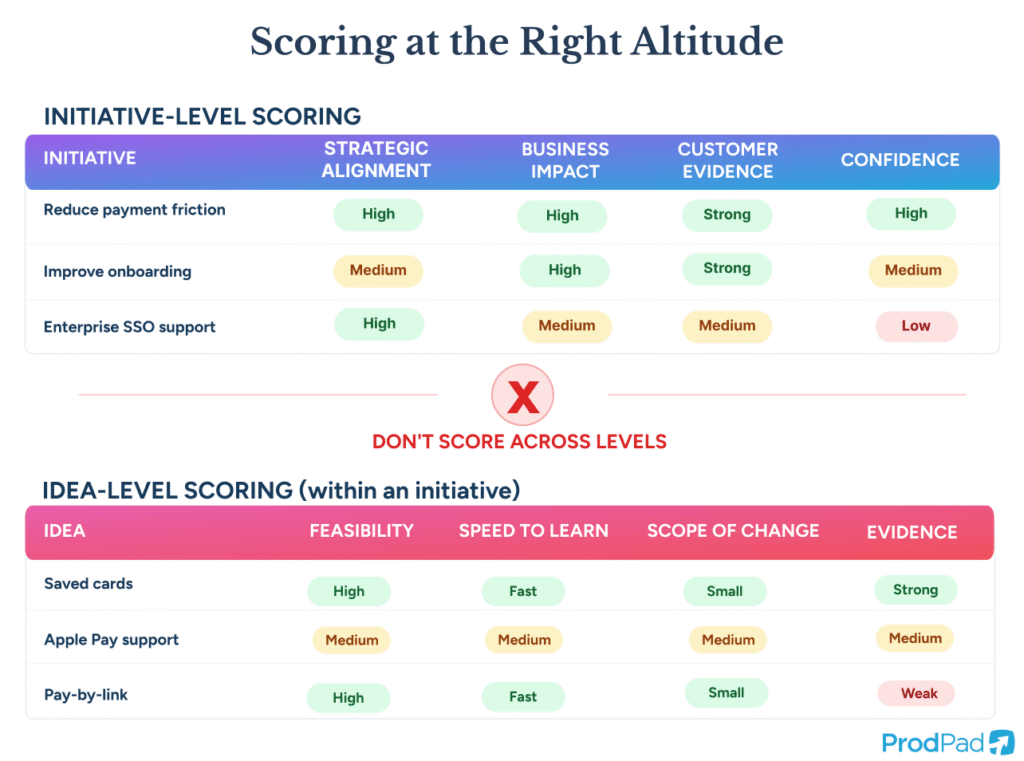
Most prioritization frameworks assume that the items being scored are comparable. RICE scoring asks you to estimate Reach, Impact, Confidence, and Effort for each item. Those are reasonable dimensions. But “Reach” for a platform migration and “Reach” for a button change are measuring fundamentally different things. The platform migration affects every user who interacts with the payment flow over the next three years. The button change affects a subset of users on a single page for the next quarter. Both produce a number. The numbers are not comparable.
Teams that rely on scoring without hierarchy end up in one of two failure modes. Either they score everything with false precision and generate misleading rankings, or they abandon scoring entirely because the results never match their intuition. Both outcomes point to the same root cause: the items being scored operate at different altitudes, and no single scoring rubric can meaningfully span that range.
The better approach is to score within a level. Compare initiatives against other initiatives using strategic criteria (alignment to objectives, expected business impact, customer evidence). Compare ideas against other ideas within the same initiative using tactical criteria (feasibility, speed to learn, scope of change). The scoring becomes meaningful because the comparison is like-for-like.
Prioritization frameworks only work when applied at the right level. Our free guide breaks down 17 frameworks and when each one actually helps.
What a Healthy Product Backlog Hierarchy Looks Like
A well-structured product backlog has three clearly separated levels, each with its own purpose and cadence.
The objective level
Objectives represent the strategic direction of the product. They answer “where are we going and why.” Cadence is quarterly or slower. Ownership sits with Product leadership, and they connect to company-wide business goals. In ProdPad, objectives sit at the top of the hierarchy and cascade into the roadmap.
The initiative level
Initiatives represent problems to solve or outcomes to achieve. They answer “what are we working on and what does success look like.” They sit on the Now-Next-Later roadmap as cards that communicate strategic intent without false delivery commitments. Each initiative connects upward to an objective and downward to a set of ideas.
The idea level
Ideas represent possible solutions, experiments, or features that could address the problem described by an initiative. They answer “how might we solve this.” They are the most granular layer, and they are the layer where most teams spend the majority of their time. The key structural principle is that ideas are never evaluated in isolation. They are always evaluated in the context of their parent initiative.
This three-level structure mirrors the flight levels concept: strategy at the top, coordination in the middle, operations at the bottom. Each level has its own prioritization criteria, its own decision-makers, and its own review cadence. When a stakeholder asks “why are we working on this,” the hierarchy provides the answer without anyone having to reconstruct the reasoning from memory.
The Backlog as a Decision System
The deeper point here is that a backlog is not a to-do list. A to-do list is a flat sequence of actions. A backlog is a decision system: a structured environment in which trade-offs are surfaced, evidence is weighed, and commitments are made at the appropriate altitude.
When the backlog lacks hierarchy, it degrades into a wishlist. Items accumulate without structure. Prioritization becomes a political exercise. Teams feel busy but strategically adrift. The common symptom is the sprint planning meeting where everyone argues about priority but nobody can articulate why any given item connects to the company’s strategic direction. The items are all at the same altitude, so the only available argument is personal conviction.
When the backlog has hierarchy, conversations change. Strategic debates happen at the initiative level, where they belong. Tactical debates happen at the idea level, scoped to a specific problem. The Product Manager stops being a human router, translating between altitudes in real-time, and starts being a decision-maker working within a system that supports structured trade-offs.The product backlog examples that actually work in practice all share this structural characteristic. They separate the “what problems are we solving” conversation from the “how are we solving them” conversation, and they give each conversation the right altitude, the right evidence, and the right decision-makers.
Hierarchy Is the Precondition for Good Prioritization
Every prioritization method, every scoring framework, every roadmapping process assumes that the items being evaluated are comparable. A flat backlog violates that assumption at a structural level. Teams can spend months debating which prioritization framework to use, when the actual problem is that their backlog lacks the hierarchy that would make any framework effective.
The fix is not a new scoring model. The fix is structure. Separate objectives from initiatives from ideas. Prioritize at each level using criteria appropriate to that altitude. Let the hierarchy do the work of creating meaningful comparisons instead of forcing Product Managers to mentally sort through mixed-altitude items in real-time.
Product teams that make this shift describe the same experience: prioritization stops feeling like a negotiation and starts feeling like a decision. The backlog becomes something the team trusts instead of something they dread. And the sprint planning meeting, finally, becomes a conversation about how to solve the problems the team has already agreed matter, rather than a rehash of which problems matter in the first place.