Pivot Strategy

What is a Pivot Strategy?
A pivot strategy is when someone in a leadership position decides to shift gears into a new strategic direction with the product or overall business. It’s a change of course, where you move from an unsuccessful Plan A to a different Plan B (or C, or D) before you run into trouble down the road.
“It’s a structured course correction designed to test a new fundamental hypothesis about the product, strategy, and engine of growth.”
– Eric Ries, Founder of Lean Startup Co.
Things go wrong in business, and especially in product management. Sometimes, despite hours of market research, detailed roadmapping, and planning, your product just doesn’t hit. The cause could be market changes, a drastic shift in customer needs, or a drop in performance.
In product management, a pivot strategy might mean refocusing on a different feature, shifting to a new market, or adopting a whole new product strategy. When your meticulously designed product isn’t resonating with customers, you steer the ship in a new direction before hitting the iceberg.
Pivots can be small corrections rather than full u-turns. You won’t be ripping up the original playbook every time. Many famous pivots have resulted in a drastic change in business identity, but a pivot can also be as subtle as marketing to a different audience or changing sales channels.
Whatever way you decide to pivot your product, adopting a pivot strategy isn’t something to take lightly. It’s a big change and takes planning and research to get right. It’s not a final gambit either. Don’t treat a pivot strategy as your last chance to fix things if performance starts to go south. It’s a calculated decision, made by looking at customer feedback and market data to determine what’s best for the business. Needing to adopt a pivot strategy isn’t a sign of failure.
When should you consider a pivot strategy?
Knowing when to pivot is harder than the pivot itself. You never want to pivot too early and not give your current approach a chance to breathe, but you also don’t want to leave it too late and miss the window. Making this change at the right time can be what gives your product the edge. Some signs that it may be time to pivot:
- You’re always playing catch-up: If your business is stuck in slow motion no matter how hard you hustle, it might be time to change direction. This doesn’t always mean a full company pivot. Maybe it’s just your product or revenue model that needs work.
- There’s too much competition: Competition shouldn’t drive you away, but if a bigger player arrives with more money and resources, you can find yourself squeezed. Sometimes the only way to survive is to zig when everyone else is zagging.
- Your company hits a plateau: If product growth has stalled and no amount of new features or marketing campaigns moves the numbers, it’s time to rethink. Even a small pivot can unlock new potential.
- One feature is working, but the rest of your product isn’t: If one feature is killing it while the rest of the product is floundering, that’s the signal. Change your product scope and focus on what works. If customers love one part of your offering, there’s gold to mine there.
- Market feedback is lukewarm: You launched the product and got crickets. Low early adoption is expected from the product adoption curve, but if the response is dry, you may need to rethink your target market. Even if the initial response was enthusiastic, if that enthusiasm fizzles out, a pivot is worth considering.
- Your perspective has changed: If your dream idea now feels outdated or impractical, move on. If your goals, vision, or market insights have evolved, your product should too.
- Your teams are ineffective: If team members aren’t working in harmony, missing deadlines, or communicating poorly, an internal organizational pivot to rethink your product team structure might help more than another feature push.
What are the advantages of a pivot strategy?
A pivot strategy can save your product and be the change that improves performance enough to make it a success. By adapting a core area of your strategy, you unlock more of the potential in your product vision.
Adopting a pivot strategy is scary and comes with a lot of hard work, but it can be one of the most strategically rewarding moves a product manager or business leader can make. The benefits in more detail:
Pivoting lets you stay agile in a rapidly changing market
The market is unpredictable. Pivoting keeps your business light on its feet. When a strategy isn’t working, pivoting lets you adjust quickly instead of doubling down on a losing battle. You can dodge industry landmines and chase new opportunities faster than your competition.
A pivot could be the lifeline that saves your business
When your original idea starts sinking, a well-timed pivot can be the life raft. By redirecting your focus to a more promising area, you avoid wasting valuable resources on a failing concept. Pivoting gives you the chance to fight another day with a sharper, more relevant product.
Pivots spark innovation
When you’re pushed out of your comfort zone and forced to reconsider the original plan, you see things from new angles. That can produce ideas you wouldn’t have surfaced while stuck on autopilot. Some of the most revolutionary products in tech emerged when teams rethought the challenge they were facing rather than pushing harder on the original solution.
Pivoting can give you a competitive edge when you’re behind
A pivot can put you back in the lead. By shifting your focus to an untapped market or repositioning your product to better resonate with customers, you regain momentum. It’s a move that shows you’re not just reactive but proactive about staying relevant.
Choosing the right pivot strategy
There are multiple ways to pivot from an original idea and plan. A pivot strategy can involve changing every aspect of your business, essentially abandoning ship and starting a new one. More commonly, a pivot strategy is where you change one specific area of your business. Knowing the difference between business strategy and product strategy helps clarify where the pivot actually needs to happen, because product-level pivots and company-level pivots require very different resources and signoff.
To assess the severity of the pivot strategy you want to adopt, you can follow the Pivot Pyramid.
The Pivot Pyramid
The pivot pyramid matrix was created by Selcuk Atli. It’s a diagram that helps you work out what you need to rethink if you want to pivot in a certain area.
The pyramid builds a hierarchy of different areas, with Growth at the top, followed by Technology, then Solution and Problem, with Customers sitting at the base.
Each level represents an aspect of a business model, where each level defines how the levels above it are constructed. If you’re making changes at the base of the pyramid, you’ll also need to make changes to the areas above it.
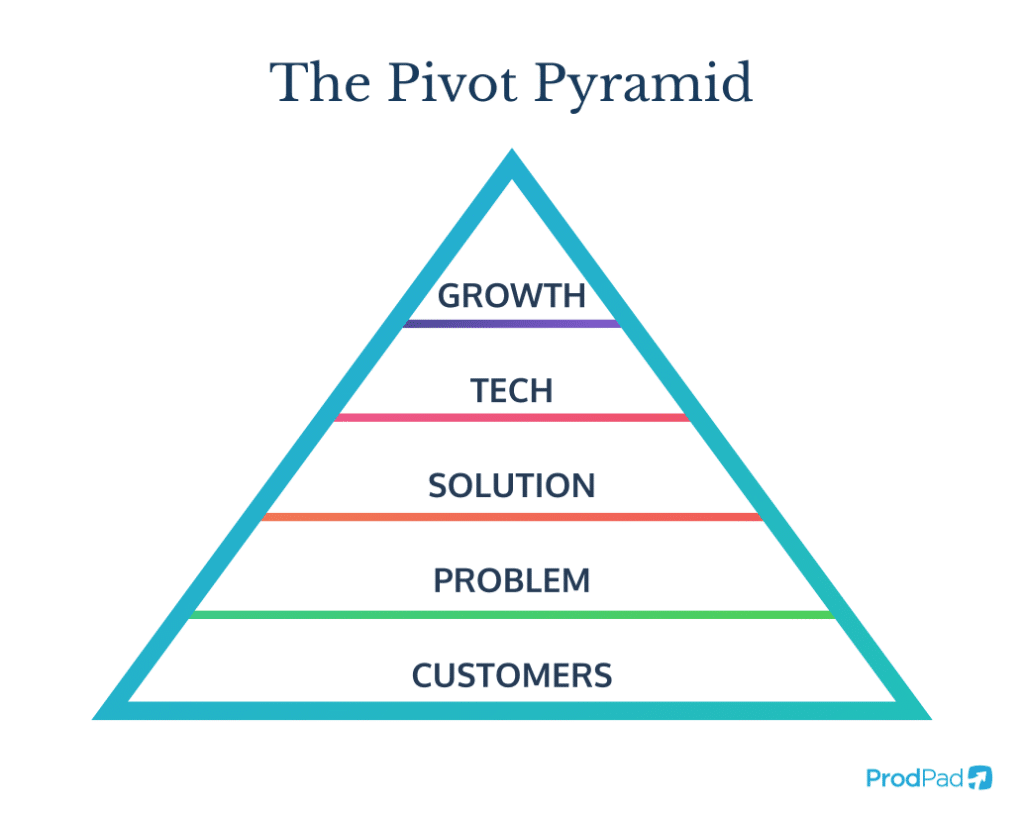
Think of each section as a building block. If you take out a block to replace it at the bottom of the structure, the rest above it falls down, so you’ll need to rebuild them too.
Pivoting away from your current customers and target market sits at the bottom of the pyramid, so you’re going to have to reconsider everything above it. A change in target customers is a pretty large pivot and one that requires a lot of resources.
If you’ve got your customers right but aren’t solving the right problem for them and have a weak value proposition, you may need to pivot here. When you do, you’ll have to re-evaluate everything above this point.
Maybe you’ve nailed the problem your users are facing, but your solution isn’t dealing with it in the best way. Then you need to look at your solution while paying attention to technology and growth.
A change in the technology you use can help you find more success without needing to adapt in many other areas. You only have to think about your growth tactics from there.
If all you want to change is how you grow and market your product, that’s the least intensive approach. It doesn’t require you to change other aspects of your business.
The different types of pivot strategy
The pivot pyramid helps you wrap your head around the work involved when pivoting in different business areas, but it doesn’t provide a comprehensive overview of all the different types of pivots you can try.
Here’s a look at the changes you can make to your product and business strategy to improve performance.
Target market pivot
If you’re barking up the wrong tree, a target market pivot is about finding the right one. This is where you shift focus to a new demographic or market segment that better suits your product, including a new age group, industry, or location.
This sits in the Customer section of the pivot pyramid, meaning you’ll have to reconsider everything above it.
Customer need pivot
This pivot is about ensuring you’re solving the right problem for your target customer. What you’re offering could be fantastic, but it may not be what your audience wants or needs. A customer need pivot involves getting customer feedback to learn about their pain points and wants, then tweaking your product to suit.
This pivot is in the Problem section of the pivot pyramid.
Product feature pivot
A product feature pivot is where you make changes to your current product. You can enhance the features you already have using incremental innovation, or offer new features altogether.
A subcategory of this type of pivot is a zoom-in pivot, where you evaluate all the features you offer and focus on one high-performing feature as your main offering.
You can also do the opposite and perform a zoom-out pivot, where you build on a single feature and adopt related solutions to improve overall value to your customers.
A product feature pivot sits in the Solution section right in the middle of the pyramid. You won’t need to rethink your customers and problems, but the technology and growth methods you use may have to be adapted.
If you’re creating a new feature, learn how to make it stick by checking out the blog below:
Feature Adoption: How to Make Your New One Stick
Technology pivot
A technology pivot is where you update or change the technology that powers your product. This helps ensure that your product is current and uses the technology your competitors are using. Examples of a technology pivot include incorporating AI or upgrading to cloud infrastructure.
This falls in the Tech section of the pivot pyramid.
Channel pivot
A channel pivot is about changing how you sell your product to your customers. The most common example is moving from a brick-and-mortar store to a digital eCommerce platform, but it also includes things like going from direct sales to partnerships.
This involves tweaking your distribution method so your channel approach best suits the expectations of your customers. Changing your product pricing strategy is another example of a channel pivot.
This change belongs in the Growth section of the pivot pyramid.
Pricing model pivot
A pricing model pivot is where you change how customers buy your products. If your current revenue streams aren’t working, you could move from a free trial to a reverse trial approach to improve your adoption rate. You could go from a subscription-based model to a one-time purchase, or change your pricing tiers. A change to your pricing model should be dictated by your customers and what suits them.
This sits in the Growth section of the pivot pyramid too, as you don’t need to make changes to the other areas below it.
Product value pivot
A product value pivot focuses on changing how you position your product. If customers don’t get it, this pivot helps you rethink how you communicate the value of your product. It can involve rebranding, changing your marketing strategy, or other product positioning work.
If you need support in better positioning your product, the webinar with positioning expert April Dunford walks through how to do it successfully:
[WEBINAR] The Secret to Product Positioning with April Dunford.
This is part of the Growth section of the pyramid, as it’s a change in how you market your product rather than a change in the product itself.
Pivot strategy examples
One of the best ways to illustrate a pivot strategy is through real-life examples. Plenty of businesses have moved away from their original concept, and there are many cases of a pivot being the catalyst that propelled their success.
Adopting a pivot strategy is so common that many founders believe it’s not a question of if you need to pivot, but when. Pivoting is seen as a necessary step in business, not something to fear or treat as failure.
Six well-known examples of companies that pivoted into something bigger than their original idea.
Slack: from failed game to workplace standard
Slack started life as Tiny Speck, a gaming company building a browser-based MMO called Glitch. The game didn’t take off, and after years of work the team had to shut it down. What they did still have was the internal messaging tool they’d built to coordinate the distributed engineering team. Stewart Butterfield and the founders bet that the tool was more valuable than the game. They turned that internal chat product into a standalone offering and Slack was born.
This is a textbook zoom-in pivot: the team evaluated everything they’d built, identified the one piece with real traction, and rebuilt the company around it. Slack went on to be acquired by Salesforce for nearly $28 billion in 2021.
Instagram: from check-in app to photo-sharing giant
Instagram didn’t start as a photo app. It started as Burbn, a location-based check-in app similar to Foursquare. Burbn had a lot of features (check-ins, plans, photos, points) and was confusing to use. Co-founders Kevin Systrom and Mike Krieger noticed users were mainly engaging with one feature: the photo sharing. They stripped everything else out, focused entirely on photos with filters, and relaunched as Instagram.
This is a combination customer need pivot and zoom-in pivot: the customers told them through behaviour that photos were what mattered, and the team made the hard call to throw away most of what they’d built. Instagram was acquired by Facebook for $1 billion in 2012, less than two years after launch.
Twitter: from podcasting platform to microblogging
In 2005, Odeo was a podcasting startup. Then Apple launched podcasts inside iTunes and effectively ate Odeo’s market overnight. The team did a company-wide hackathon to come up with new ideas, and one of them was a short-message status-update tool called twttr, built by Jack Dorsey, Noah Glass, Biz Stone, and Evan Williams. The founders bought back the company from investors, killed the podcasting product, and bet everything on the messaging idea.
This is a product feature pivot combined with a target market pivot: a completely new product type targeting a completely different use case. Twitter eventually IPO’d in 2013 and was acquired by Elon Musk in 2022.
Shopify: from snowboard store to commerce platform
Tobi Lütke and his co-founders started Snowdevil in 2004, an online store selling snowboards. They couldn’t find an eCommerce platform that worked the way they wanted, so they built their own. After running Snowdevil for a year, they realized the platform was more interesting than the snowboards. They shut down the snowboard business and rebranded the underlying technology as Shopify.
This is a customer need pivot: they discovered that other merchants had the same problem they did and were willing to pay for the solution. Shopify went public in 2015 and is now one of the largest commerce platforms in the world.
Netflix: from DVD-by-mail to streaming to studio
Netflix has pivoted more than once. It started in 1997 as a DVD-by-mail rental service, competing directly with Blockbuster. As internet bandwidth grew, founders Reed Hastings and Marc Randolph made a deliberate channel pivot to streaming, eventually phasing out the DVD business entirely (the last DVDs shipped in 2023). A second pivot followed: from licensing other people’s content to producing original content, starting with House of Cards in 2013. That was a product feature pivot that turned Netflix from a distribution business into a studio.
Two pivots, twenty-six years apart, each reshaping what Netflix actually is. Both held their nerve through investor and customer pushback.
Nintendo: from playing cards to global gaming
Nintendo was founded in 1889 as a playing card company in Kyoto. For nearly 70 years, that was the business. In the 1960s and 70s the company experimented with taxis, instant rice, and love hotels (none of which worked), before stumbling into electronic toys and then video games. By the 1980s Nintendo had reinvented itself as a console gaming company with the release of the Famicom (NES). Today it’s one of the most valuable gaming companies in the world.
This is a long-arc technology pivot: a 100-year-old company that recognized the future was in a completely different category and made the leap. Nintendo’s lesson is that pivots don’t have to happen in startup years. Old companies can change course too, as long as the new bet matches a real shift in the market.
What can go wrong when using a pivot strategy?
You shouldn’t be quick to turn to a pivot strategy. It’s a big change in how you do things and augments an aspect of your product or business. That makes it risky, especially if it’s not properly considered.
The drawbacks of getting a pivot wrong can be severe. The biggest dangers to avoid:
Pivoting too late
When the warning signs are flashing red and you delay a pivot, you’re wasting resources on a doomed product. The later you pivot, the more damage control you’ll have to do, and sometimes it’s too late to salvage anything.
Poor execution can sabotage the best ideas
Even a brilliant, well-considered pivot can flop if execution is messy. Teams not on the same page, failure to communicate the changes to customers, or mismanagement of resources, all of it can sink a smart strategy. A well-thought-out plan is only as good as how well it’s carried out.
Losing your core audience
If your pivot alienates the customers who supported you from the start, it can backfire spectacularly. A drastic change that didn’t need to happen might leave your loyal audience wondering what happened to the product they loved, leading to lost trust and revenue.
Chasing the wrong opportunity
Not every shiny new market or trend is the golden goose. If your pivot is based on a hunch rather than solid data and research, you can end up investing in the wrong direction. This is where lean experimentation before committing to a full pivot earns its keep: small, low-cost tests of the new direction can tell you whether the bigger bet is worth making.
Failing to iterate after the pivot
Pivoting is rarely a one-time fix. If you assume everything will fall into place after the initial shift and stop iterating, you risk stagnating. Successful pivots need ongoing monitoring, adjustments, and fine-tuning based on performance and customer feedback.
How do I implement a pivot strategy well?
Implementing a pivot strategy is not a simple task. You need to approach this change with the right focus and planning. Follow these pivot strategy best practices to set yourself up for a quality pivot.
1. Assess if a pivot is necessary
Before making any drastic changes, evaluate whether a pivot is the right move. Analyze your business performance, dig into customer feedback, study market trends, and review your financial metrics. If things aren’t aligning and there’s nothing else to try first, then a pivot strategy can get you back on track.
2. Develop a clear and focused pivot plan
A pivot without a plan is chaos. Define your new strategy with clear objectives, outlining how the pivot aligns with your long-term business goals. Whether it’s entering a new market, changing your customer base, or adopting new technology, your plan needs to be detailed and actionable.You may need to realign your goals to the new pivot strategy if your change is drastic enough. It’s worth rethinking your product vision and Objectives and Key Results. The Ultimate Collection of Product OKR Examples can help you find the right goals to work to that suit your new approach.

3. Have a customer-centric approach
Look to get customer feedback to guide you in how to change and alter your product or approach. You don’t want to change what’s already working for your customers, and you certainly don’t want to implement any changes that lead to an increase in customer dissatisfaction or customer churn. Pay close attention to your customer metrics, like Pirate Metrics. They will often do a lot of the heavy lifting on strategic thinking for you.
4. Ensure your team understands the pivot and their roles
A pivot can’t happen in a vacuum. Communicate the reasons behind the pivot clearly to your team, making sure everyone understands their role in the new strategy. When your team is aligned, they’ll be more effective in executing the pivot successfully.
5. Allocate your resources effectively
Every pivot needs resources: money, people, and time. Once the new direction is clear, reassess and reallocate accordingly. You might need to hire new talent, shift budgets, or cut certain projects to focus on what matters most for the pivot’s success. Before putting resources into the change at scale, you can run a Proof of Concept (PoC) to test whether the new direction will work.
6. Once started, move quickly
Whether it’s developing a new product, targeting a new customer segment, or updating your operations, execution needs to be swift but strategic. Keep an eye on progress and be prepared to tweak things as you go. No pivot is set in stone.
7. Get buy-in from your customers
Your customers need to know why this pivot benefits them. Communicate your new direction confidently, explaining how it solves their problems or brings added value. Customer buy-in is critical to ensuring your pivot sticks and strengthens your relationship with your audience.
The pivots people remember share a pattern
Look at the six examples above and the pattern is clear. None of them started life as the company they became famous as. Each made a deliberate, evidence-led decision to leave behind something that wasn’t working and bet on something that was. None of them pivoted on a whim. All of them pivoted before it was too late.
Pivoting takes the discipline to recognize the signals, the research to know what to change, and the planning to execute without losing your team or your customers in the process. The companies whose pivots become case studies are the ones who treated it as a strategic move, not a panic move. The rest are forgotten.
If you’re ready to leave behind the frustrations of your current roadmap and pivot to something more aligned with your goals, ProdPad has your back. With features for roadmapping, customer feedback management, and team collaboration, ProdPad gives you the visibility and discipline to make pivots that work.
Try ProdPad today, no credit card required.