Why Product Roadmaps Don’t Need Deadlines

Most roadmap problems aren’t prioritization problems. They’re expectation problems.
The moment a roadmap contains dates, stakeholders stop reading it as a strategy document and start reading it as a commitment. That’s why so many roadmaps create friction, disappointment, and endless status meetings.
The highest-performing product teams have stopped putting deadlines on their roadmaps altogether. We call this approach Roadmaps Without Deadlines: product roadmaps organized around confidence, priorities, and outcomes rather than delivery dates.
The hidden cost of false certainty
Timeline-based roadmaps optimize for certainty.
Product management optimizes for learning.
Those two goals pull in opposite directions, and the roadmap is where the conflict shows up first.
Here is the logic, step by step. You build something, you ship it, and you learn something you did not know before. That learning changes what matters next. The further out you look on a roadmap, the less you actually know about what you should build, because all the discovery that would inform those decisions hasn’t happened yet. A date attached to a Later item is a guess about a solution to a problem you have not finished understanding.
Modern product teams practice continuous discovery, which means new evidence is constantly reshaping priorities and decisions.
The faster a market changes, the less useful long-range feature commitments become. AI products are a good example: teams are learning from customer behavior, model capabilities, and competitors in real time. A roadmap built around fixed delivery dates can become obsolete before the work reaches production.
This is the argument that sits underneath the Now-Next-Later roadmap. Timeline roadmaps fail because discovery keeps changing what should be built, and a fixed date pretends that change won’t happen. A date-based roadmap looks confident in the planning meeting and then quietly becomes a record of everything you got wrong about the future. The certainty was never real. It was a presentation choice.
The teams that accept this stop trying to manufacture confidence they don’t have. They commit hard to the near term, hold the medium term loosely, and treat the far term as a set of bets rather than promises. The roadmap stops being a liability the moment the plan changes, because the plan changing was always the expectation.
Meet the Now-Next-Later roadmap
Discover the roadmap format that replaces timeline commitments with confidence horizons.
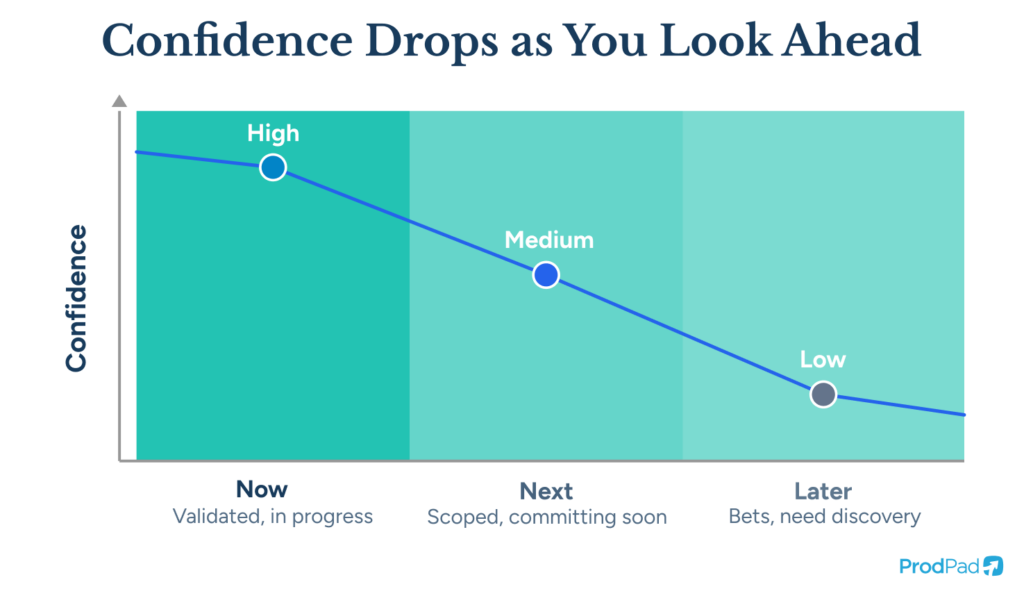
It organizes work by how much you actually know, not by when you hope to do it.
Why teams without deadlines actually do better
Removing deadlines is not about working less or holding teams to a looser standard. Teams that operate without roadmap dates tend to outperform teams that don’t, and the reasons are concrete rather than cultural.
1. They stop padding estimates
When a date carries consequences, people protect themselves. A developer says three days, the Product Manager writes down a week, and the roadmap inflates so everyone feels safe. Multiply that across a quarter and the plan is built on buffer that exists only to absorb blame. Teams without imposed dates have nothing to pad against. They work to a standard, deliver, and move to the next problem, which is faster than the padded version even though it looks less precise on paper.
2. They protect quality
A deadline turns quality into the variable that gets cut when time runs short. The work passes the obvious tests and ships, and the parts that take judgment, things like documentation, maintainability, and whether the next engineer can understand why it was built this way, get skipped. One thing we say at ProdPad is to build as though you’re the person who will train your replacement in two years. That standard survives when the team controls its own pace and erodes the moment a date overrides it.
3. They tell the truth
Strict deadlines produce a quieter team, not a more honest one. People who fear the reaction to a missed date stop surfacing problems early, and problems surfaced late are always more expensive. This is psychological safety in plain operational terms. Trust is the opposite of control, and trust has to be given before it can be returned. A team that knows it won’t be punished for an honest “this is taking longer and here’s why” will tell you sooner, which is the only version of the news you can actually act on.
4. They spend money on building, not forecasting
A team forced to produce a timeline spends real hours estimating, re-estimating, and checking estimates against reality, all of it work that produces no product. That is salary spent on the appearance of predictability. Point a capable team at a clear problem, give them the room to find the route, and the same budget produces more shipped value and more value reaching the customer over the year. The lean operators on the indices everyone benchmarks against work this way for a reason.
Why smart teams refuse to commit to dates
The teams that hold the line on dates are not being difficult. They are being precise about what they can responsibly commit to and what they can’t. The distinction comes down to what stays fixed and what stays flexible.
The Fixed/Flexible Rule
Great product teams keep problems fixed and solutions flexible.
| These can be fixed | Flexible |
|---|---|
| Customer problem | Exact feature |
| Desired outcome | Specific solution |
| Strategic priority | Delivery date |
The commitment is to solving a real problem and moving a real outcome, and the team stays free to change how and when as it learns. Reverse the columns, lock in the feature and the date, and you have committed to a specific solution before you have evidence it’s the right one, while giving up the freedom to respond when the evidence arrives.
This is why a confident, senior product team will push back on a date and not on an outcome. The outcome is the thing they intend to be held to. The date is the thing that would force them to fake it.
The deadline trap: what actually happens in practice
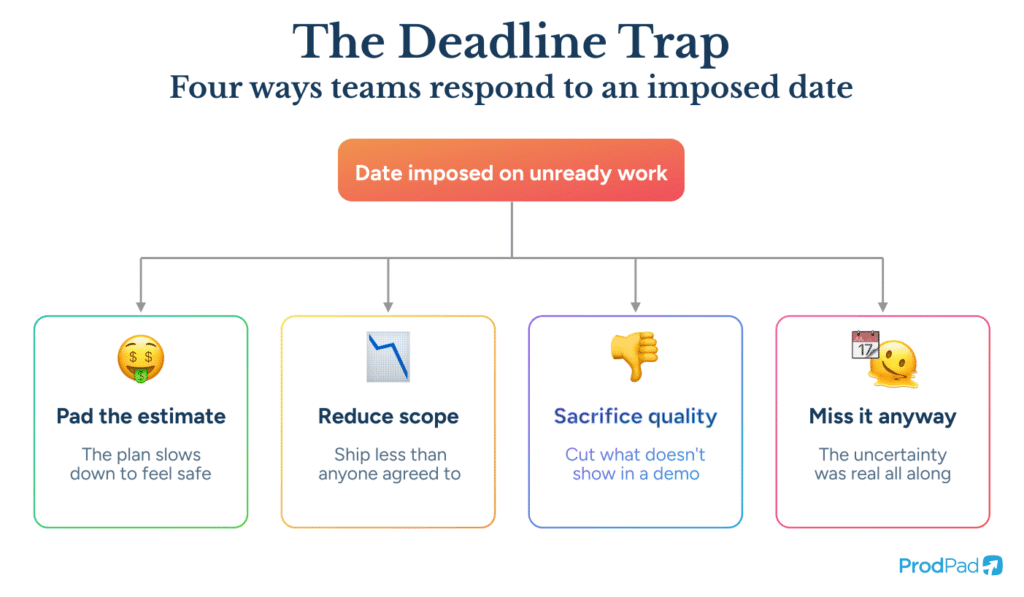
When a date is imposed on work that isn’t ready for one, teams usually respond in one of four ways:
- Pad the estimate, making the roadmap look slower than the work requires.
- Reduce scope, shipping less than originally intended.
- Cut quality, skipping the work that doesn’t show up in a demo.
- Miss the date anyway, because the uncertainty was real and pressure didn’t make it disappear.
As Jeff Gothelf has argued, projects with both fixed scope and fixed time rarely end well. The deadline moves, the scope shrinks, or the team burns itself out trying to make the plan fit reality.
The problem isn’t a lack of accountability. It’s treating a guess as a commitment before the team has enough information to make one.
Timeline Roadmaps vs Roadmaps Without Deadlines
| Timeline roadmap | Roadmaps Without Deadlines |
|---|---|
| Organized by dates | Organized by confidence |
| Encourages commitments | Encourages learning |
| Feature-focused roadmapping | Outcome-focused roadmapping |
| Assumes certainty | Embraces uncertainty |
What stakeholders actually need when they ask for dates
The request for a date is rarely a request for a date. It’s a request for confidence, and you can almost always give the underlying thing without committing to the calendar item. Three groups ask, and each one wants something different.
Sales asks for dates because they need confidence to sell
A salesperson asking when a feature lands is trying to avoid promising something that won’t exist. Give them a confidence range and the reasoning behind it instead of a hard date. “This is in Now, we expect it within the next few weeks, here’s what could move it” is more useful to a good salesperson than a date that turns into an apology later. The honest range protects the customer relationship better than the precise guess.
Leadership asks for dates because they need predictability
Executives asking for dates are usually managing their own commitments upward and want to know the business is in control of its direction. Give them prioritization and outcomes rather than a delivery promise. A roadmap that shows which problems you’re solving, in what order, and why, tied to the OKRs those problems serve, answers the real question. The roadmap shows the plan. The OKRs carry the commitment. That separation is what lets you give leadership something firm to hold without forcing the team to invent dates.
Customers ask for dates because they’re planning around you
A customer asking for a date is trying to plan their own work. Share direction rather than commitments. Most customers respond well to “this is something we’re actively working on” or “this is on our radar for later,” and they respond badly to a date that slips. Direction keeps the relationship honest. A broken promise does the opposite.
When dates actually do matter
Roadmaps don’t need deadlines. Businesses sometimes do.
The argument here is not that dates never belong anywhere. Some work has a real external deadline, and pretending otherwise would be its own kind of dishonesty. Dates are appropriate when they come from outside the team’s control.
Genuine commitments, regulatory deadlines, and strategic milestones still matter. The key is attaching dates only where they carry real meaning rather than forcing every roadmap item onto a timeline.
When something is genuinely time-bound, plan around it deliberately. Mark the commitment clearly and manage delivery against it, while everything else stays on horizons rather than a calendar.
Even teams that have left timeline roadmaps behind still account for real external dates. The skill is knowing the difference between a date the world imposed on you and a date you imposed on yourself to feel in control.
Need to show dates on a lean roadmap?
Learn how to add meaningful dates without falling back into timeline thinking.
What to use instead of deadlines
Drop the dates and you still need a way to communicate priorities, confidence, and direction. The replacement is time horizons sorted by confidence, which is what the Now-Next-Later roadmap gives you.
Now is the work in progress. High confidence, discovery done, the team is building. Next is validated opportunity, scoped and waiting its turn, with enough certainty to commit soon. Later is the set of future bets, low confidence, still needing discovery, likely to change. Confidence is the axis, not time. You know a great deal about what you’re building this week and very little about what you’ll build in six months, and the format reflects that honestly instead of papering over it.
The order of operations is straightforward. Understand why timeline roadmaps fail, then adopt an outcome-based format, then learn the origin of the approach if you want the full reasoning, then convert your existing roadmap. If you’re ready for that last step, the eight-step guide to converting a timeline roadmap to Now-Next-Later shows you how to do it without throwing away the work already on your current plan.
Ready to leave roadmap deadlines behind? Follow the eight-step process to move from a timeline roadmap to a Now-Next-Later roadmap without throwing away the work already on your plan.
Trust is what makes the roadmap work
The deadline habit is self-reinforcing. Long timelines make leaders crave certainty, the craving pushes teams to pad their estimates, the padding slows everything down, and the slowness makes everyone crave certainty even harder. Somewhere in that loop there’s no time for review, no room to rebuild, and no one willing to own a missed date that was really a systemic problem wearing a personal one’s clothes.
Stepping out of the loop takes one thing, and it’s trust. Leadership trusts the team to manage the roadmap, the team earns that trust by being honest about what it knows and doesn’t, and the whole system gets faster because nobody is spending their energy defending a guess. The roadmap stops being a contract about dates and becomes what it was always supposed to be, which is a shared, living view of the problems worth solving and the order they’re worth solving them in. That’s the version your customers feel, because it’s the version that ships.

FAQs
- Should a product roadmap have dates?
No. A product roadmap should not include delivery dates for most work. It’s a communication tool for direction and priority, and dates create false precision that breaks trust when priorities shift. Genuine external deadlines (regulatory, contractual, event-driven) are the exception and can be marked clearly. Everything else belongs on horizons sorted by confidence.
- What are product roadmap deadlines?
Product roadmap deadlines are delivery dates attached to roadmap items. While they are often intended as estimates, stakeholders frequently interpret them as commitments. This is why many product teams replace roadmap deadlines with confidence horizons that communicate priorities without creating false certainty.
- Why do roadmap deadlines create false expectations?
Roadmap deadlines create false expectations because they imply certainty long before a team has enough information to make a reliable commitment. Stakeholders naturally interpret dates as promises, even when they were intended as estimates. As priorities change and new information emerges, the roadmap changes but the expectation remains.
- What should you use instead of roadmap deadlines?
Use confidence horizons rather than delivery dates. Frameworks such as Now-Next-Later organize roadmap items by how much is known about them rather than when they are expected to ship. This communicates priorities and uncertainty more honestly while allowing plans to evolve as teams learn.
- How do you communicate progress without deadlines?
Show movement through horizons and progress against outcomes. As work gains confidence it moves from Later to Next to Now, and you report against the OKRs each initiative serves rather than against a date. Stakeholders see what’s advancing, what’s been learned, and what’s shipped, which is a truer signal of progress than a date on a chart.
- How do sales teams work without roadmap dates?
Sales works from confidence ranges and direction rather than hard dates. “This is in active development, expected in the next few weeks” gives a salesperson something honest to say, and an honest range protects the customer relationship better than a precise date that slips into an apology.
- What if leadership demands deadlines?
Find out what the demand is really about, which is almost always predictability and control of direction. Offer prioritization, outcomes, and OKRs as the firm thing leadership can hold, and reserve dates for the work that genuinely has external constraints. Leadership rarely wants the date itself. They want to know the business is pointed in the right direction and moving.
- Can an agile roadmap include dates?
Yes, for genuinely time-bound work. An agile roadmap can mark a regulatory deadline, a contracted delivery, or an event launch, while keeping the rest of the roadmap on horizons. The distinction is between dates the outside world imposes and dates a team imposes on itself to manufacture certainty.