Process Eats Tooling For Breakfast

A product team is struggling. Priorities feel arbitrary, stakeholders are frustrated, nothing seems to ship on time, and morale is fraying. Someone in a leadership meeting says the line that always gets said: “I think we need a better tool.” A procurement cycle kicks off, and a shiny new platform gets selected. The team spends six weeks migrating everything across, and there is a genuine sense of momentum. Six months later, priorities still feel arbitrary and stakeholders are still frustrated. Someone is quietly starting to evaluate the next tool.
This loop runs in product organizations constantly. It is worth saying plainly, even though ProdPad sells a tool. Most teams reaching for new software are trying to solve a problem that no software can touch. The tool changed. The thing that was actually broken did not. Understanding why a tool cannot fix it, and what has to happen first, is what matters. That understanding is the difference between a purchase that compounds and one that just relocates the mess.
The tool-shopping reflex, and why it feels like progress
When a team is in pain, buying a tool is the most satisfying move available, because it is concrete. There is a vendor to evaluate, a budget line to approve, a go-live date to rally around, and a clear before-and-after. Compared to the slow, ambiguous work of changing how a team actually operates, a procurement cycle feels like decisive leadership.
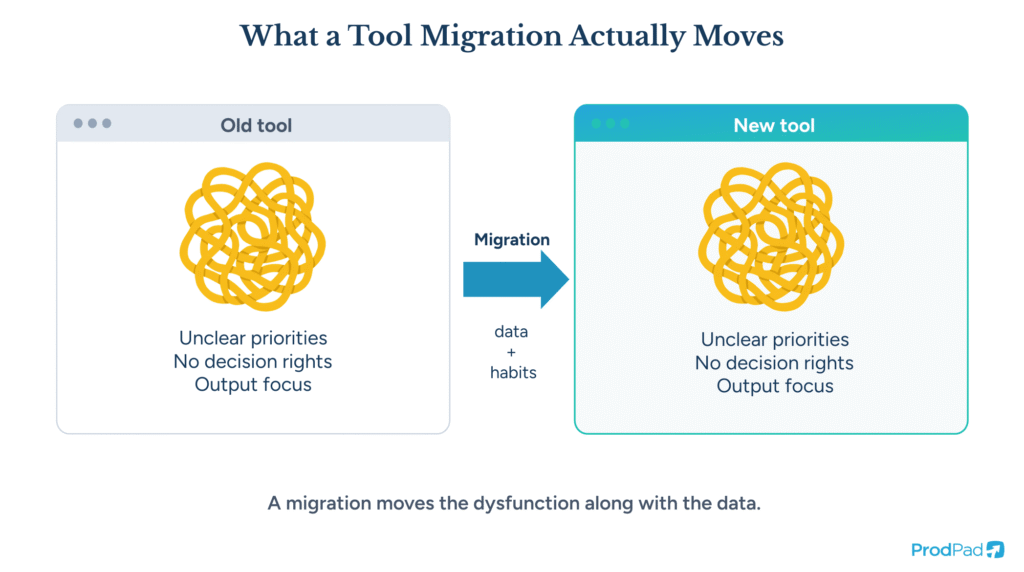
The trouble is that the satisfaction is mostly about motion. A tool purchase produces visible activity and a sense that the problem is being attacked. It gives everyone a deadline to point to. None of that is the same as the problem getting solved. The reflex is so common for a reason. It converts an uncomfortable, open-ended operating problem into a comfortable, closed-ended buying project. And buying projects are far easier to run than change projects.
Procurement gives the feeling of fixing without the work of fixing
A new tool comes with an implicit promise: the answer is in the box. Once the team is fully onboarded, the dysfunction will resolve. That promise is appealing precisely because it locates the problem outside the team’s own habits. If the old tool was the issue, then no one has to confront harder questions. No one examines how the team prioritizes, makes decisions, or talks to stakeholders. The fix is something you install rather than something you practice.
This is why the relief after a tool migration is real but temporary. For a few weeks, the novelty of a cleaner interface and a fresh start feels like the problem lifting. Then the team’s actual operating habits reassert themselves inside the new environment. The original symptoms return, and the search for the next tool begins. The cycle is expensive. It gets blamed on the tools, rather than on the thing the tools were never going to address.
Before you shop, map how you actually work today. The free Product Management Process Handbook lays out a best-practice flow you can sense-check yours against 👇
What a tool can fix, and what it cannot
Tools are genuinely good at a specific class of problem. They remove friction, they create a shared place for information, they automate repetitive steps, and they make work visible. A team drowning in manual status updates or scattered spreadsheets can get real relief from the right software. That relief is not an illusion.
What a tool cannot do is make the decisions that the team has been avoiding. Software does not decide which problems are worth solving, or what the team should say no to. It does not decide who gets to make a call, or how a strategy reaches a nervous board. Those are judgment and operating-model questions. A tool that arrives without answers to them simply provides a more efficient venue for the same unresolved arguments.
Tools remove friction, they do not supply judgment
The distinction that matters is between mechanical problems and judgment problems. A mechanical problem, like “our feedback is scattered across five places,” is exactly what tooling is for. A judgment problem, like “we cannot agree what matters most this quarter,” is immune to tooling. No feature decides priorities for you. Most teams in pain have judgment problems wearing the costume of mechanical ones. That is why the mechanical fix keeps failing to land.
A tool accelerates the process you already run
A tool is a multiplier applied to your existing way of working. Point it at a clear, healthy process and it makes that process faster and more consistent. Point it at a confused one and it makes the confusion faster and more consistent too. This is the same lesson that played out with AI adoption. Teams that bolted powerful new capability onto an unchanged operating model mostly got speed without improvement. We explored that pattern in how AI made your product team faster but not better.
How a broken process survives a tool migration intact
The reason the new tool disappoints is that a migration is a copy operation. It moves the data, the structure, and the habits across to a new home without changing any of them. Whatever was dysfunctional about how the team captured ideas, ranked them, and decided what to build gets faithfully reproduced. It reappears in the new environment, now with a different logo at the top.
This is the system dynamic that the tool-shopping reflex misses entirely. The problem was never living in the software. It was living in the team’s operating model, and operating models travel with the team wherever they go. A nicer interface does not edit a team’s incentives. A better roadmap view does not resolve who actually gets to decide what goes on the roadmap.
The feature factory does not care which tool it runs on
John Cutler’s feature factory, the organization that measures success by output shipped rather than outcomes achieved, is the clearest example of a process problem that no tool can touch. A feature factory running on a basic backlog tool is still a feature factory after it migrates to the most sophisticated platform on the market. The factory is defined by what it values and rewards, which is shipping, and the tool just gives it a more efficient conveyor belt. Swapping the tool while leaving the values untouched produces a faster factory, not a better product team.
The deeper point is that tools encode and amplify whatever behavior a team already exhibits. A team rewarded for output will use any tool to track and accelerate output. The behavior comes from the incentives and the operating model, and until those change, the tool is just a more powerful expression of them.
This is exactly why we are picky about what we build. We do not add features that work against good product practice, even when customers ask, as explained in why ProdPad is a different kind of Product Management tool→
The process decisions that have to come first
Fixing the operating model means making a handful of decisions that no tool will make for you, before any tool can help. These are not glamorous, and none of them require software to answer. They require the team and its leadership to agree on how product work actually gets done.
Decide how problems get captured and triaged
Agree on where ideas, requests, and feedback enter the system and what happens to them when they arrive. A team without a triage agreement does not have a capture problem a tool can solve; it has an ownership problem, because nobody has decided who looks at incoming work and how often. Look at your own inbound right now. Is there a named owner and a routine for what happens to a new request, or does it depend entirely on who happened to see it?
Decide how you prioritize, and what you say no to
Prioritization is a series of decisions about what not to do, and a team that cannot say no does not have a prioritization framework, it has a wish list. The hard part is agreeing, as a leadership group, on the basis for those trade-offs and committing to declining the things that do not clear the bar. A scoring feature in a tool is useless until that agreement exists, because the numbers only matter if the team will actually honor them.
Saying no is the hard part, and a framework makes it defensible. Our free guide to 17 prioritization frameworks helps you agree, as a team, on the basis for those trade-offs 👇
Decide how decisions get made and recorded
Name who has the authority to make which calls, and where those decisions get written down so they stop getting relitigated. A great deal of product churn comes from decisions that were made informally, never recorded, and therefore reopened every few weeks by whoever was not in the room. This is an operating-model choice about decision rights, and it has to be made by people, not configured in software.
Decide how the plan gets communicated
Agree on how the team’s plan and progress get shared, with whom, and how often, so that communication is a designed habit rather than a scramble before each meeting. The format matters here, and a roadmap built as a communication tool rather than a delivery schedule is part of that decision, but the underlying choice is about rhythm and transparency, which no tool sets for you.

Where tooling earns its place
None of this is an argument against tools, which would be a strange argument for a software company to make and an even stranger one to believe. Once a team has designed a healthy process, a tool becomes genuinely valuable, because its job shifts from rescuing the team to reinforcing the good decisions the team has already made.
A well-chosen tool makes the right way of working the path of least resistance. It encodes the triage routine so capture happens consistently, holds the prioritization logic so trade-offs stay visible, records decisions so they stop being reopened, and publishes the plan so communication is automatic. This is what a workflow with best practice built in is actually for, and it is why tooling matters enormously once the process is sound. The tool stops being a substitute for the operating model and becomes the thing that helps the operating model survive turnover, growth, and pressure.
Communication is where most processes quietly break down. The Ultimate Guide to Product Roadmaps shows how to build a roadmap that does the communicating for you →
Choose a tool for the behavior it encourages
Because tools amplify behavior, the most important question when selecting one is what behavior it nudges a team toward. A tool oriented around tickets and output will pull a team toward output thinking, regardless of intentions. A tool oriented around problems, outcomes, and decision context will pull a team toward those instead, which is the same reason accountability improves when teams operate against outcomes in a visible system. The right tool is the one whose grain runs in the direction of the process you have decided to build.

Why the process decides what the tool can do
The teams that get real value from new software are the ones that did the unglamorous work first. They agreed on how they capture, prioritize, decide, and communicate, and only then brought in a tool to make that agreed way of working faster, more consistent, and harder to drift away from. The tool compounded something that was already sound.
The teams stuck in the buy-migrate-disappoint loop skipped that step and asked the software to supply judgment it does not have. A tool is a multiplier, and a multiplier applied to a confused operating model produces a more efficient version of the confusion. Design the process first, because the process is what determines whether the tool becomes leverage or just a faster way to arrive at the same disappointing place. Get that order right and the tool finally gets to do the thing it is genuinely good at, which is making a good way of working feel effortless.
Once the process is sound, put it to work in a tool built to reinforce it.