Our philosophy
The ProdPad Way
Most product management tools let you work however you want. ProdPad has opinions about how you should work. Six of them, specifically. They’re baked into every feature, every workflow, and every decision we’ve made since 2012. If they match how you think about product management, you’ll feel it immediately. If they don’t, we’re probably not the right tool for you. And that’s fine.
ProdPad exists because the tools available in 2012 didn’t match how product management should work. Janna Bastow and Simon Cast had been building products, running teams, and co-founding Mind the Product (the world’s largest community of product people). They knew what good product management looked like. They couldn’t find a tool that agreed with them.
So they built one. And they built it with opinions.
ProdPad doesn’t try to be everything to everyone. It’s built around a specific set of beliefs about how product teams should operate. Some of those beliefs are now mainstream (the Now-Next-Later roadmap went from a sketch on a whiteboard to an industry standard). Others still make people uncomfortable (we don’t do RICE scoring, and we never will). All of them are informed by thirteen years of working with product teams, running roadmap clinics, and listening to thousands of product managers describe the same problems in different words.
These are the six principles behind every product decision we make. If you recognize yourself in them, ProdPad was built for you.
Your roadmap should describe problems to solve, not features to ship. It defines strategy.

A roadmap full of features with delivery dates creates false certainty. It tells stakeholders exactly what they’ll get and approximately when they’ll get it. It sounds like a plan. It’s actually a trap.
The moment you commit to features on a timeline, you lose the ability to learn. Customer feedback that contradicts the plan gets ignored because the plan is already committed. A better solution discovered mid-cycle gets shelved because the committed feature is “nearly done.” The team ships what was promised instead of what would actually move the needle.
ProdPad frames roadmaps around initiatives, which are problems to solve or outcomes to achieve, not features to build. Each initiative connects to a strategic objective. The team’s job is to find the best solution to the problem, not to deliver a predetermined feature by a predetermined date.
This changes everything about how the team works. Discovery becomes meaningful because the outcome is fixed but the solution is flexible. Stakeholders get clarity on direction without false precision on delivery. Product managers spend their time on strategy and validation instead of defending a timeline.Teresa Torres, author of Continuous Discovery Habits, has written that she’sa fan of the Now-Next-Later roadmap format for exactly this reason: it communicates strategic intent without locking teams into solutions too early.A roadmap full of features with delivery dates creates false certainty. It tells stakeholders exactly what they’ll get and approximately when they’ll get it. It sounds like a plan. It’s actually a trap.
We have lots of requests that we often say no to. While we explain the reasons to our customers on an individual basis, it’s really interesting to gather those reasons together. It’s all about product integrity, which helps us to align with our company mission to “change the way businesses build their products and services, by empowering the organization”.
Empowering the product management organization means helping the product team to work in a culture conducive to success. Many of the ProdPad team have been product managers. They’ve experienced the issues faced by product teams and have seen the effects of those issues on individuals, teams and businesses. We also hold regular roadmap clinics, so we talk to product managers constantly. This keeps our understanding of their pain points up-to-date.
See ProdPad’s Now-Next-Later roadmap in action. Try the sandbox with sample data and explore a real roadmap built around outcomes, not features.
The loudest voice in the room should stop winning
Every product team has a version of this story: the CEO’s pet project jumps the queue. A big customer threatens to churn unless you build their request. A stakeholder “just knows” that Feature X is the right call. And the Product Manager, armed with gut instinct and a spreadsheet, has no ammunition to push back.
ProdPad doesn’t solve this with a scoring algorithm. Weighted scoring systems like RICE create an illusion of objectivity. Someone still has to assign the numbers, and those numbers carry all the same biases the scoring was supposed to remove. When scores don’t match what leadership wants, the scores get adjusted until they do. We’ve seen it happen hundreds of times in roadmap clinics.

Instead, ProdPad links every idea to the customer feedback that supports it. Real feedback from real customers, captured from Slack, Intercom, Salesforce, support tickets, email, and branded feedback portals. When someone asks “why should we build this?”, the answer is the 47 customers who told you about the same problem. When someone asks “why shouldn’t we build that?”, the answer is that three people mentioned it and two of them churned for unrelated reasons.
This is evidence-based prioritization. Not a formula that pretends to be neutral. Actual customer evidence, connected to ideas, visible to everyone.
See how feedback connects to ideas → See how Signals surfaces patterns automatically →
“In the comments, everybody feels heard and can say their opinion about new ideas. As a PM you need to say NO very often, and it makes your job much easier if that feedback comes from other people in the organization.”
— Lucas Wagner, Product Manager, wefox
Jira is for building.
ProdPad is for deciding what to build.
Product management doesn’t stop when something goes to development. And it doesn’t start there either. Before dev, you’re capturing feedback, scoring ideas, writing specs, validating, and planning the roadmap. After dev, you’re closing the loop with customers who requested it, measuring outcomes against OKRs, and feeding what you learned back into the next round of discovery.
Most teams run all of this inside their delivery tool. Jira, Azure DevOps, Linear. The backlog becomes a dumping ground for half-formed ideas and validated initiatives mixed together. The “after” work (outcome measurement, customer follow-up, learning) doesn’t happen at all because the tool doesn’t support it.
ProdPad covers both sides. Before dev: ideas, feedback, validation, prioritization, roadmapping. After dev: status synced back, customers notified, outcomes tracked, insights fed into the next cycle. Delivery tools handle the middle slice: backlog grooming, sprint planning, building, shipping. ProdPad and Jira stay in sync throughout, but each does what it’s built for.
The result is a continuous loop, not a one-way handoff.

As Michelle Eide, Product Manager at Target, put it: “I use ProdPad for all of my pre-development work. Nothing goes in Jira until it meets our definition of ready.”
That separation is one of the most common reasons teams tell us they chose ProdPad over Jira Product Discovery, which tries to solve discovery inside the delivery tool. When discovery lives inside delivery, it gets shaped by delivery thinking: sprints, story points, and timelines. And the “after” work never gets a home at all.
Feedback flows to ideas. Ideas connect to roadmap initiatives. Initiatives trace back to objectives.
Most product teams piece together their workflow from disconnected tools. Feedback lives in a spreadsheet. Ideas live in another spreadsheet or a Notion doc. The roadmap is a slide deck. Objectives are in a Google Doc somewhere. And the connections between them exist only in the Product Manager’s head.
When someone asks “why are we building this?”, the PM has to reconstruct the reasoning from memory, Slack threads, and old meeting notes. When a new PM joins the team, there is no system to learn from. When a product leader wants to see across multiple teams, they get seven different formats and no way to compare.
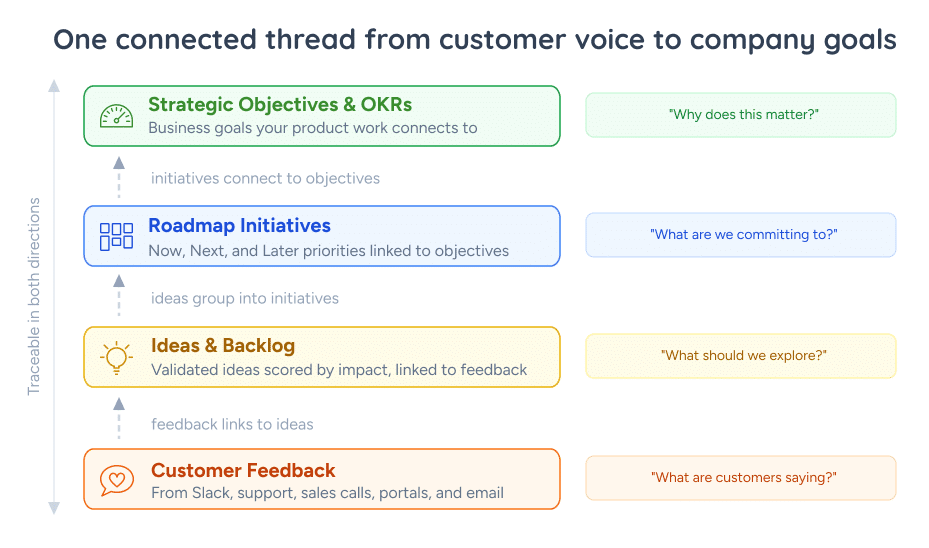
ProdPad connects these layers by design. A piece of customer feedback links to the idea it supports. The idea links to the roadmap initiative it belongs to. The initiative links to the strategic objective it serves. The thread from a single support ticket to a company-level OKR is visible in clicks, not hours of archaeology.
This is the moment our customers describe as “seeing the full picture.” It’s the moment a Head of Product opens the portfolio view and can see every team’s roadmap against the same set of objectives. It’s the moment a PM realizes that the feedback they captured last month already supports the initiative they’re exploring this week.
“ProdPad gives us a centralized place to align our whole company, operating in multiple markets and time zones, on what we are building when and why without any unnecessary overhead.”
— Aku-Jaakko Saukkonen, Product Manager, ResQ Club
Now, Next, and Later. Not Q1, Q2, and Q3.
The Now-Next-Later roadmap started as a sketch in Janna and Simon’s notebooks in 2012. It replaced the timeline roadmap they’d been forced to maintain at previous companies, the one that was always wrong, always out of date, and always the source of arguments about missed deadlines.
The logic is simple. Confidence decreases the further out you look. Work that’s happening now is high-confidence: the problem is validated, the solution is being built, the team is committed. Work that’s next is medium-confidence: the problem is clear, the solution is being explored, the team plans to pick it up. Work that’s later is low-confidence: the strategic intent is there, but the details are still forming.
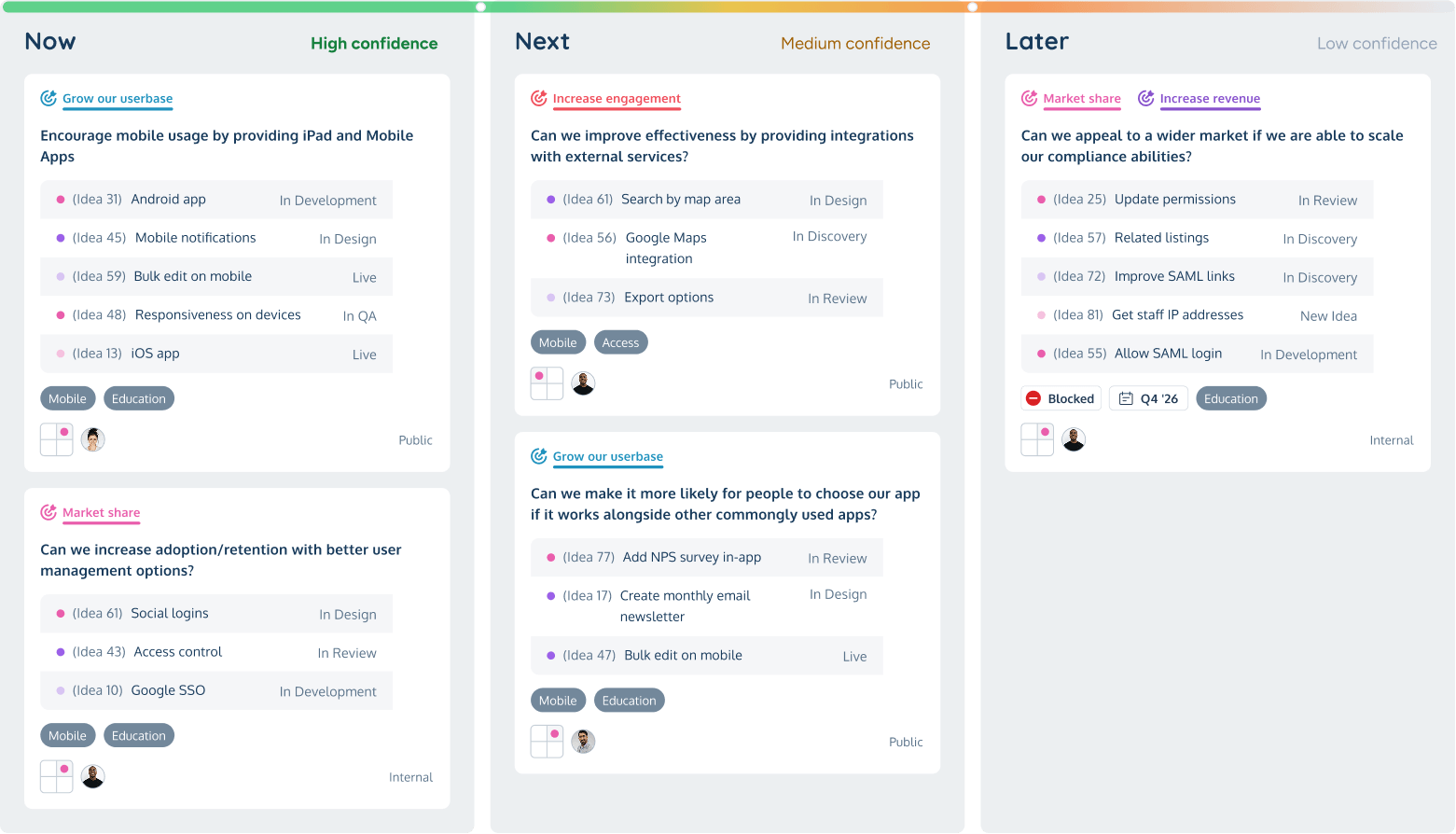
Putting these on a calendar implies equal confidence across all three. Putting them on a Now-Next-Later board makes the confidence gradient visible. Stakeholders can see direction without demanding dates. Product Managers can communicate strategy without making promises they can’t keep.
The format has become an industry standard. Bruce McCarthy and C. Todd Lombardo reference it in Product Roadmaps Relaunched. Teresa Torres recommends it in her webinar on handling stakeholders who still want dates. It’s taught in Product Management courses worldwide. It lives natively in ProdPad because this is where it was invented.
Read the origin story of the Now-Next-Later roadmap →
Read the full guide: Ditch the Timeline Roadmap →
ProdPad doesn’t just give you tools. It teaches you how to use them.
Most product management software is a blank canvas. Configure it however you want. Build your own workflow. Define your own process. That flexibility sounds appealing until you’re three months in, every PM on the team has configured things differently, and nobody can report across products consistently.
ProdPad is opinionated by design. It comes with best-practice workflows, structured idea canvases, and a roadmap format that guides teams toward better Product Management from their first session. A new PM joining your team logs into ProdPad and sees the workflow, the roadmap format, the idea template, and the feedback pipeline. The process is the tool.
As Adam Robinson, Head of Product at Pepper, put it: “ProdPad helped me to formalize our internal processes and introduce best practices. I’ve implemented it in two startups now and wholeheartedly recommend it.”
ProdPad isn’t a neutral container for whatever process you happen to have. It’s an expression of how we believe Product Management should work. The templates, workflows, and guardrails are informed by thirteen years of roadmap clinics, thousands of customer conversations, and the collective experience of the team that co-founded the world’s largest Product Management community.
We say no to features that would undermine good product culture. We deliberately don’t build customer voting portals (they introduce bias into your feedback process). We don’t build weighted scoring systems (they create false objectivity). We don’t allow the dev tool to overwrite product specs (that breaks accountability). Every “no” in ProdPad’s product decisions is a “yes” to better product practice.
Want to see opinionated Product Management in action? Start a free trial and see how ProdPad’s built-in workflows guide your team toward better practices from day one. Your trial extends the more you use it.
Either this resonates, or it doesn’t. Both are fine.
ProdPad was built for product teams who believe that strategy matters more than timelines, that evidence matters more than opinions, and that Product Management is a discipline worth doing well. If you’ve been nodding along, the tool will feel like it was built for you, because it was.
If you’d rather have a blank canvas, a RICE scoring matrix, and a Gantt chart, there are tools for that. They just aren’t this one.
Built by product people, for product people.
ProdPad was founded by Janna Bastow and Simon Cast, co-founders of Mind the Product, and inventors of the Now-Next-Later roadmap. Thousands of product teams have adopted their framework and used their tools.
See ProdPad in action
Start a free trial (it extends the more you use it) or explore the sandbox with sample data.