Feature Voting

Feature voting sounds like the most democratic way to build a product. Give your customers a portal, let them upvote the features they want, sort by popularity, and build from the top. Simple. Transparent. Customer-driven. Except the products built this way tend to drift from strategy, over index on the loudest voices, and quietly erode the Product Manager’s ability to solve real problems. Feature voting has a role in Product Management, but that role is far narrower and more nuanced than most teams realize when they first spin up a voting board.
What is Feature Voting?
Feature voting is a process where customers or internal stakeholders submit, browse, and upvote feature requests for a product, typically through a dedicated portal or board. The goal is to surface demand signals by letting users indicate which proposed features matter most to them, giving Product teams a quantitative layer of input alongside qualitative feedback. Done well, it provides a lightweight signal of relative interest. Done carelessly, it becomes a popularity contest that replaces product judgment with crowd consensus.
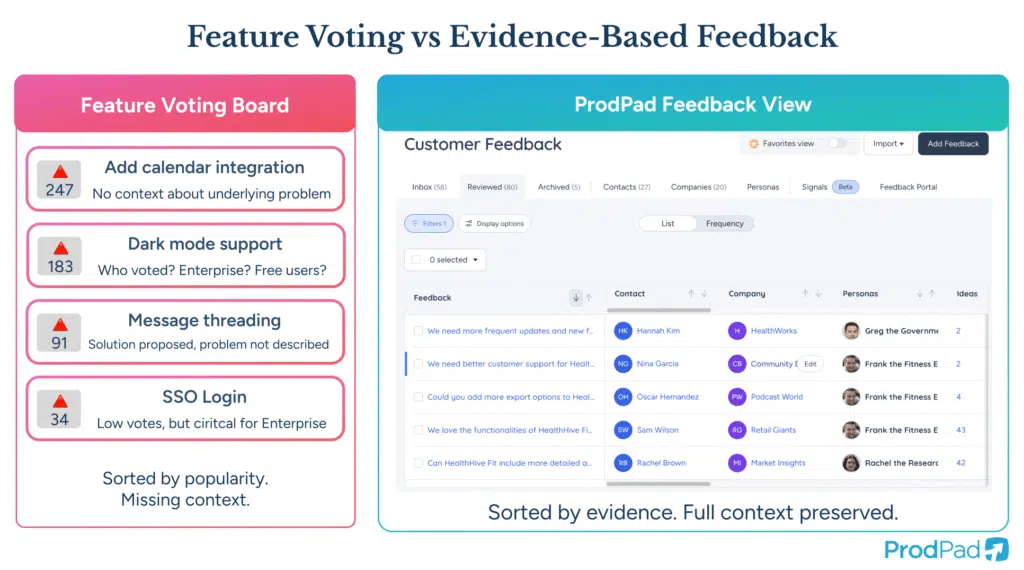
Feature voting sits within the broader discipline of customer feedback management and feature prioritization. Most implementations involve a public or semi-public board where users can browse existing feature requests, add new ones, and cast votes (often a simple upvote, sometimes a thumbs-up/thumbs-down or a weighted scale). The vote tally then becomes one of many inputs the Product team can use to inform what goes onto the product roadmap.
The concept gained widespread adoption in the late 2000s and early 2010s as SaaS companies looked for scalable ways to collect customer input. An entire category of voting portal tools emerged, and voting modules were added to broader Product Management platforms. The appeal was obvious: instead of relying on anecdotal feedback from a handful of conversations, teams could gather structured demand data from hundreds or thousands of users at once.
The tension, though, has always been the same. A vote count tells you that people clicked a button. It does not tell you why they want the feature, how urgently they need it, whether they would actually use it, or whether building it would advance the product’s strategic direction. That gap between signal and understanding is where feature voting breaks down, and where more rigorous approaches to continuous discovery start to look essential.
How Does Feature Voting Work?
Most feature voting implementations follow a similar pattern, though the details vary depending on the tool, the audience, and the level of sophistication a team brings to the process.
The basic mechanics
A feature voting board typically includes a submission form where users can propose new feature ideas, a browsable list of existing requests, and a voting mechanism (usually an upvote button, occasionally a scale). Users can browse what others have requested, add their own suggestions, and indicate support for ideas they care about. The board displays a running count of votes per feature, and many tools allow filtering by category, status, or popularity.
Some teams make voting boards public, accessible to anyone visiting their website. Others restrict access to paying customers, beta testers, or internal stakeholders. The audience composition matters enormously, because a public board will attract votes from free-tier users, competitors researching your product, and people who will never become customers, while a gated board skews toward existing users whose needs may not represent the broader market.
Internal vs. external feature voting
Feature voting can be internal (team members vote on ideas within the Product team’s backlog) or external (customers and end users vote on feature requests through a public-facing portal). Internal voting tends to be less risky, since the voters have context about strategy, technical constraints, and business priorities. External voting is where most of the pitfalls emerge, because customers are voting on solutions without understanding the underlying problems, the product’s strategic direction, or the effort required to deliver each request.
ProdPad, notably, takes a deliberate position against customer-facing voting portals. The reasoning is grounded in how voting distorts feedback quality: when users can see how many others have voted for an idea, bandwagon effects take over. It becomes easier to join a crowd than to articulate an independent perspective. The result is that high-vote features accumulate even more votes (social proof bias), while genuinely important but less visible ideas languish at the bottom of the list.
ProdPad’s internal voting mechanism works differently. Team members can vote Yea, Maybe, or Nay on ideas in the product backlog, and every vote requires a written comment explaining the reasoning. This forces qualitative context into every vote, making the signal richer and the outcome more useful for Product Managers who need to understand not just “how many” but “why.”
Why Do Teams Use Feature Voting?
Feature voting is popular because it solves a real operational challenge: how to collect, organize, and make sense of feature requests at scale. As a product grows, the volume of incoming feedback from customers, prospects, Sales, Support, and internal stakeholders quickly outpaces any single Product Manager’s ability to manually track and categorize it.
Scaling feedback collection
For teams fielding hundreds of feature requests per month across email, support tickets, Slack messages, and sales calls, a voting board provides a centralized place for requests to land. Instead of feedback scattering across a dozen channels and disappearing, it accumulates in one searchable, sortable interface. The organizational benefit alone is substantial, especially for teams that previously tracked requests in spreadsheets or lost them entirely.
Creating a sense of customer engagement
Giving customers a place to submit and vote on features signals that you value their input. It creates a visible feedback channel that can strengthen customer relationships, reduce churn risk (customers feel heard), and even generate useful product insights. When combined with status updates (planned, in progress, shipped), a voting board can function as a lightweight public roadmap that keeps users informed about what the team is working on.
Providing a data point for prioritization
Vote counts, when treated as one signal among many, can help Product teams gauge relative interest in different features. A feature with 300 votes and another with 3 votes carry different weight, all else being equal. The challenge is that all else is rarely equal, and the vote count alone strips away the context needed to make a good prioritization decision.
Watch how to turn hundreds of scattered feature requests into prioritization decisions without relying on vote counts in this webinar on How to Analyze Feedback to Inform Your Product Decisions
What Are the Problems with Feature Voting?
The criticisms of feature voting are well-documented across the Product Management community, from practitioners like Jason Evanish and Adam Kalsey to product-led companies like ProdPad. The problems fall into several categories, and they compound as the voting board scales.
Votes lack context
A vote is a binary signal. It tells you someone clicked a button. It does not explain the problem behind the request, the urgency of the need, the use case driving the ask, or whether the voter would actually adopt the feature if it were built. Jason Evanish, a product leadership coach, has argued that a PM with 25 logged customer conversations has more actionable data than a PM with 50 upvotes on a feature request, because conversations include the context (severity, frequency, workarounds, willingness to pay) that votes strip away.
Adam Kalsey, a product practitioner, put it sharply: a vote gives the illusion of giving customers a voice while removing all the useful information about their request. Voting systems actually discourage people from sharing their problems, because instead of describing their situation, they find someone else’s proposed solution and click upvote.
Popularity bias and social proof
When vote counts are visible (as they are on most public boards), existing vote totals influence future voting behavior. A feature with 200 votes attracts more votes because it looks important, while a feature with 5 votes looks like a niche concern, regardless of its actual strategic value. This creates a self-reinforcing cycle where early momentum drives further momentum, and the board becomes a popularity contest rather than a genuine reflection of customer needs.
Not all voters are equal
A vote from a free trial user, a churned customer, a competitor’s employee, and a $50,000/year enterprise account all count the same on a standard voting board. Without segmentation by customer type, plan tier, revenue value, or engagement level, the signal is essentially meaningless for strategic prioritization. A feature that is massively popular with free users but irrelevant to paying enterprise customers would be a disastrous priority choice for a company targeting enterprise buyers.
This is one of the core reasons ProdPad deliberately avoids customer-facing voting. When feedback is collected as structured input linked to customer records, the Product Manager can see exactly who is asking, how valuable that customer segment is, and whether the same request keeps surfacing from the accounts that matter most. A vote count collapses all of that context into a single number. Worse, votes persist indefinitely. A customer who voted six months ago may have churned, found a workaround, or shifted priorities entirely, but their vote still sits on the board inflating demand for a feature they no longer need.
Customers propose solutions, not problems
Feature requests are, by nature, solution-oriented. A customer who submits “add message threading” is describing what they imagine the solution looks like. The actual underlying problem might be about organizing conversations, reducing notification noise, or improving team collaboration. The Jobs-to-be-Done framework exists precisely because customers are better at articulating desired outcomes than they are at designing solutions. A voting board full of proposed solutions bypasses the entire discovery process that would uncover what the customer actually needs.
ProdPad CEO Janna Bastow has written about this dynamic as the Agency Trap: companies with product-led ambitions that end up building whatever customers request, feature by feature, without investigating whether the requested feature is actually the best way to solve the underlying problem. A voting board accelerates this trap. Instead of mapping the problem space and identifying the highest-impact problems to solve, teams end up debating which customer-proposed solution to build first. The roadmap fills up with output (“build message threading”) rather than outcomes (“help teams organize conversations more effectively”), and the discovery work that would surface better solutions never happens.
It creates false expectations
When you ask customers to vote on features, you are implicitly promising that votes influence outcomes. If the most-voted feature never gets built (because it conflicts with strategy, is technically infeasible, or would serve the wrong audience), you have not only wasted the customer’s time but actively damaged their trust. Soliciting requests without making decisions on them harms the customer relationship. And declining to build the most-voted feature on a public board is a very visible “no” that feels personal to every voter who backed it.
When Can Feature Voting Be Useful?
Despite its significant limitations, feature voting can serve a purpose when it is treated as a signal, not a strategy. The key distinction is between using votes as one input among many versus letting vote counts drive prioritization decisions.
As a lightweight demand signal
In early-stage products or teams without robust feedback infrastructure, a voting board can provide a basic sense of what themes resonate with users. If 40% of feature requests cluster around a particular workflow or pain point, that is useful directional information, even if the specific solutions proposed are not the right ones to build. The themes matter more than the individual feature requests.
For internal team alignment
Internal feature voting (where team members vote on ideas within the backlog) can be useful as a structured discussion starter. When every vote requires a written justification, the exercise becomes less about tallying preferences and more about surfacing different perspectives. ProdPad’s internal voting mechanism is designed around this principle: the vote is the conversation catalyst, and the required comment is where the real value lives.
As a customer engagement tool
Some companies use voting boards primarily as a relationship-building mechanism rather than a prioritization tool. Customers appreciate having a visible channel where their input is acknowledged, and status updates on requests (planned, shipped, declined with explanation) can strengthen the customer feedback loop. The risk is that this engagement benefit evaporates the moment customers realize their votes do not meaningfully influence the roadmap.
Turn votes into real signal by training your customer teams to capture problems, not feature requests. See our guide on How to Train Customer Teams to Get Really Useful Feedback
What Should You Do Instead of Feature Voting?
The product community has largely converged on a set of practices that capture the benefits of feature voting (scalable feedback collection, customer engagement, demand signaling) while avoiding its worst pitfalls. The through-line across all of these alternatives is the same: invest in understanding problems, not tallying solution preferences.
Collect feedback, not votes
The most fundamental shift is moving from “which feature do you want?” to “what problem are you trying to solve?” Rich, contextual feedback, captured from customer conversations, support tickets, sales calls, and in-app prompts, provides the raw material for product decisions that voting boards cannot. When feedback is linked directly to ideas in the backlog, Product Managers can see not just how many customers mentioned a topic, but who those customers are, what they were trying to accomplish, and how severely the problem affects them.
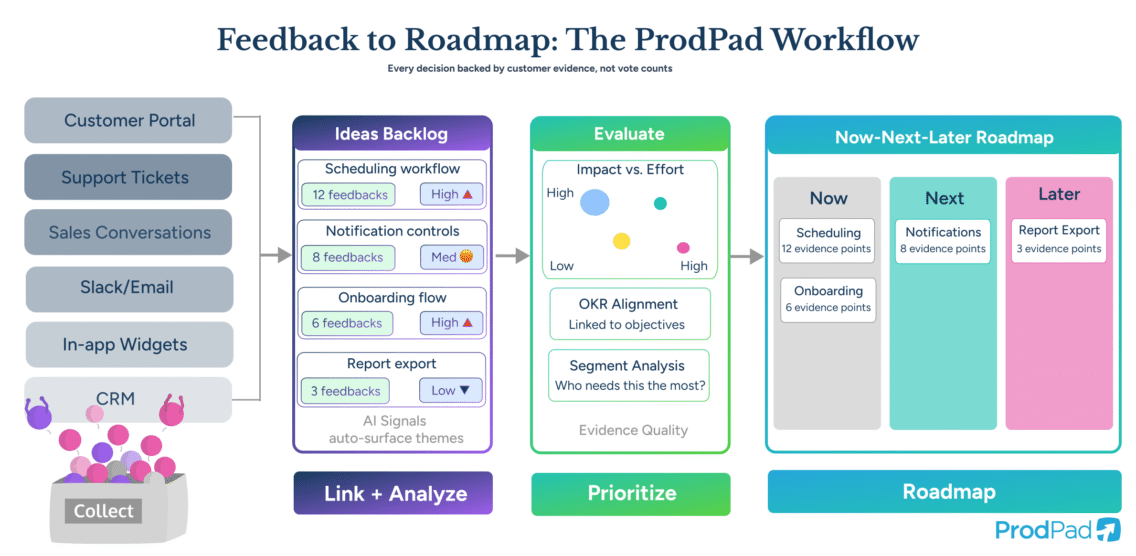
This is the model ProdPad’s feedback management system is built around. Feedback flows in from multiple channels (email, Slack, Intercom, Salesforce, in-app widgets), gets linked to specific ideas, and the accumulated evidence for each idea becomes visible alongside impact/effort scores and strategic alignment. The volume of feedback attached to an idea functions like a demand signal, similar to a vote count, but each individual piece of feedback carries context that a vote never can.
Use evidence-based prioritization
Rather than sorting features by popularity, mature Product teams use prioritization approaches that weigh multiple factors: customer impact, strategic alignment with OKRs, effort required, evidence quality, and revenue implications. ProdPad’s impact vs. effort prioritization provides a visual framework for this, plotting ideas on a chart where the highest-impact, lowest-effort items surface naturally.
Itamar Gilad, creator of the GIST framework and author of Evidence-Guided, advocates for replacing opinion-based prioritization with evidence-based approaches that evaluate ideas based on supporting data, not gut feelings or crowd preferences. In this model, the question is not “how many people voted for this?” but “how strong is the evidence that this will move the needle on the outcome we care about?”
Close the loop on feedback
One of the strongest arguments for voting boards is that they let customers see what happened with their input. That transparency is genuinely valuable, but it does not require votes. Closing the customer feedback loop means proactively communicating back to customers when their feedback leads to a shipped feature, a planned initiative, or a deliberate decision not to pursue something. In ProdPad, this is a one-click action: when an idea ships, every customer who submitted feedback linked to that idea can be notified directly. The feedback loop closes without anyone ever needing to cast a vote.
Separate discovery from delivery
Feature voting typically happens in a context where the lines between “what to build” and “when to build it” are blurred. Customers vote on features they want delivered, which conflates strategic discovery (identifying the right problems to solve) with execution planning (sequencing work for development). Mature Product teams separate these concerns by keeping discovery work (feedback analysis, opportunity mapping, experimentation) upstream of delivery planning. ProdPad is designed to operate as the strategic hub where discovery happens, with Jira or similar tools handling downstream execution. This separation ensures that the question “what should we build?” is answered through evidence and strategy, not through a leaderboard of customer votes.
17 evidence-based prioritization frameworks that replace vote counting with real decision-making
How ProdPad Approaches Feature Voting Differently
Most feature voting tools follow the same basic pattern: collect requests, tally votes, sort by popularity. ProdPad was built around a fundamentally different philosophy. Understanding that difference clarifies what a feedback-driven product practice actually looks like in a purpose-built tool.
Feedback as evidence, not as votes
Rather than building a voting portal, ProdPad treats every piece of customer feedback as evidence that connects to ideas in the product backlog. Feedback flows in from multiple channels (email, Slack, Intercom, Salesforce, in-app widgets, customer portals) and gets linked directly to the ideas it relates to. The accumulated evidence for each idea becomes visible alongside impact/effort scores, strategic alignment with OKRs, and workflow status. The system does not ask “how many people want this?” but rather “what does the accumulated evidence tell us about which problems are most worth solving?”
Customer portals without popularity bias
ProdPad does offer customer-facing feedback portals, but they work differently from voting boards. Customers can browse ideas and submit their perspective, but they do not see vote counts or popularity rankings. This eliminates the bandwagon effect that distorts public voting boards. Every customer who provides feedback is contributing independent evidence, not piling onto a leaderboard. And because each piece of feedback is linked to a customer record, Product Managers can segment by account value, plan tier, or customer type when evaluating demand.
Connected workflow from feedback to roadmap
The real limitation of standalone voting tools is disconnection. Votes accumulate in one place, roadmap planning happens in another, and the link between “customers want this” and “here’s why we’re building it” exists only in the Product Manager’s head. ProdPad connects the full chain: feedback links to ideas, ideas link to initiatives on the Now-Next-Later roadmap, and initiatives link to strategic objectives. When a feature ships, every customer who submitted related feedback can be notified with a single click. The feedback loop closes automatically, without anyone ever needing to check a voting leaderboard.
The choice comes down to what a team actually needs. If the primary goal is basic demand sensing, a lightweight voting tool may suffice. If the goal is to build a rigorous, evidence-driven product practice where every decision connects to strategy and customer evidence, ProdPad was purpose-built for that work.
Feature Voting Best Practices (If You Choose to Use It)
For teams that decide feature voting is right for their context, several practices can mitigate the worst risks.
Segment your voters
Track who is voting. A feature that is popular among free-tier users and irrelevant to your highest-value enterprise accounts is a very different signal than one that resonates across all segments. The ability to filter votes by customer tier, plan value, deal stage, or engagement level transforms raw vote counts into something closer to actionable intelligence.
Require context with every vote
A bare upvote tells you nothing useful. Requiring a written comment (even a single sentence explaining why the voter cares about the feature) adds qualitative depth that helps Product Managers distinguish between genuine pain points and casual preferences. ProdPad’s internal voting system enforces this by design, and any team running an external voting board should consider adding a similar requirement.
Treat votes as one input, not the decision
Vote counts belong in the same category as NPS scores, usage data, and support ticket volume: useful directional indicators that require interpretation and context before they should influence a product decision. The moment a team starts sorting their backlog by vote count and building from the top, they have abdicated their responsibility to make strategic product decisions.
Hide vote counts from voters
If your voting tool allows it, consider hiding the running vote totals from other users. This reduces bandwagon effects and social proof bias, encouraging voters to express their genuine preferences rather than piling onto already-popular requests. ProdPad’s approach of showing ideas to customers for feedback without displaying popularity signals is rooted in this principle.
Set expectations about how votes are used
Be transparent with your customers that votes inform but do not determine the roadmap. A brief explanation on the voting board itself (something like “We review all feedback and prioritize based on strategic fit, customer impact, and feasibility, not just vote counts”) goes a long way toward managing expectations and protecting the trust relationship.
See how ProdPad handles voter segmentation, required context, and hidden vote counts in practice.
Where Feature Voting Fits in the Product Management Workflow
Feature voting occupies a narrow but specific place in the broader Product Management process. It sits at the intersection of feedback collection and prioritization, but it is not a substitute for either.
In a mature product practice, feedback collection happens through multiple channels: customer interviews, support tickets, sales conversations, in-app surveys, analytics data, and yes, potentially a voting board. The feedback is then analyzed, patterns are identified, and opportunities are mapped. Prioritization happens downstream, informed by strategic objectives (OKRs), evidence quality, impact/effort analysis, and capacity constraints. A product backlog managed in a tool like ProdPad provides the connective tissue, linking individual pieces of feedback to ideas, ideas to initiatives, and initiatives to strategic goals.
Feature voting, at its best, contributes to the feedback collection stage. It provides a structured channel for users to surface what they care about. At its worst, it short-circuits the entire middle portion of the workflow, jumping from “people want this” directly to “we should build this” without the analysis, discovery, and strategic evaluation that produce good product outcomes.
The products that get built well, the ones that genuinely solve customer problems and advance strategic goals, are rarely the ones that won the popularity contest. They are the ones where Product teams invested in understanding the problem, evaluated multiple possible solutions, tested assumptions through product validation, and made a deliberate, evidence-backed decision about what to build and why.
The Real Risk of Building by Popular Vote
The most consequential problem with feature voting is not any single bias or limitation. It is the cumulative effect of outsourcing product judgment to crowd preference. When a Product team relies heavily on votes to determine what to build, the team gradually loses its ability (and its organizational mandate) to make strategic decisions. Stakeholders point to vote counts as justification. Engineering asks why the top-voted feature has not been built yet. Customers feel entitled to delivery because “everyone voted for it.”
Over time, the product drifts toward whatever its most vocal users happen to want, which is often incremental improvements to existing workflows rather than the kind of innovative, problem-reframing work that creates real competitive advantage. As Janna Bastow wrote in a recent piece on accountability over autonomy, the distinction that matters is between teams that serve as order-takers (building what stakeholders and customers request) versus teams held accountable for outcomes. Feature voting, when it becomes the primary prioritization mechanism, pushes teams firmly toward the order-taker end of that spectrum. The roadmap fills up with what customers asked for, and the team loses the organizational mandate to discover and deliver something better.
The alternative is a product practice grounded in evidence, strategy, and discovery. Feedback from customers is essential, but it should flow through a system designed to preserve context, connect insights to strategic goals, and put Product Managers in a position to make informed decisions. That is the model ProdPad was built to support, and it is why the platform deliberately avoids customer-facing voting portals in favor of a connected feedback-to-roadmap system where every decision is backed by real customer evidence, not just a tally of clicks.
Build products based on evidence, not popularity. Grab our free Product Feedback & Idea Submission Guidelines to help your whole team capture richer insight from day one.

Enjoy a single source of truth for every product idea
Start a free trial and see how easy your Product Management life could be with ProdPad