Product Pricing Strategies: Choosing the Right Approach for You

Choosing a product pricing strategy is one of the highest-leverage decisions a product manager makes. A price that’s too low leaves money on the table. A price that’s too high keeps potential users away. The job is to find the price that captures real value for the business while still feeling fair to the customer.
If you’ve been guilty of pricing your product similarly to your competitors and calling it a day, it’s time to dig deeper into your product pricing strategy.
Pricing strategy lives squarely in the business management world, and any textbook will list dozens of options. This article focuses on pricing strategy from a product manager’s perspective and translates the business theory into practical decisions you can actually make.
For advice on the SaaS pricing question specifically, ProdPad co-founder Janna Bastow’s article goes deeper into the PM-to-PM details:
How to Price a Product – From One Saas PM to Another
What are product pricing strategies?
A product pricing strategy is the overarching plan for how a company prices its products or services. Think of it as the philosophy that dictates how you set your price. It’s the why behind the specific pricing model you choose to run.
Pricing needs thought. Looking at what competitors are charging and pitching your product in the same ballpark is barely a strategy at all. A real pricing strategy considers your positioning, your competitors, your market, and your business goals, then arrives at a price that serves all of them.
There are multiple strategies you can adopt, and you can jump between them based on different factors. A core part of the product strategist role is figuring out which strategy fits where you are right now and where you want to go.
What’s the difference between product pricing strategies and pricing models?
Don’t mix these up. A pricing strategy and a pricing model are not the same thing. If product pricing strategies are the why, then pricing models are the how. They’re the specific methods you adopt when setting up your pricing.
A pricing strategy is conceptual and broad. A pricing model is the specific mechanics. Your pricing strategy feeds into what model you deploy.
Popular pricing models include:
- Freemium pricing: A basic version of the product is free, with revenue coming from users who pay for premium features. Freemium is increasingly paired with the reverse trial.
- Tiered pricing: Different product versions or service levels at varying price points, catering to different customer segments.
- Flat-rate pricing: A single price, either as a one-time purchase or a recurring subscription, for a product that performs a few key functions exceptionally well.
- Usage-based pricing: Customers pay based on how much they use the product (per API call, per token, per seat-hour, per gigabyte). This has become the default for AI products and is increasingly common in mid-market SaaS.
- Hybrid pricing: A base subscription combined with usage-based overage charges. Most enterprise SaaS now uses some version of this.
What are the different product pricing strategies?
There are three main product pricing strategies that most products gravitate toward. These are:
- Competitive based pricing
- Value-based pricing
- Cost-plus pricing
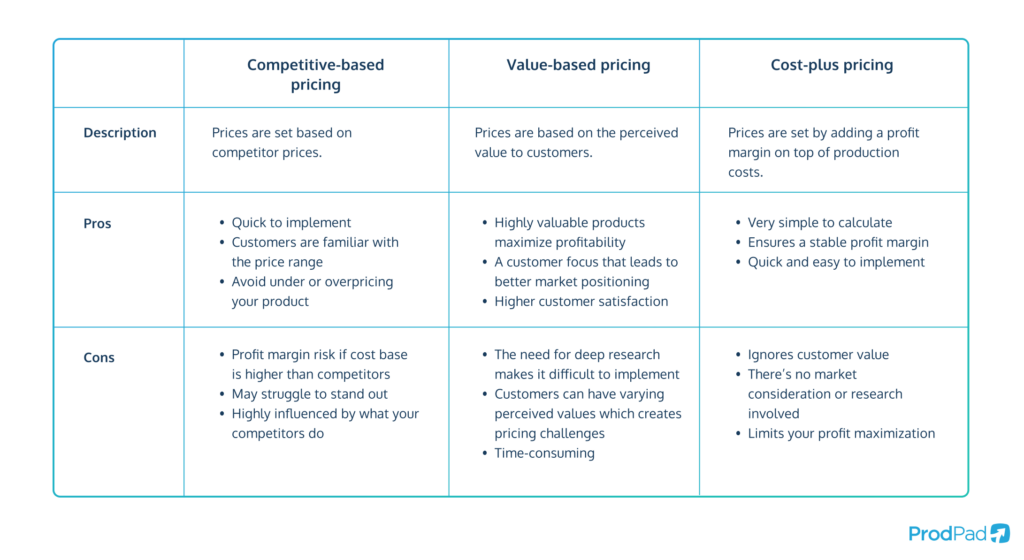
A closer look at each one to help you identify the right fit.
Competitive based product pricing strategies
This strategy is where your price points are most heavily influenced by your competitors. You’re placing more value on the outward market than on your own costs.
Competitive-based pricing works best when you offer similar products or services to your competitors. There are three main approaches within it:
- Lowest cost offering: Position as the cheapest option, undercutting the market. This can be attractive to price-sensitive customers, but it can also erode profit margins. You should have a plan to eventually move customers to a higher-profit option.
- Premium price points: Charge more than competitors to position as a luxury or higher-quality option. This requires a strong brand and a product that genuinely outperforms competitors.
- Price match: Guarantee your product price will match a named competitor. This is risky because your cost base may differ, and it tends to work best if you have multiple products and can subsidize one with another.
The advantages of competitive-based pricing: customers won’t be surprised by what you charge, you’ll be seen as a viable option quickly, and you can piggyback off competitor research without doing as much yourself.
The drawback: you’re heavily reactive to competitors. If they change, you’ll need to react. Your profit is also at risk if your cost base is higher than theirs.
Value-based product pricing strategies
Value-based pricing means setting your price based on how valuable customers perceive your product to be. This requires drilled-in knowledge of your target market. It’s where collecting customer feedback, creating user personas, and willingness-to-pay research come into play.
It’s a tough strategy to get right, which is why many teams opt for alternatives. But it’s also where the biggest profit potential sits.
The mechanics: research your customers, find out what problems your product solves, and quantify the monetary benefit your product creates for them. Use that data to set a price that captures a fair portion of the value you create. Add experimentation, A/B price tests on landing pages, and willingness-to-pay surveys for ongoing refinement.
The main benefit: if you understand the value your product creates, you can charge meaningfully more than cost-plus or competitive approaches would allow. You also build a deeper understanding of your customers, which compounds across product decisions beyond pricing.
The cost: it’s time-intensive. Not all customers will agree on perceived value. Different segments will have different willingness to pay, which often means different prices for different tiers. The research never really ends, because value perception shifts as the market matures.
Value-based pricing is where most product-led SaaS companies eventually land. When a product is genuinely valuable and customers perceive it as such, price sensitivity drops and you can set prices that reflect the impact your product creates rather than the cost to build it.
Which brings us to your cost base.
Cost-plus product pricing strategies
Cost-plus pricing is the easiest to wrap your head around. Decide how much extra you want to charge for your product on top of what it costs you to build it.
For example, if you sold TVs, cost-plus pricing means deciding to sell the TVs for 30% more than it costs to make them. Every item sold delivers a fixed profit margin.
How much extra you charge is a function of how much profit you want to make on each unit, tempered by what the market will bear. Customers won’t pay a gazillion dollars just because you want a gazillion-percent margin. Cost-plus pricing usually needs to be sense-checked against competitive principles to make sure the resulting price is competitive at all.
The hardest part of cost-plus pricing is working out your true cost per unit. Everything that goes into building the product and getting it out the door counts: development, manufacturing, marketing, salaries, office rent, customer support. Miss any of those and you may price your product at a loss.
Cost-plus pricing isn’t right for every product manager. It’s primarily used by teams selling physical products who want to keep things simple. It’s not ideal for maximizing profits. For most SaaS product managers, it’s the wrong strategy, because a better pricing approach factors in customers and competitors, not just internal costs.
Alternative product pricing strategies
The big three cover most use cases, but there are other options worth knowing.One well-known framework is Kotler’s pricing strategies. Philip Kotler’s matrix helps you plot your product based on price and quality, sorting offerings into categories like premium, economy, rip-off, or superb-value. Worth reading if you want the academic foundation
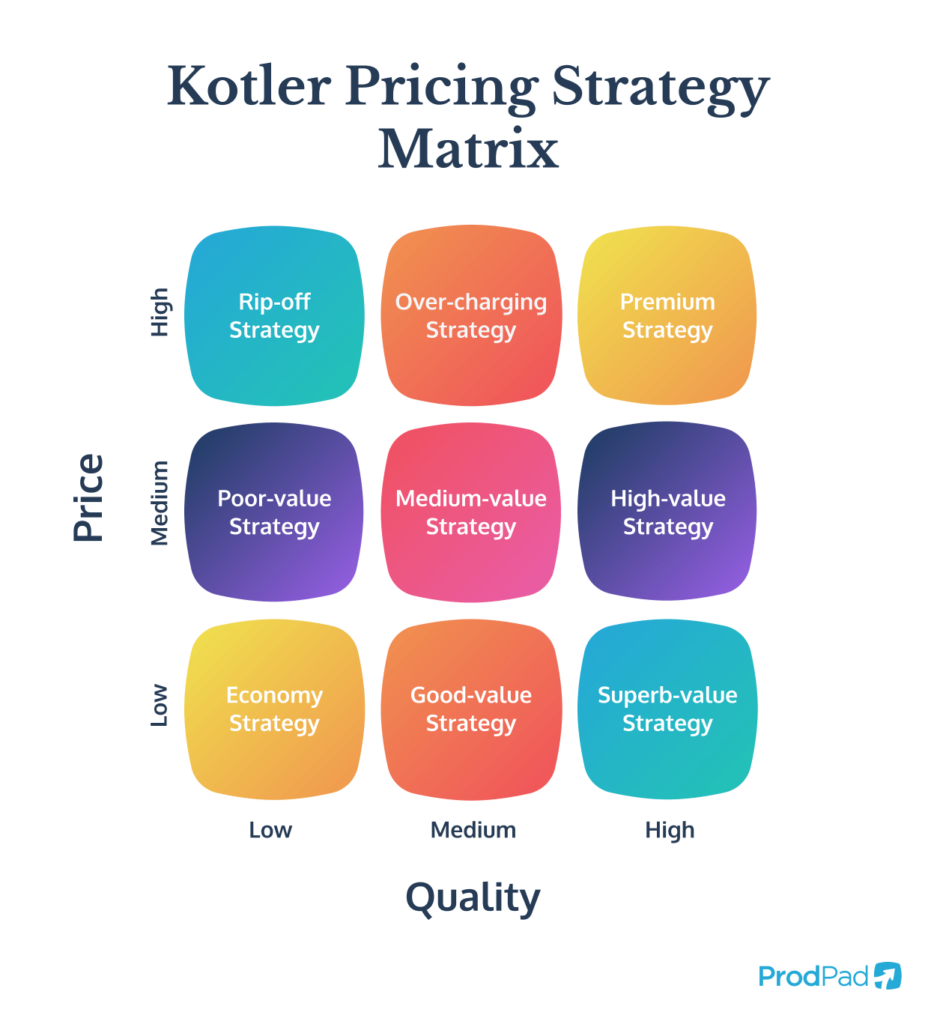
Other options worth considering:
- Dynamic pricing strategies. Adjust the cost to the end customer based on market trends, demand, and other signals. The aim is to maintain a target profit margin by flexing prices in real time. Common in travel, ride-share, and energy.
- Penetration pricing strategies. Break into the market by offering your product at a much lower price than competitors. Can be a short-term stunt or a longer-term play through extended free trials.
- Price skimming strategies. Launch at a high price on the assumption that a small number of early adopters will pay it. Reduce the price gradually as competition arrives and the early-adopter market saturates.
AI-era pricing models
The arrival of generative AI has reshaped how SaaS products think about pricing. The economics of running AI features are fundamentally different from traditional software. Every query has a real marginal cost (compute, tokens, inference). Flat-rate subscription pricing doesn’t capture that cost reliably, so most AI-first products and AI-enabled SaaS have moved toward usage-based or hybrid models.
The main patterns showing up across the market:
Usage-based pricing
The customer pays per unit of consumption: per API call, per token, per generated image, per minute of audio processed. Most foundation model providers (Anthropic, OpenAI, Google) use this approach. The benefit is that pricing scales with value created and with cost incurred. The downside is unpredictable bills for customers, which creates friction in procurement.
Hybrid subscription plus usage
A base subscription covers a defined level of usage, with overages billed separately. This is now the dominant approach in mid-market and enterprise SaaS adding AI features. It gives customers a predictable floor while letting the vendor capture additional revenue from heavy users.
Outcome-based pricing
The customer pays based on the result the product produces (a ticket resolved, a lead qualified, a meeting booked). This is emerging in AI customer service, AI sales tools, and AI support products. It aligns vendor and customer incentives more tightly than usage-based pricing but it requires the vendor to have high confidence in delivering the outcome consistently.
Per-seat with AI as a premium tier
Traditional per-seat SaaS pricing with AI bundled into the higher tier or sold as an add-on. This is what most established SaaS vendors have done as they layer AI features on top of existing products. It’s the easiest model to retrofit but it doesn’t reflect the actual cost of serving the AI features.
The pricing model decision for any product adding AI features comes down to three questions: how much does it cost you to serve the feature, how predictable can the customer’s bill be, and how directly can you measure the outcome the AI delivers? Different answers point to different models.
So which product pricing strategy is the best?
There’s no universal answer. If there were, every company would use the same one. Some strategies make more sense than others in most contexts, with value-based pricing being the general favorite for SaaS. But “what works for most” isn’t “what works for you.”
The best pricing strategy depends on the unique characteristics of your business. One strategy that’s great for a company in adjacent space can be wrong for yours. Things to consider when choosing:
Your business goals
What are your overall business goals? What do you want your product to achieve in the long and short term? If you’re trying to gain market share quickly, penetration pricing may work best. If you’re hoping to maximize profit over the long term, skimming or premium pricing fits better.
Pricing strategy is also dictated by brand positioning. If you want to be seen as a premium option, the pricing strategy needs to back that up. If your goal is to be the default low-cost option, your pricing should reflect that too.
Looking to better define your business goals? We’ve got you covered with the ultimate collection of ready-made OKRs to boost your goal-setting. Download below 👇
Your market and competition
To nail the right product pricing strategy, you need a good grasp of market demand. In a highly competitive space with multiple alternatives for customers, you’ll benefit from a competition-based pricing strategy.
Researching what competitors charge is part of the work regardless of which strategy you choose. It anchors your decision-making to industry standards and lets you decide whether to match, exceed, or undercut based on your value proposition.
Your customers
Your audience and the segments that make up your user base will heavily dictate which pricing strategy fits. Different customer types value different things and have different willingness to pay. This makes value-based pricing effective when you understand each segment’s pricing tolerance deeply.
That said, if customer research reveals that your users are highly sensitive to price changes, other strategies may serve you better. The point is to make the choice based on evidence rather than guesswork.
Your cost structure
When choosing your product pricing strategy, always keep an eye on costs. Your strategy needs to cover expenses and still deliver a profit. Depending on your cost structure, you may not be suited to economic pricing strategies, which can drag margins down.
To make sure cost is factored in, you can always overlay cost-plus principles on top of a value-based strategy to set a minimum margin floor.
Your competitive advantage
Have something unique your competitors can’t match? That opens you up to value-based pricing, where you charge a premium because your product genuinely outperforms competitors. A Unique Selling Point (USP) gives you more freedom over pricing strategy.
If you’re an established business with strong brand loyalty, you’re in a stronger position to sustain a premium pricing strategy over time.
When should you change your product pricing strategy?
Many product managers fall into the trap of not experimenting with pricing often enough. Companies frequently leave pricing untouched for years, while the market, product, and customer base all evolve underneath. SaaS pricing expert Patrick Campbell (founder of ProfitWell, later acquired by Paddle) has long argued that prices should be revisited every six months, not every three years.
Changing your pricing feels scary because the consequences are visible immediately. But product managers iterate on every other part of the product constantly. Pricing deserves the same treatment.
Iterations don’t have to be large. Big changes are disruptive, especially for customers on tiered plans who don’t want prices that flex with the seasons. Small, additive changes work better: introduce a new tier and migrate willing customers, add a related plan with a slightly higher value metric and price, or change the inclusions at each tier rather than the headline price. This little-by-little approach to evolving pricing keeps the strategy fresh without destabilizing existing customers.
What if I don’t want to change my product pricing strategy that often?
If you’re set against making regular changes, watch for the signals that force a switch.
The obvious ones first. If your bills and expenses increase and your profit line falls, it’s time to think about changes. Track customer churn to see if pricing is the reason customers leave. If competitors charge prices that no longer align with yours, you’ll need to update.
A less obvious signal: customers signing up without any pushback. If your product is selling rapidly and customers accept your pricing without question, you may be charging too little. Your value proposition is exceeding the price you’re charging, which leaves money on the table.
Imagine a popular band selling tour tickets that sold out in ten minutes. On the surface, that looks like a win. But it likely means the tickets were underpriced.
The right pricing strategy puts most customers in a position where they’re just about willing to pay. You don’t want to be in a situation where no one is buying. You also don’t want them buying without consideration. Some pushback on price while maintaining consistent customer acquisition is the healthy zone.
How should you implement new product pricing strategies?
A change in pricing can be difficult to oversee. Rushing it upsets existing customers. The right way:
Communicate the change effectively
When changing your prices, make sure everyone knows what’s happening. Open communication with current customers so they’re not surprised. Don’t apologize for a price change. Treat it as an opportunity. If you’re adding a new pricier tier, position it as the option for customers who need more, and let them choose. Transparency is what builds trust through the change.
Don’t forget internal communication. Sales and Marketing need to be aligned so they’re not quoting old, outdated prices or models. Keep all stakeholders informed of changes and the reasoning behind them.
Monitor and adjust
When you change your pricing strategy, don’t feel like you have to stick it out if it’s not working. You’re free to tweak or revert if that’s the best thing for your product. Track performance after the change, looking at metrics like user activation, conversion rate, and revenue per account to see if there’s a dip to address. Pair these with the KPIs you set out in your product strategy.
Need KPIs for your product? Download the list to use or steal from.
Get customer feedback
When you change prices, maintain your customer feedback loop so the insight can guide further changes and innovation. Actively ask customers what they think of the new pricing. Do they think it’s fair? Do they prefer the new model? This makes sure you’re making the right changes for users.
Prepare for pushback
A significant change to your pricing strategy and model may produce resistance from customers. Going from a one-off payment to a subscription-based model is jarring and will cause dissatisfaction in some segments.
Have a plan to address objections. Offer discounts or promotions to ease customers into the new model. Grandfather long-standing customers if needed.
Customers aren’t the only group that may react. Competitors may respond to your new pricing strategy, which could force further changes down the road to stay competitive. Watch the market.
What happens if you get your product pricing strategy wrong?
Getting product pricing strategy wrong rarely ruins a company outright. If you notice early enough, you can adjust and recover. But there are real consequences worth understanding.
The biggest issue is leaving money on the table. If your pricing is too low and people are snapping up your product, you’re missing out on revenue that could have been captured. If you go too high, you put potential customers off entirely.
Both scenarios produce a lower-than-necessary profit margin, which can become dangerous if not corrected quickly.
Getting pricing wrong also affects how the market perceives you. If you’re undercutting competitors with constant sales and discounts, you can dilute the value of your brand. Customers may start to see your product as low quality even if it isn’t, which corners you on positioning. No one buys that you’re a premium option if they’ve built a different perception in their head.
If you want to dig deeper into product positioning, the webinar with April Dunford covers it expertly:Getting product pricing strategy wrong rarely ruins a company outright. If you notice early enough, you can adjust and recover. But there are real consequences worth understanding.
The biggest issue is leaving money on the table. If your pricing is too low and people are snapping up your product, you’re missing out on revenue that could have been captured. If you go too high, you put potential customers off entirely.
Both scenarios produce a lower-than-necessary profit margin, which can become dangerous if not corrected quickly.
Getting pricing wrong also affects how the market perceives you. If you’re undercutting competitors with constant sales and discounts, you can dilute the value of your brand. Customers may start to see your product as low quality even if it isn’t, which corners you on positioning. No one buys that you’re a premium option if they’ve built a different perception in their head.
If you want to dig deeper into product positioning, the webinar with April Dunford covers it expertly:
[WEBINAR] The Secret to Product Positioning with April Dunford
A poor pricing strategy is a missed opportunity. You sacrifice potential income and give up customers to competitors who would have loved your product. The longer it goes uncorrected, the more it compounds.
Pricing is one of the few PM decisions you can revisit every month
The pricing strategy you launch with isn’t the pricing strategy you’ll end on. The companies that get pricing right treat it as an ongoing discipline, not a one-time decision. They run small experiments, watch the metrics, and adjust before the gap between price and value becomes a problem.
Whether you’re using competitive-based, value-based, cost-plus, or one of the AI-era usage models, the work is the same: keep testing, keep listening, keep tweaking. Pair that with a tool that lets you connect customer feedback directly to product decisions and you’ll have the evidence base to defend every pricing call you make.With ProdPad, you can manage your entire product roadmap in the Now-Next-Later framework, track customer feedback, and surface the recurring themes that point to where your value (and your pricing) really lives.
Try ProdPad for free, no credit card needed.
This artical of unpacking the complexity behind product pricing strategies. I appreciate how it breaks down the differences between pricing strategy and pricing model—a distinction that’s often overlooked. The analogy to Goldilocks was spot on, and the advice about not just copying competitors’ prices is a critical reminder. I found the section on value-based pricing particularly insightful, especially how it highlights the importance of understanding customer perception. Also, the encouragement to experiment with pricing more frequently—rather than waiting years—is both practical and often underutilized.