Scrum Master

What Is a Scrum Master? Role, Responsibilities, and Where It Fits in Product
The Scrum Master is one of the most widely held titles in software teams. It is also one of the most poorly defined. The role gets handed to project managers looking for a rebrand. Or to senior developers who happen to be organized, or delivery leads who already run the standups. In each case the title sticks but the accountability shifts. The team ends up with a meeting scheduler or a status chaser rather than a coach. Understanding what a Scrum Master is actually accountable for matters for Product Managers. The quality of that role shapes how well a Scrum team turns strategy into shipped, learned-from work.
What Is a Scrum Master?
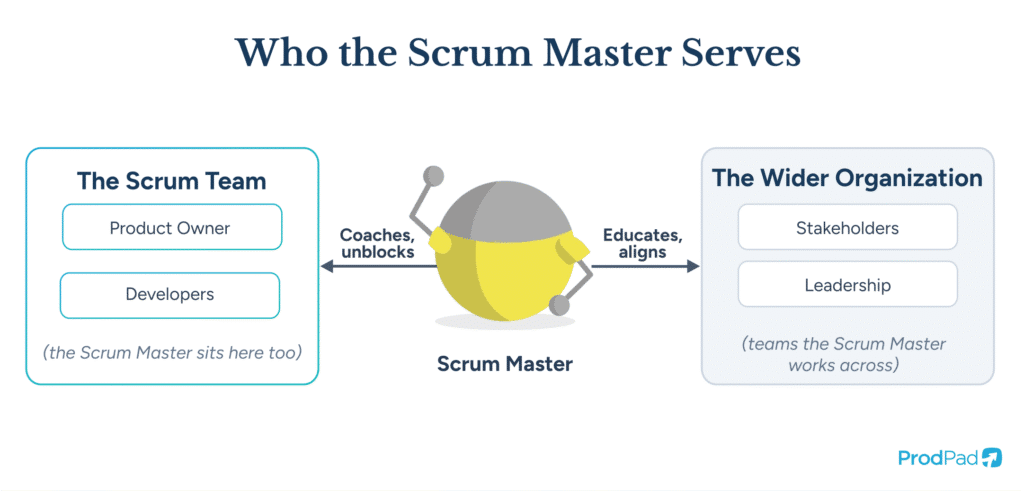
A Scrum Master is the person accountable for a Scrum Team’s effectiveness. They coach the team on Scrum, facilitate its events, and remove the impediments that slow delivery. The role is one of service and influence rather than authority, which is why it is so often misunderstood.
The 2020 Scrum Guide frames the role as a “true leader who serves the Scrum Team and the larger organization.” That phrasing is deliberate. A Scrum Master holds no positional power over the team. They cannot assign tasks, set priorities, or make product decisions. Their influence comes from coaching, facilitation, and the credibility they build by helping the team work better.
This is the source of most confusion about the role. People expect leadership to look like control, and the Scrum Master role offers none. A good Scrum Master spends their time creating the conditions for a team to self-manage. That means protecting focus, surfacing problems early, and improving how the team works together. It also means clearing the organizational obstacles the team cannot clear on its own. When that work is done well, the role can look almost invisible. That is part of why it is so easily cut or diluted when budgets tighten.
What Does a Scrum Master Actually Do?
The day-to-day work of a Scrum Master spreads across the team, the product, and the wider organization. Scrum groups them loosely. In practice they fall into four areas that any Product Manager working alongside a Scrum Master should recognize.
Facilitating Scrum Events
The Scrum Master makes sure the team’s events happen, stay useful, and finish on time. That includes Sprint Planning, the Daily Scrum, the Sprint Review, and the Sprint Retrospective. Facilitation here means more than booking the meeting. A strong Scrum Master shapes the conversation so the team reaches a real decision, draws out quieter voices, and stops a planning session from collapsing into a task-assignment exercise. When events become routine and lifeless, that is usually a facilitation problem the Scrum Master is responsible for fixing.
Removing Impediments
An impediment is anything slowing the team down that the team cannot resolve alone. It might be a flaky test environment or a dependency on another team. It could be a slow approval process, or a stakeholder who keeps interrupting the sprint with urgent requests. The Scrum Master’s job is to surface these blockers and chase them down. That often means working across the organization rather than within the team. The measure of this work is simple. The team spends more of its time building and less of its time waiting.
Coaching the Team on Self-Management
Scrum depends on a team that manages its own work. The Scrum Master coaches the team toward that self-management. That means helping it hold itself accountable, improve its estimates, and own its commitments. This is patient, ongoing work. A team does not become self-managing because someone tells it to. It gets there through repeated cycles of trying, reflecting in the retrospective, and adjusting. The Scrum Master coaches the process rather than directing the outcome.
Serving the Organization
The Scrum Master also works outside the team, helping the wider organization understand how to work with a Scrum team. That can mean educating stakeholders on why the team protects its sprint. It can mean helping leadership set realistic expectations. It can also mean pushing back when the organization treats velocity as a performance target. This part of the role is the easiest to skip and the most valuable when done well. Most of a team’s biggest impediments live outside the team.
A Scrum Master keeps the team moving, but movement without direction is just motion. ProdPad gives Scrum teams the strategic context that Scrum itself leaves out, connecting goals, customer feedback, and roadmap initiatives to the work in the sprint.
What Skills Does a Good Scrum Master Need?
The Scrum Master role rewards a specific blend of soft skills and systems thinking. The technical depth of a senior engineer is useful but not essential. What matters far more is the ability to influence without authority and to see the patterns in how a team works.
Facilitation
Good facilitation keeps a group of smart, opinionated people moving toward a decision without flattening the discussion. A skilled Scrum Master can run a retrospective that surfaces real friction, manage a planning session that ends with a clear Sprint Goal, and keep a Daily Scrum to fifteen focused minutes. Facilitation is a learnable craft, and it is the single most visible skill the role demands.
Coaching
Coaching is the difference between solving a problem for the team and helping the team solve it themselves. A Scrum Master who fixes every issue personally creates dependency. One who coaches builds a team that needs them less over time. This means asking questions, holding space for the team to work things out, and resisting the pull to step in and direct.
Conflict Navigation
Teams under delivery pressure generate friction: disagreements over scope, tension between Engineering and the Product Owner, frustration with dependencies. The Scrum Master helps the team work through that friction productively rather than letting it calcify into resentment or silence. This is uncomfortable work that many people in the role avoid, which is why teams with an absent Scrum Master often carry unresolved tension for months.
Systems Thinking
The best Scrum Masters diagnose problems at the level of the system, not the individual. When a team consistently misses its Sprint Goal, a weak Scrum Master looks for someone to blame. A strong one looks at the incentives, the dependencies, the quality of the backlog, and the way work flows into the team. Most chronic delivery problems are structural, and the Scrum Master is positioned to see and address that structure.
Scrum Master vs Product Owner and Product Manager: What Is the Difference?
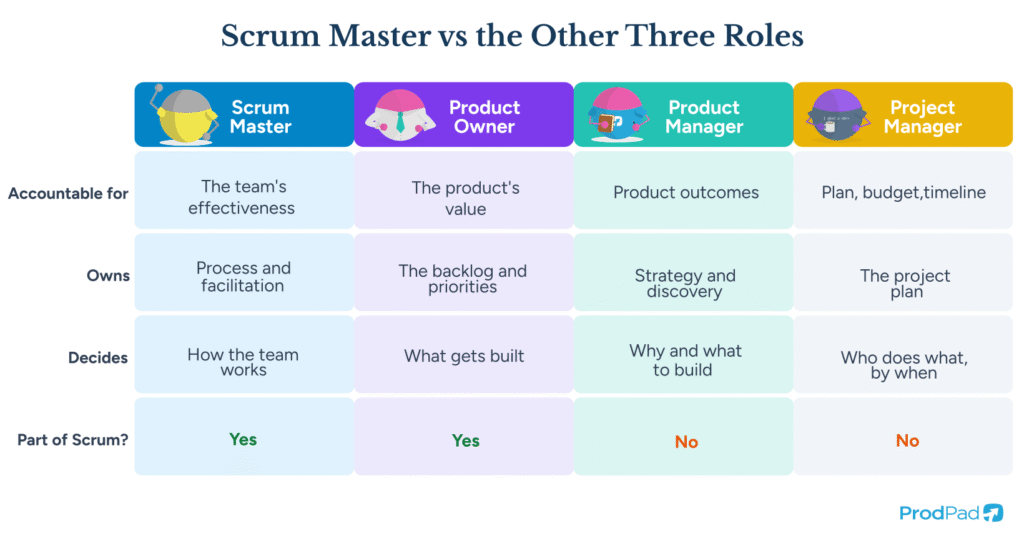
The Scrum Master is frequently confused with the two roles closest to it in product work: the Product Owner, who sits inside the same Scrum Team, and the Product Manager, who usually sits outside it. Keeping all three straight matters because each owns something the others do not.
The Product Owner is accountable for the value of the product within the Scrum Team. They own the Product Backlog, set the priorities, represent the customer and the business, and decide what the team builds. The Scrum Master is accountable for how effectively the team works. They own the process, the facilitation, and the removal of impediments, and they have no say over what gets built. A simple way to hold the two apart: the Product Owner is responsible for building the right thing, and the Scrum Master is responsible for the team building things right.
The Product Manager is a wider role that usually lives outside the Scrum framework entirely. The Product Manager owns product strategy, discovery, and the outcomes the product is meant to drive, often across several teams. Scrum does not define a Product Manager, which is part of why the boundary blurs. In many organizations the Product Manager also carries the Product Owner accountability, wearing both hats at once, while the Scrum Master stays focused on the team. The way the Product Owner and Product Manager roles overlap adds another layer of nuance, and our breakdown of how the Product Owner and Product Manager roles differ is worth reading separately, since how those roles are split shapes how much strategic context reaches the Scrum team at all.
When the same person holds more than one of these accountabilities, the strain shows up quickly. A Product Manager doubling as Scrum Master has to coach the team’s process and steer the product’s direction at the same time, and the two pulls compete for attention. Smaller organizations often combine the roles out of necessity, and naming which accountability is active in a given moment keeps the team from losing either the strategy or the facilitation.
Scrum Master vs Project Manager: Why the Distinction Matters
The Scrum Master is often mistaken for an agile-flavored project manager, and the mistake causes real damage. The two roles operate on opposite assumptions about how work gets done.
A project manager owns a plan, a budget, and a timeline, and drives the team toward delivering against them. The role carries authority: a project manager assigns work, tracks progress against a baseline, and is accountable for hitting a defined scope by a defined date. The Scrum Master carries none of that. They do not own the plan, do not assign work, and are not accountable for delivering a fixed scope by a fixed date. Their accountability is the team’s effectiveness and its adherence to Scrum.
When an organization hands a former project manager the Scrum Master title without changing the underlying expectations, the team gets the worst of both worlds. The Scrum Master starts assigning tasks, tracking individual output, and treating the sprint as a mini-project plan to be defended. Self-management evaporates because the team no longer owns its own work. This is one of the most common ways Scrum quietly reverts to command-and-control delivery while keeping the agile vocabulary intact. The titles change, the habits do not, and the team feels the contradiction even when nobody names it.
What Are the Most Common Scrum Master Anti-Patterns?
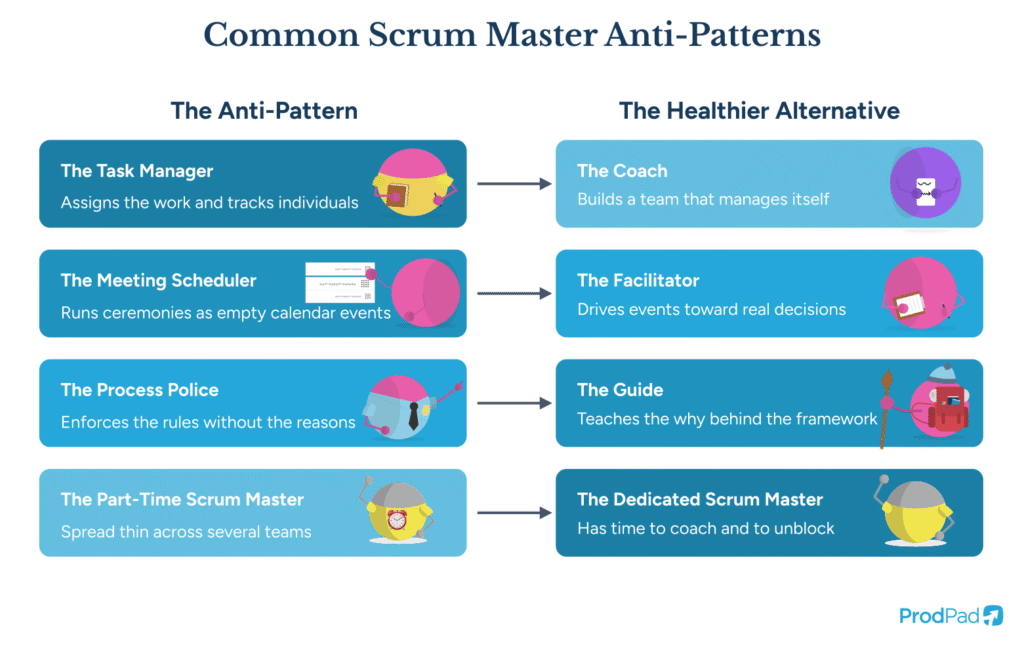
Scrum Master problems are rarely about a person being bad at their job. They are usually about an organization holding the wrong expectations of the role, then rewarding the wrong behavior. These anti-patterns show up across teams of every size.
The Scrum Master as Task Manager
The Scrum Master starts assigning work, tracking who is doing what, and holding individuals accountable for tasks. This pulls authority away from the team and undermines the self-management Scrum depends on. The team stops owning its plan because someone else is managing it.
The Scrum Master as Meeting Scheduler
The role gets reduced to running the ceremonies on a calendar. The events happen on time, but they are hollow. Planning produces a task list with no Sprint Goal, the retrospective generates action items nobody revisits, and the Daily Scrum becomes a status update to the Scrum Master rather than a planning conversation among the team. The form survives and the function disappears.
The Scrum Master as Process Police
The Scrum Master enforces Scrum to the letter and treats any deviation as a failure. Teams under a process-police Scrum Master follow the rules without understanding the reasons, which is exactly the rigidity Scrum was designed to avoid. The framework becomes a compliance exercise instead of a tool for learning.
The Part-Time or Shared Scrum Master
The role is split across several teams or bolted onto someone’s existing job. A part-time Scrum Master can keep the events running, but they rarely have the time to do the deeper work: coaching self-management, navigating conflict, and chasing down the organizational impediments that take persistence to clear. The visible parts of the role get done, and the high-value parts get dropped.
How Do You Become a Scrum Master?
There is no single qualification that makes someone a Scrum Master, but two certification bodies dominate the field and most hiring managers recognize their credentials.
The Scrum Alliance offers the Certified ScrumMaster (CSM) path, which starts with a two-day course and an exam, then progresses through Advanced and Professional levels. Scrum.org offers the Professional Scrum Master (PSM) path, with PSM I, II, and III exams that can be taken without a mandatory course. Both are credible, and the choice between them matters less than the depth of understanding behind the certificate. A certification proves familiarity with the framework. It does not prove the facilitation, coaching, and systems-thinking skills the role actually depends on.
In practice, most effective Scrum Masters reach the role through experience rather than a certificate alone. They have worked on agile teams, watched what makes delivery flow and what stalls it, and developed the judgment to coach a team through both. Certification gives you the vocabulary and the structure. The harder skills come from doing the work, reflecting on it, and improving, which is the same loop the role is meant to instill in a team.
Where Does the Scrum Master Fit in Product Management?
The Scrum Master operates inside the delivery system, and the delivery system is only one part of how products get built. Scrum gives a team a cadence for building and inspecting work. It says almost nothing about strategy, discovery, or whether the work shipped actually moved a meaningful metric. A great Scrum Master keeps the delivery engine running smoothly, but a smooth engine pointed in the wrong direction still wastes the trip.
This is where the limits of the role become clear. A Scrum Master can run flawless sprints while the team builds the wrong things efficiently. The framework has no built-in mechanism for continuous product discovery, no requirement to validate assumptions before development, and no way to tie a sprint to a business outcome. Those practices have to be layered on by the Product Manager and the Product Owner, supported by tooling that holds strategy and delivery in the same place.
Tools shape behavior. When the only tool a team uses is a sprint board, the team optimizes for clearing tickets, and the Scrum Master ends up coaching a faster production line. When the team also has a strategic roadmap connected to OKRs, a structured discovery process, and a way to measure outcomes, the Scrum Master’s work compounds into something that matters. ProdPad sits upstream of the sprint, holding the strategy, goals, and validated ideas that feed the backlog, and it connects to delivery tools through a two-way Jira integration so the context survives the handoff. The Scrum Master keeps the team effective; the system around them makes sure that effectiveness adds up to outcomes.
Strong Sprint Goals start with clear product objectives, and that is exactly what a good Scrum Master helps the team hold onto. Download our Ultimate Collection of Product OKR Examples to give your goal-setting a head start.
Roman Pichler, a product strategy and leadership expert, has written extensively about how agile roles fail when they are stripped of strategic context. The same logic applies to the Scrum Master. A team with a brilliant Scrum Master and no strategic direction will deliver smoothly and learn nothing. The Now-Next-Later roadmap was built to give teams that direction without forcing them back into the fixed-date timelines that Scrum’s flexibility is supposed to escape.
Your Scrum team’s cadence deserves a roadmap that keeps up with it. Learn why timeline roadmaps break down in agile environments and how to replace them in our Ditch the Timeline Roadmap guide.
Why the Best Scrum Masters Think in Outcomes
The strongest Scrum Masters understand that their job is not finished when the sprint is delivered. They coach the team to ask whether the work mattered, not just whether it shipped. They help the Product Owner protect time for discovery. When the organization measures the team on velocity, they push back. And they use the retrospective to push the team toward work that moves the business, not just faster delivery.
That kind of Scrum Master is rare because most organizations never ask for it. They hire for the ceremonies, reward the on-time delivery, and quietly let the deeper coaching slide. Teams that get the most from the role share one trait. They pair a skilled Scrum Master with a system that keeps strategy, discovery, and outcomes visible alongside the sprint. The framework gives you the rhythm. A Scrum Master keeps that rhythm honest. The strategy around them decides whether any of it was worth playing.
See how a strategy-first setup keeps your Scrum team focused on outcomes. Try the ProdPad sandbox, a pre-loaded environment where you can see outcome-based roadmapping connected to delivery.