Key Performance Indicator (KPI)

Every Product Manager has, at some point, stared at a dashboard full of numbers and struggled to figure out which ones actually matter. Metrics are cheap. Data is everywhere. Analytics tools will happily serve up dozens of charts, graphs, and trend lines for any product. The challenge has never been about access to data. It has always been about knowing which numbers represent genuine signals of product health, and which ones are just noise dressed up in a nice visualization.
A key performance indicator (KPI) is supposed to solve that problem. It is the metric (or small set of metrics) that a product team agrees to treat as the most important measure of whether the product is succeeding. But the gap between what a key performance indicator should do and how most teams actually use them is enormous. KPIs get misused, over-counted, and disconnected from strategy so often that many product leaders have become cynical about the whole concept.
That cynicism is misplaced. The problem is rarely with the idea of a key performance indicator itself. The problem is usually with how teams select, frame, and act on them.
What is a Key Performance Indicator (KPI)?
A key performance indicator (KPI) is a quantifiable metric deliberately chosen to evaluate performance against a defined business or product objective. KPIs are distinguished from general metrics by their connection to a specific objective and the expectation that movements in the number will prompt investigation and action, not just passive monitoring.
That definition is worth unpacking further. The word “key” is doing important work. There are hundreds of metrics a product team could track, from page load times to daily active users to support ticket volume. A key performance indicator is distinguished by the fact that it has been deliberately chosen as a priority measure. It is connected to a specific objective. It is reviewed regularly. And movements in the metric are expected to prompt action or investigation.
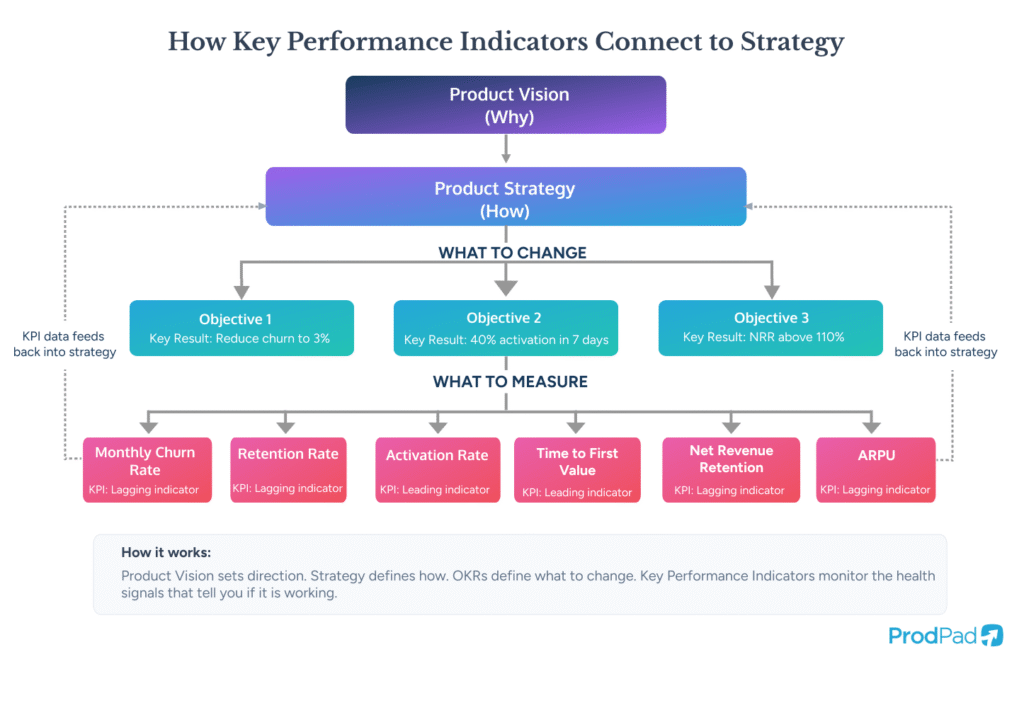
This differs from general metrics, which might be tracked passively or monitored in the background. A key performance indicator sits at the center of how a team understands whether the product is heading in the right direction.The connection to objectives is critical. A key performance indicator without a clear objective behind it is just a number. And a number without context can lead a team anywhere, including in circles. This is why the relationship between KPIs and OKRs (Objectives and Key Results) matters so much in modern Product Management.
How do Key Performance Indicators relate to OKRs?
The relationship between key performance indicators and OKRs is one of the most commonly confused areas in Product Management. Teams frequently treat them as interchangeable, and that confusion leads to poorly structured goals, redundant measurement, and wasted effort.
Ant Murphy, a product coach and practitioner, frames the distinction clearly in his breakdown of how KPIs and OKRs serve different roles: KPIs are measures of health, while OKRs are about things you want to change. A key performance indicator tracks how a system is performing on an ongoing basis. An OKR defines a specific improvement you want to achieve over a defined period and measures progress toward that improvement through key results.
Consider a SaaS product team tracking monthly churn rate as a key performance indicator. That number gets monitored every month, quarter after quarter. It represents the ongoing health of customer retention. If the churn rate starts climbing, the team might create an OKR to address it: “Reduce monthly churn from 5% to 3.5% by end of Q3.” The churn rate is still a KPI. The OKR defines the specific change the team is committing to pursue.
This means a lagging key performance indicator can trigger the creation of an OKR. And the key results within that OKR often reference KPIs as the measurement mechanism. The two systems work together, with KPIs acting as the monitoring layer and OKRs acting as the action layer.
ProdPad, as a product management tool, supports both OKR tracking and outcome-based roadmapping, making it possible to connect the key performance indicators you monitor with the strategic objectives driving your product roadmap.
Where this relationship breaks down is when teams treat every key performance indicator as an OKR or set OKRs without anchoring them in observable KPI data. The result is either a bloated goal-setting process or goals that lack grounding in real product performance.
Want to connect your KPIs to a proper goal-setting framework? ProdPad’s free OKR course covers how OKRs, KPIs, and roadmaps work together.
What types of Key Performance Indicators do product teams track?
Key performance indicators in Product Management tend to cluster around a few core categories. The exact metrics vary depending on the product, business model, and stage of growth, but the categories remain consistent.
Product usage and engagement KPIs
These key performance indicators measure how customers interact with the product. Common examples include daily active users (DAU), monthly active users (MAU), session duration, feature adoption rates, and activation rates. For product teams, engagement KPIs provide the clearest window into whether the product is delivering value in practice, rather than just in theory.
Activation rate, in particular, is one of the most important key performance indicators for SaaS products. It measures how quickly and effectively new users reach the “aha moment” where they experience real value. A low activation rate often signals onboarding friction, a misalignment between marketing promises and product reality, or a confusing initial experience.
Retention and churn KPIs
Retention rate and churn rate are two sides of the same coin, and both are critical key performance indicators for any subscription or recurring-revenue product. Retention tracks the percentage of customers who continue using the product over a given period. Churn tracks the percentage who leave.
These KPIs matter because acquiring a new customer is significantly more expensive than retaining an existing one. Product teams that focus exclusively on acquisition metrics (new signups, trial starts) without watching retention are building on sand.
Revenue and financial KPIs
For Product Managers, revenue-oriented key performance indicators include monthly recurring revenue (MRR), annual recurring revenue (ARR), average revenue per user (ARPU), customer lifetime value (LTV), and customer acquisition cost (CAC). The ratio between LTV and CAC is particularly telling. A product where LTV is three or more times CAC is generally considered healthy.
These financial key performance indicators connect product work directly to business outcomes, which is important for earning and maintaining executive trust and investment in the product function.
Customer satisfaction KPIs
Net Promoter Score (NPS), Customer Satisfaction Score (CSAT), and Customer Effort Score (CES) are all key performance indicators that gauge how customers feel about the product experience. Each captures a slightly different dimension. NPS measures willingness to recommend. CSAT measures satisfaction with a specific interaction. CES measures how easy it was to accomplish a task.
The risk with satisfaction KPIs is treating them as standalone measures of success. A high NPS score paired with rising churn is a warning sign, not a trophy. Satisfaction metrics are most valuable when cross-referenced with behavioral data like retention and feature adoption.
Process and velocity KPIs
Some key performance indicators measure the health of the product development process itself. Cycle time, lead time, deployment frequency, and defect rates fall into this category. These metrics help teams understand how efficiently they are shipping work and how reliably they are delivering quality.
The danger here is well documented: when process KPIs become targets in themselves, teams optimize for speed of output rather than quality of outcomes. Measuring how fast you ship is useful. Using it as the primary success metric for a Product Team creates perverse incentives. The gap between “we shipped a lot” and “we moved the numbers that matter” is where most product organizations lose their way.
How do you choose the right Key Performance Indicators?
Choosing key performance indicators is one of the most consequential decisions a product team makes, and most teams get it wrong in predictable ways.
Start with strategy, not with available data
The most common mistake is choosing key performance indicators based on what is easy to measure rather than what matters. Analytics tools surface dozens of metrics by default. If the team starts there and works backward to find significance, they end up tracking numbers that describe activity without illuminating outcomes.
The better approach starts with the product strategy and its associated objectives. Each objective should have a small number of key performance indicators that would indicate progress or regression. The question to ask is: “If this number moves, does it tell us something meaningful about whether our strategy is working?” If the answer is no, the metric should be monitored passively at best.
Keep the number small
There is no universally agreed number, but most experienced product leaders settle on somewhere between three and seven key performance indicators per product or product area. Fewer than three risks blind spots. More than seven means nothing is really “key” anymore.
John Doerr, who brought OKRs to Google from Intel, has repeatedly emphasized the discipline of focus. The same principle applies to key performance indicators: if everything is a priority, nothing is.
Ensure KPIs are actionable
A key performance indicator needs to change in response to actions the product team takes. If a metric fluctuates based entirely on external forces (macroeconomic conditions, competitor pricing, seasonal trends) and the team has no lever to influence it, tracking it as a KPI creates frustration rather than insight.
John Cutler, writing on the Amplitude blog about vanity metrics and the actionability test, observes that teams tend to gravitate toward “safe” metrics that convey good news but fail the actionability test. A key performance indicator that never prompts a difficult conversation is probably measuring the wrong thing.
Balance leading and lagging indicators
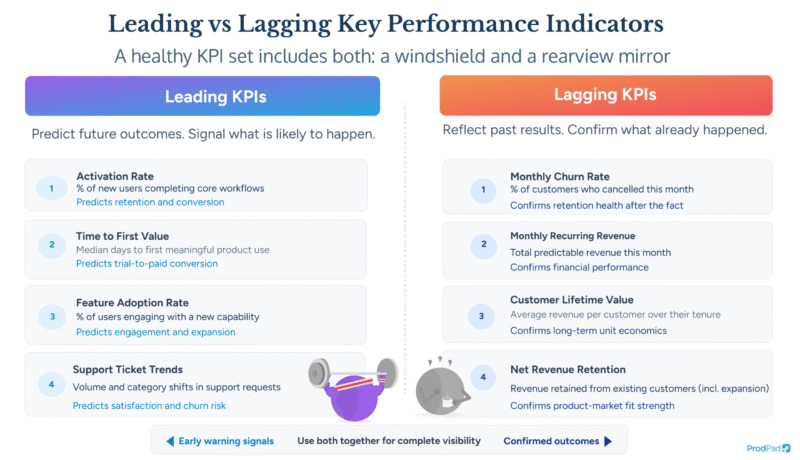
Lagging key performance indicators (revenue, churn, LTV) tell you what has already happened. Leading indicators (activation rate, feature adoption, support ticket trends) signal what is likely to happen next. A healthy key performance indicator set includes both, giving the team a rearview mirror and a windshield.
Teams that rely entirely on lagging indicators find themselves reacting to problems months after those problems started. Teams with strong leading indicators can spot issues early and course-correct before the damage compounds.
Need OKR inspiration to go with your KPIs? Grab ProdPad’s Ultimate Collection of Product OKR Examples, with 25+ ready-made OKRs you can adapt.
What are common Key Performance Indicator mistakes in Product Management?
The gap between KPI theory and KPI practice is wide. Several anti-patterns show up repeatedly across product organizations.
Tracking too many Key Performance Indicators
When a team monitors 30 or 40 metrics and calls them all key performance indicators, the word “key” loses its meaning. No team can meaningfully act on that many signals simultaneously. The result is a dashboard that gets glanced at occasionally but rarely drives decisions. Consolidation requires discipline, and discipline requires a clear product strategy to anchor decisions about what to measure.
Confusing Key Performance Indicators with vanity metrics
Vanity metrics are numbers that look impressive on the surface but provide little actionable insight. Total registered users, raw page views, and social media followers are classic examples. Eric Ries, in The Lean Startup, flagged this pattern years ago, and it remains pervasive.
The test is straightforward: does a change in this number prompt the team to take a specific action? If the number goes up and the only response is “great,” or it goes down and the only response is a furrowed brow, the metric is likely vanity. A true key performance indicator drives investigation, hypothesis formation, and action. ProdPad has a practical guide to product management KPIs that moves beyond vanity metrics and toward meaningful measurement.
Using Key Performance Indicators as individual performance targets
A key performance indicator should measure the performance of the product, a feature area, or a team-level outcome. When KPIs get repurposed as individual performance reviews for Product Managers, the incentive structure shifts. People start gaming the metric rather than improving the product. Product outcomes are shaped by dozens of factors (market conditions, Engineering capacity, design decisions, sales behaviors) and pinning them to one person creates a distorted picture.
Setting Key Performance Indicators and never revisiting them
Products change. Markets shift. Customer needs evolve. A key performance indicator that made sense 18 months ago may no longer be relevant. Regular reviews of whether the current KPI set still aligns with the active product strategy are essential. Teams that “set and forget” their KPIs end up optimizing for outdated goals while the real challenges go unmeasured. ProdPad’s blog covers six common pitfalls when implementing OKRs, and most of those same traps apply to key performance indicators as well.
Disconnecting Key Performance Indicators from the roadmap
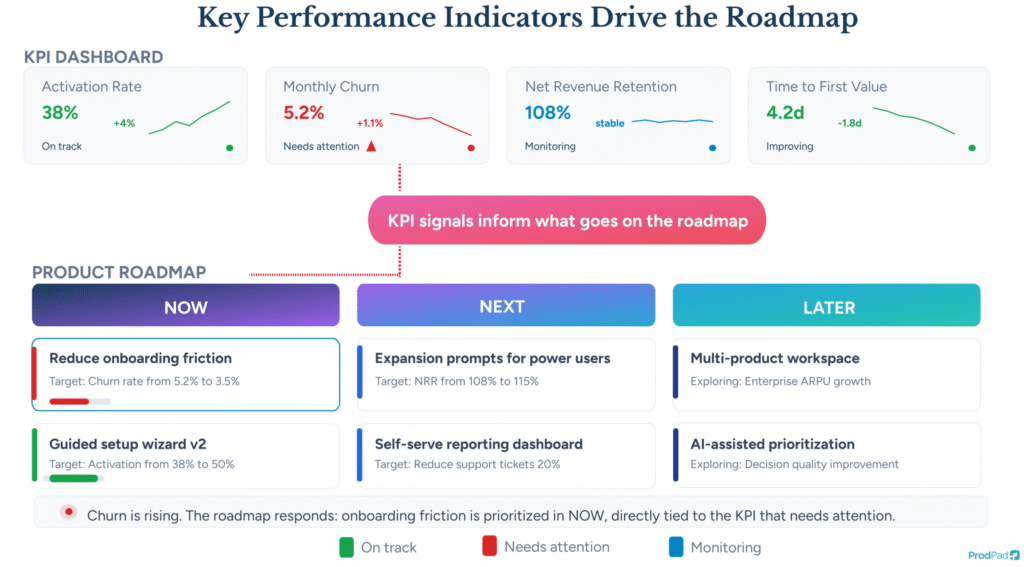
This is where tooling and process intersect. When key performance indicators live in a separate analytics dashboard with no connection to the product roadmap, teams lose the thread between what they are building and why. The roadmap becomes a feature list, and the KPIs become a reporting exercise. The two should be tightly connected: roadmap initiatives should have clear hypotheses about which KPIs they will move, and KPI reviews should inform what goes onto the roadmap next.
ProdPad was built around this principle. By connecting OKRs, outcomes, and roadmap items within a single system, teams can see the direct line from strategy to metric to initiative to learning.
See how OKRs and lean roadmapping connect in ProdPad’s guide to ditching the timeline roadmap.
How do tools shape Key Performance Indicator behavior?
The tools a team uses influence how they think about and act on key performance indicators, often in ways the team does not consciously recognize.
Analytics tools create metric abundance
Products like Amplitude, Mixpanel, and Google Analytics make it trivially easy to track hundreds of metrics. This abundance is useful for exploration but dangerous for focus. When a team can see every metric, it becomes tempting to treat them all as important. The discipline of selecting a small number of key performance indicators and committing to them requires deliberate effort that the tooling alone does not enforce.
Delivery tools anchor teams in output metrics
When a product team’s primary workspace is a delivery tool like Jira, the most visible metrics tend to be output-oriented: tickets completed, velocity, sprint burndown. These are valuable for engineering workflow management, but they measure activity, not outcome. A team can close 50 tickets in a sprint and move no key performance indicator at all, because the work shipped does not address the right problem or reach the right users.
This is the core tension: delivery tools optimize for getting things done. Strategy tools optimize for getting the right things done. Product teams need both, and the key performance indicators that matter most sit on the strategy side.
Strategy tools connect KPIs to decisions
ProdPad complements delivery tools by providing the strategic layer where objectives, outcomes, and key performance indicators live alongside the roadmap. This makes it possible to evaluate whether the work being delivered is actually moving the numbers that matter. The Now-Next-Later roadmap format reinforces this by organizing work around strategic intent rather than delivery timelines, keeping key performance indicators visible as the reason behind the work.
What does a good Key Performance Indicator look like in practice?
Abstract definitions of key performance indicators only go so far. Concrete examples make the concept tangible.
SaaS product example
A B2B SaaS product focused on growing its mid-market segment might select the following key performance indicators:
Activation rate (percentage of new trial users who complete three or more core workflows within 14 days). This is a leading indicator that signals whether the onboarding experience is converting trials into engaged users.
Net revenue retention (percentage of revenue retained from existing customers, including expansion and contraction). This lagging indicator shows whether customers are finding enough ongoing value to stay and grow their usage.
Time to first value (median number of days between account creation and the user’s first successful use of a core feature). This leading indicator highlights friction in the early experience.
Each of these key performance indicators is directly connected to the product strategy (grow mid-market accounts), actionable by the product team, and reviewed on a regular cadence.
Ecommerce product example
An ecommerce platform focused on improving repeat purchases might track:
Repeat purchase rate (percentage of customers who make a second purchase within 90 days). This is the central key performance indicator tied to the core strategic objective.
Cart abandonment rate (percentage of users who add items to a cart but do not complete checkout). This is a diagnostic KPI that helps identify friction in the conversion funnel.
Average order value (mean revenue per transaction). This financial KPI helps the team understand whether pricing, bundling, or recommendation changes are influencing purchasing behavior.
Enterprise platform example
A platform team serving internal engineering teams might use:
Developer adoption rate (percentage of internal teams actively using the platform’s services). This adoption-oriented key performance indicator is critical for platform teams whose value depends on internal usage.
Mean time to resolution (average time from a reported issue to a deployed fix). This process KPI reflects both platform reliability and the team’s responsiveness.
API call success rate (percentage of API requests that return a successful response). This operational key performance indicator tracks platform stability and directly affects the experience of the teams that depend on it.
Download ProdPad’s complete KPI eBook for a detailed breakdown of 34 product management KPIs with guidance on how to select, track, and act on them.
How should you review and act on Key Performance Indicators?
Tracking key performance indicators is only half the job. The other half is building a cadence and culture around reviewing them that leads to better decisions.
Establish a regular review cadence
Most product teams benefit from reviewing key performance indicators weekly or biweekly at the team level, with a more strategic review monthly or quarterly at the leadership level. The team-level review focuses on short-term movements and emerging signals. The leadership review focuses on trends, progress against OKRs, and whether the current KPI set still reflects the right priorities.
Pair KPIs with context
A key performance indicator in isolation is dangerous. Churn went up 2% this month. Is that a disaster or expected seasonal variation? Revenue per user dropped. Is that because you added a lower-priced tier that is attracting a different segment? Every key performance indicator review should include context: what else changed, what was shipped, what external factors might be at play.
Use KPIs to generate questions, not just answers
A dropping activation rate does not, by itself, tell the team what to do. It tells them something changed and warrants investigation. The best product teams treat key performance indicator movements as hypotheses to explore rather than instructions to follow. A KPI says “something is happening here.” Discovery, user research, and experimentation tell you what to do about it. Teresa Torres’ continuous discovery framework emphasizes exactly this connection between quantitative signals and qualitative investigation: start with a measurable outcome, then explore the opportunity space to understand what is driving the number.
Connect KPI insights to roadmap decisions
Key performance indicator reviews should directly feed into roadmap discussions. If a core KPI is trending in the wrong direction, that signal should influence what gets prioritized on the product roadmap. If a KPI is stable and healthy, the team can redirect attention elsewhere. This feedback loop between measurement and planning is what keeps product work strategically grounded rather than reactive.
See how KPIs, OKRs, and roadmap initiatives connect in practice. The ProdPad sandbox is pre-filled with example data so you can explore without signing up
Why Key Performance Indicators Break Down in Real Product Organizations
The theory of key performance indicators is clean. Pick meaningful metrics. Track them. Act on them. Improve the product. Repeat. The reality is messier.
Key performance indicators break down when the product strategy itself is unclear, because without a clear strategy, there is no basis for deciding which metrics are “key.” They break down when teams are rewarded for shipping features rather than improving outcomes, because the incentive structure redirects attention away from the numbers that reflect real product health. They break down when the metrics live in a different system than the roadmap, because the distance between measurement and action creates a gap that gets wider over time.
Most product organizations face all three of these problems simultaneously. The fix is systemic, not tactical. It requires clear strategy. It requires outcome-oriented goals. It requires tooling that connects the dots between what you are measuring, what you are building, and why.
A key performance indicator is only as useful as the system it operates within. Choose the right ones, connect them to your strategy, review them honestly, and let them guide (not dictate) what happens next. That is when key performance indicators stop being a reporting chore and start being a genuine decision-making advantage.
Enjoy a single source of truth for every product idea
Start a free trial and see how easy your Product Management life could be with ProdPad