The Danger of Bottom-Up Roadmaps

Most Product teams don’t set out to build a bottom-up roadmap. They set out to be practical. The backlog is full, the team is capable, and there’s always something reasonable to work on next. So the roadmap gets assembled from what’s already there: a pile of validated ideas, customer requests, and tech debt tickets that have been sitting around long enough to feel urgent. The result looks productive. It even looks strategic, if you squint. But the intent behind the work has been quietly replaced by the gravity of the backlog itself.
Bottom-up roadmaps are seductive because they feel grounded. They come from real inputs: customer feedback, engineering constraints, sales requests. They avoid the hand-wavy aspirationalism of top-down strategy decks that never survive contact with reality. And they ship. Teams running bottom-up roadmaps can point to velocity, throughput, and a satisfying cadence of releases. The problem is that none of those metrics tell you whether the product is heading in the right direction.

Why Teams Fall Into Bottom-Up Planning
Bottom-up planning rarely starts as a conscious choice. It’s what happens when the conditions for top-down planning aren’t in place. The company hasn’t articulated a product strategy. The OKRs are vague or disconnected from product work. Leadership changes direction every quarter. Or the Product team is so deep in delivery that stepping back to reframe feels like a luxury they can’t afford.
The strategy vacuum
When product strategy is absent, unclear, or changes too frequently to be useful, teams default to what they can control: the backlog. They focus on the queue of known work because it provides structure and predictability. Melissa Perri described this dynamic thoroughly in her exploration of the build trap, where organizations measure success by features shipped rather than problems solved. The backlog becomes the de facto strategy, and “what should we build next” gets answered by “what’s at the top of the list” rather than “what will move us closer to our objectives.”
The tooling trap
The tools teams use shape how they think. When the primary planning surface is a delivery tool like Jira, the unit of work becomes the ticket. Tickets are concrete: they have descriptions, acceptance criteria, story points. They feel real in a way that strategic initiatives don’t. But tickets don’t carry strategic context. They don’t explain why something matters, what objective it serves, or what outcome it should produce. Over time, the team starts planning in ticket-shaped chunks, and the roadmap becomes a prioritized list of things to build rather than a plan for outcomes to achieve. John Cutler has written extensively about how teams can get stuck optimizing for output velocity instead of value creation velocity, building a well-oiled feature factory that ships efficiently without knowing whether any of it matters.
The comfort of consensus
Bottom-up planning is also politically easier. When the roadmap is assembled from things people have already agreed to, there’s less conflict. Nobody has to make the hard call about what to deprioritize. Nobody has to tell a stakeholder that their pet project doesn’t align with the strategy, because there is no strategy to point to. The backlog provides cover: “We’re working through the prioritized list.” It avoids the difficult conversations that real strategic planning demands.
Is your backlog running the show instead of your strategy? Watch how product teams untangle chaotic backlogs and reconnect their roadmap to objectives
How Backlog Gravity Replaces Decision-Making
Once a team settles into bottom-up planning, a specific pattern emerges that’s worth naming: backlog gravity. This is the tendency for items that have been in the backlog longest, or that have accumulated the most votes, requests, or internal advocacy, to rise to the top simply by virtue of their persistence. Backlog gravity replaces intentional decision-making with inertia.
The accumulation effect
In any active product, the backlog grows faster than the team can process it. Customer requests pile up. Internal stakeholders add ideas. Engineers flag technical improvements. Each item individually makes sense, and many are genuinely useful. But without a strategic filter, the backlog becomes an undifferentiated mass where the loudest signal wins. Rich Mironov has pointed out the absurdity of trying to do ROI analysis on hundreds or thousands of backlog items, noting that it makes no sense unless anchored in a clear business model and strategy. The exercise itself becomes a time sink that masquerades as rigor.
Momentum masquerading as direction
Teams caught in backlog gravity often feel productive. They’re shipping regularly, closing tickets, and responding to customer requests. But strip away the velocity metrics and ask a harder question: if you removed the backlog entirely and started fresh, knowing only your company’s strategic objectives, would you rebuild the same list? Most teams would not. That gap between “what we’re building” and “what we should be building” is the cost of bottom-up planning, and it compounds over time.
The slow erosion of intent
The most dangerous aspect of backlog gravity is how gradually it erodes strategic intent. A team doesn’t wake up one morning and decide to abandon their product strategy. They just stop referencing it. Sprint planning becomes a conversation about what’s next in the queue, not about which objective needs attention. Roadmap reviews become status updates on delivery, not discussions about direction. The roadmap stops being a strategy artifact and starts being a project plan, and nobody notices because the cadence of work never slows down.
The Difference Between Initiative-Led and Feature-Led Planning
The structural difference between a bottom-up roadmap and a strategy-aligned roadmap comes down to the unit of planning. Bottom-up roadmaps plan in features. Strategy-aligned roadmaps plan in initiatives.
Features describe solutions; initiatives describe problems
A feature is a specific piece of functionality: “Add SSO support,” “Build a CSV export,” “Redesign the onboarding flow.” A feature assumes the solution is known. An initiative describes the problem or opportunity the team is pursuing: “Reduce friction for enterprise buyers,” “Make it easier for teams to extract insights from their data,” “Accelerate time-to-value for new users.” Initiatives leave room for the team to explore different solutions, test hypotheses, and iterate toward the best outcome.
This distinction matters enormously for how the roadmap functions. A theme-based roadmap built around initiatives communicates what the team is trying to achieve and why. A feature-based roadmap communicates what the team is going to build, with the “why” implied (or missing entirely). Stakeholders looking at a feature roadmap will judge it on whether their favorite feature is included. Stakeholders looking at an initiative roadmap will engage with whether the right problems are being prioritized.
Initiative-led planning creates strategic flexibility
When the roadmap is built around initiatives, the team retains the ability to change course as they learn. If the first approach to “reduce enterprise onboarding friction” doesn’t work, the initiative persists on the roadmap while the specific solution changes. The strategic commitment remains stable even as the tactical execution evolves. This is the core principle behind outcome-based roadmapping, where the roadmap declares the outcomes the team is pursuing, and the specific features become hypotheses to be validated, not promises to be delivered.
Feature-led planning locks teams into commitments prematurely
A feature-based roadmap, by contrast, locks the team into specific solutions before they’ve been validated. Changing direction means removing items from the roadmap, which triggers stakeholder anxiety (“You said you were building SSO this quarter”). The team ends up defending the plan rather than adapting it, and the sunk cost of having communicated the feature makes it harder to pivot even when evidence suggests a different approach would be more valuable.
Still building your roadmap around features? Learn the 8 steps to shift from timeline-based, feature-level planning to an initiative-driven Now-Next-Later roadmap
Reintroducing Objectives Without Boiling the Ocean
For teams that have been running bottom-up for a while, the prospect of “adding strategy” can feel paralyzing. The backlog is enormous. There are commitments in flight. Stakeholders have expectations. Stopping everything to define a product strategy and build a new roadmap from scratch isn’t realistic. The good news: it doesn’t have to happen all at once.
Start with the work already in progress
The simplest entry point is to look at what’s currently on the roadmap and ask: what objective does this serve? In many cases, the answer exists but has never been made explicit. The team is working on improving search performance because they know activation rates are too low. They’re building an integration because enterprise customers keep churning without it. These are strategic motivations, just unspoken ones. Making them visible is the first step.
Take the current roadmap items and group them under the objectives they support. Some items will cluster naturally around clear themes. Others will sit awkwardly, belonging to no particular objective, which is useful information in itself. Items without a clear strategic home deserve scrutiny: they may be perfectly valid work, or they may be backlog gravity in action.
Use objectives as a filter, not a straitjacket
The goal is to use objectives to evaluate the work the team is already doing, not to impose a rigid framework overnight. If the team can articulate three to five product objectives and map their current work against them, they’ve already made a significant shift. They can now see where effort is concentrated, where objectives are underserved, and where work is happening that doesn’t align with any stated goal.
ProdPad’s approach to OKR alignment was designed specifically for this kind of incremental adoption. Linking roadmap initiatives to objectives creates visibility into which objectives have active work supporting them and which are effectively orphaned, without requiring teams to rebuild their entire planning process from scratch.

Elevate the planning conversation
Once objectives are visible on the roadmap, the planning conversation changes. Instead of “What should we build next?” the question becomes “Which objective needs the most attention right now?” Instead of debating whether Feature A or Feature B is more important (a conversation that usually devolves into opinion and politics), the team debates which strategic problem is most urgent. The features become potential solutions to that problem, and the team has permission to explore alternatives.
This is where the shift from feature-led to initiative-led planning becomes tangible. An initiative like “Reduce time-to-value for new users” might contain three or four different ideas the team could pursue. The roadmap declares the initiative as a priority, and the team runs discovery to determine which approach will have the greatest impact. The roadmap stays stable while the execution stays flexible. Itamar Gilad has advocated for a similar approach through the GIST framework, which separates goals, ideas, steps, and tasks to prevent premature commitment to specific solutions.
You don’t need a strategy offsite to start roadmapping strategically. Treat your roadmap as a prototype. Iterate it, don’t perfect it.
Making the Roadmap a Strategy Artifact Again
The roadmap is one of the most scrutinized artifacts in any product organization. Executives review it. Sales references it. Engineering plans around it. Customers ask about it. Given that level of attention, the roadmap is either reinforcing strategic thinking every time someone looks at it, or it’s undermining it. A bottom-up roadmap, no matter how well-maintained, does the latter. It tells people what’s being built without explaining why, and it invites feature-level negotiations instead of strategic conversations.
The roadmap should declare intent
A strategy-aligned roadmap does something a feature list never can: it declares what the organization is trying to achieve and in what order. It answers the question “where are we going” before it answers “what are we building.” When someone opens the roadmap, they should be able to understand the Product team’s priorities, the problems being solved, and the objectives being pursued, without needing a separate strategy deck to provide context.
This is the principle behind the Now-Next-Later roadmap format, which organizes work into time horizons based on confidence rather than calendar dates. Items in “Now” are committed, well-understood, and actively being worked on. “Next” holds what’s being prepared and validated. “Later” represents strategic direction that hasn’t yet been fully explored. The format itself communicates that certainty diminishes over time, which is both honest and strategically useful.
Connect the layers
A roadmap that functions as a strategy artifact needs visible connections between the layers of planning: objectives at the top, initiatives that serve those objectives in the middle, and specific ideas or experiments at the bottom. When someone asks “why are we building this,” the answer should be traceable directly from the feature up through the initiative to the objective. That chain of reasoning is what makes a roadmap strategic. Without it, the roadmap is just a prettified backlog.
The feedback-to-idea-to-roadmap connectivity that ProdPad users consistently describe as a breakthrough moment is exactly this kind of visible connection. Customer feedback links to ideas. Ideas link to initiatives on the roadmap. Initiatives link to objectives. Every level of the chain is visible, which means every decision is auditable and every priority is explainable.
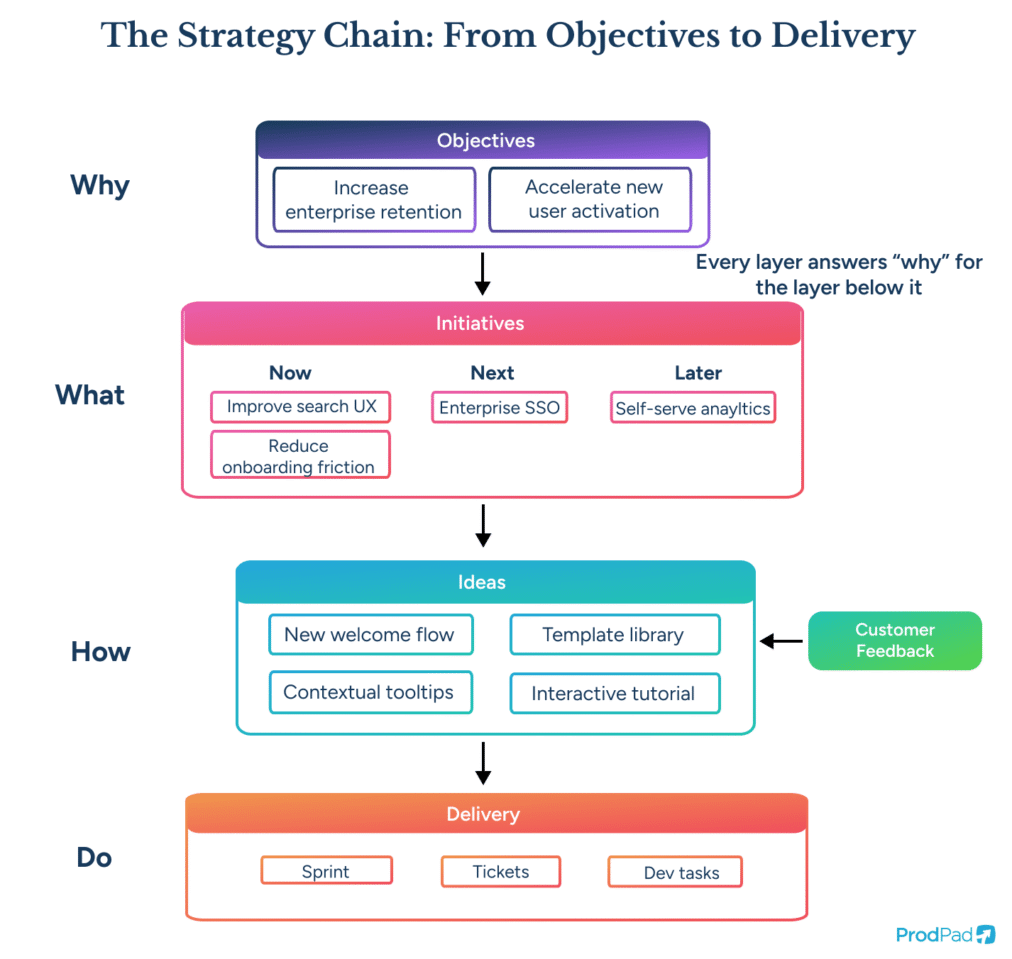
Itamar Gilad’s GIST framework and the Now-Next-Later roadmap share the same DNA: separate goals from solutions, and stop committing to features before you’ve validated them
Strategy is a living practice, not a launch event
The biggest mistake teams make when trying to move from bottom-up to strategy-led roadmapping is treating it as a transformation project. They plan an offsite, build a comprehensive strategy framework, define 12 objectives, and try to rewire everything at once. Two months later, the framework is gathering dust and the team is back to working from the backlog because that’s where the muscle memory is.
The shift works better as a gradual practice. Start with one roadmap review where you ask “which objective does this serve” for every item. Tag initiatives with the objectives they support. Notice when an item can’t be connected to any strategic goal and have a conversation about it instead of ignoring it.Over a few cycles, the roadmap will naturally evolve from a feature list into something that looks, sounds, and functions like a strategy.
Rich Mironov captures this well with his framing that the goal isn’t to have a roadmap, but to have a good product strategy where hard choices have been made, and the roadmap simply reflects those choices. The roadmap is the output of strategic thinking, not a substitute for it. When teams work bottom-up, they’re doing it backwards: building the roadmap and hoping strategy emerges from the collection of features. It almost never does.
When the Roadmap Carries the Strategy, Everything Else Gets Easier
Product teams that operate from bottom-up roadmaps spend an enormous amount of energy on activities that strategy-led teams barely think about. These teams spend hours in prioritization debates because there’s no shared framework for what matters most. Decks get built to justify decisions because the roadmap doesn’t communicate the reasoning on its own. Stakeholders constantly ask “why are we building X instead of Y” because the strategic logic isn’t visible. Every shift in priorities looks like indecision rather than learning, so the team ends up defending the plan instead of adapting it.
A roadmap that carries the strategy eliminates most of this overhead. When objectives are visible, prioritization becomes a discussion about which problems matter most, not which features are loudest. Framing initiatives as problems to solve gets stakeholders engaging with direction rather than debating specific solutions. And once the chain from objective to initiative to idea is visible, changes in execution don’t look like changes in strategy, because the strategic layer hasn’t moved.
The teams that get this right describe a fundamental shift in how they spend their time. Less time explaining and defending. More time on discovery, experimentation, and learning. Less time managing the backlog. More time shaping the direction of the product. The product roadmap stops being a source of anxiety and starts being a tool for alignment, which is what it was always supposed to be.
Bottom-up roadmaps feel safe because they come from real inputs and produce real outputs. But safety and progress are different things. A team that ships features without strategic intent is moving fast in no particular direction. The roadmap is the one artifact with enough organizational gravity to change that, if it’s built to carry strategy instead of just features.