Needfinding

What is needfinding?
Needfinding is the art of uncovering unmet user needs before the product development process begins. It’s the crucial first step towards building something truly valuable: before a single feature is planned, before a roadmap is drawn, and certainly before any code is written.
Essentially, needfinding is about understanding the problems that your users face, so that your product can address them meaningfully.
Okay, so far this sounds like your typical customer research – what’s the catch?
Well, instead of figuring out what customers demand and then doing that, needfinding is all about figuring out why they want what they want so that you can create something that addresses that why.
Rooted in design thinking, needfinding goes beyond surface-level requests to discover the root of what’s being asked for. While users can tell you what they want, often these desires are informed by solutions they already know.
What’s truly valuable is uncovering needs that users may not be able to express directly. By prioritizing these insights, product teams ensure they’re not just building a product, but solving a real problem in a meaningful way.
Done well, needfinding aligns innovation with actual user behavior and expectations, setting the foundation for products that resonate, differentiate, and succeed in the market.
Needs vs. wants
In the 1970s, Stanford professor Robert McKim laid the groundwork for needfinding, distinguishing it from other product research methodologies by prioritizing customer needs over wants.
While many approaches take customer desires at face value (the customer knows best after all) needfinding digs deeper, focusing on the fundamental problems that require solving.
But what’s the difference?
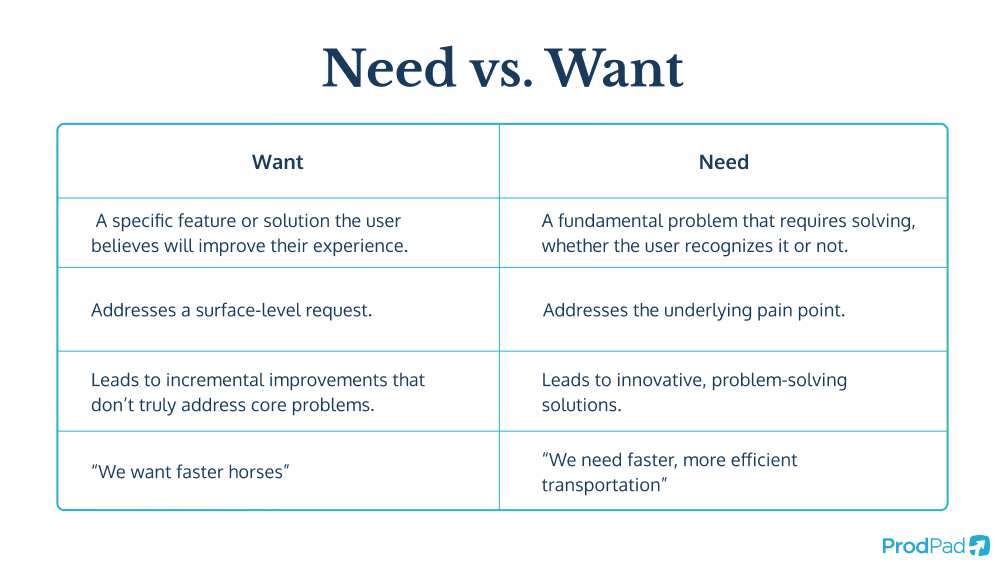
A want is a specific feature or solution that a customer believes will improve their experience, often shaped by personal preferences or familiarity with existing options. A need, on the other hand, is the core problem that requires solving, whether the customer recognizes it or not. It’s the gap between the current reality and an ideal solution.
Henry Ford famously illustrated this distinction:
“If I had asked people what they wanted, they would have said faster horses.”
A faster horse was the want. A solution customers could envision based on their experience. But their need was more fundamental: faster, more efficient transportation. Ford’s success came not from delivering what people asked for but from solving their deeper problems. What was leading them to ask for faster horses?
This is why needfinding is such a powerful tool for Product Managers. By focusing on needs rather than simply fulfilling wants, product teams can break free from incremental improvements and uncover game-changing innovations. Rather than building something that looks like what the competition already offers, needfinding enables teams to identify opportunities for radical product improvement that will benefit their customers.
Why is needfinding important?
Needfinding is the foundation of user-centric product development. Without it, teams risk building solutions that miss the mark, and focus on output over outcome, like a feature factory. This can lead to you wasting time, money, and effort on products no one truly needs. Here’s why it’s essential:
- Prevents costly mistakes
Developing a product is not cheap. Without a clear understanding of unmet needs, teams may invest in features or solutions that fail to resonate with users. If you don’t identify the core problem early on, you risk spending time building features that no one will use. By prioritizing needfinding as part of your product discovery, companies can focus their resources on solving real problems, increasing the likelihood of success and minimizing costly mistakes. - Goes beyond what customers say
Listening to customer requests provides only part of the picture. People often express what they want, but their deeper needs may remain hidden. True needfinding involves observing users in their natural environments, uncovering pain points they may not even articulate. This is where traditional surveys and feedback forms often fall short. Observing users’ behaviors in their own environments allows you to understand the unspoken challenges they face. You can then design solutions that address the root problem – not just the symptoms. - Informs the product roadmap
Needfinding ensures that every feature and decision on the roadmap is grounded in real user needs. Instead of relying on assumptions or internal guesses, product teams gather qualitative insights through focus groups, interviews, and firsthand observations. This data-driven Product Management approach aligns product strategy with actual market demand, leading to higher adoption rates and long-term success. The result? Products that users truly want to use, not just products that you think they need.
In short, needfinding isn’t just another research step: it’s the key to building products that matter. By understanding what users truly need (not just what they say they want), companies can innovate in ways that create real impact.
How do you do needfinding?
Needfinding is hard. It requires blending techniques like observation, questioning, and interpretation to uncover what users truly need.
It’s tempting to take requests at face value, but that rarely leads to the best solutions. Think of it like dealing with a toddler who can’t quite express themselves yet. They might beg for an ice cream cone at the beach, so you get them one – only for them to demand a slushy next. You oblige again, but soon enough, they’re still unhappy.
Why? Because the real problem isn’t a lack of treats: it’s that they’re overheating. If you take a step back and look deeper, you realize the best solution isn’t ice cream; it’s a shady spot under a parasol and a cool hat. Problem solved.
So how do you do the equivalent of this for your customers as a Product Manager? Well, there’s a few methods.
Key methods of needfinding
- User interviews: One-on-one conversations with users help uncover their experiences, pain points, and expectations. Of course, to get deeper insight into the why behind the wants, you’re going to need to ask open-ended questions that encourage honest, detailed responses. We’ll cover interview questions in a bit.
👉 Best for: A deeper understanding of customer need, emotions, and motivations.
- Surveys: Surveys are an efficient way to collect data from a large audience, helping quantify user needs and preferences. This can help you understand what your general user base wants. After all, you don’t want to build a solution for just one person.
👉 Best for: Identifying trends and patterns across a broad user base.
- Observation: This is probably the biggest part of needfinding. Instead of asking users what they need and learning about a subjective experience, watch how they interact with a product or service in their daily lives. People often struggle to articulate their needs, but actions speak louder than words.
👉 Best for: Discovering hidden needs that users wouldn’t mention in interviews. You’ll be surprised by what you uncover when users aren’t aware they’re being observed.
Alone in a vacuum, each method may not reveal the deeper need. But, used together, it can uncover insights into what your users really need.
The needfinding process: step by step
Now that we know the methods, let’s break down the step-by-step needfinding process for conducting needfinding effectively.
Step 1: Frame and prepare
Before you begin your needfinding journey, it’s crucial to set a clear and solid foundation. This starts with defining the scope of your research. Begin by developing a hypothesis about what user needs might be. What do you think they need, before you back it up with research?
This acts as a guiding framework for your exploration. However, it’s important to remember that this hypothesis shouldn’t limit or box you in, sometimes users will reveal needs that completely surprise you, and being open to those insights is key.
Next, you’ll need to choose your target user personas with care. Who exactly are you observing and interviewing? This decision is vital because the quality of your findings will depend heavily on whether you’ve selected the right people whose behaviors, struggles, and preferences align with the context of your study.
Do you want to find the common need for all your users, or are you focusing on a specific type of user?
Step 2: Watch and record
We’ve established that observation is a powerful tool in needfinding. It’s not enough to ask users what they need.
To continue the needfinding process, use replay tools like Hotjar to get an understanding of what users do. Follow their journey, the choices they make, and identify any obvious friction points. This gives you the chance to see firsthand what they do, where they struggle, and how they work around obstacles. Pay attention to how they interact with different features, noticing what frustrates them and what seems to be working well.
Recording these interactions is essential. In this step of needfinding, make note of specific pain points, any inefficiencies they encounter, or ways they adapt to challenges. For example, users may be using your product in ways you’ve not envisioned to work around a limitation. Spotting this can clearly show you what your users need from you.
Step 3: Ask and record
Once you’ve spent time observing users, it’s time to dive deeper with open-ended questions that will help clarify their behaviors and provide context to your observations. By now, you’ll have a solid understanding of what users are doing, but you still need to understand why they’re doing it and what it means to them.
When asking follow-up questions, focus on uncovering struggles and preferences. Avoid leading the conversation with your own assumptions and be open-ended. This open-ended approach lets them reveal things you may not have anticipated.
For example, you might notice that users frequently export data from your SaaS platform into spreadsheets. At first glance, this seems like a standard workflow, but when you ask about it, you learn that the built-in reporting tool doesn’t let them filter data in the way they need. This insight is crucial – it tells you that the real need isn’t an easier exporting process, but better in-app filtering options.
Your observations should serve as a guide for these follow-up questions. If you’ve noticed a pattern in how users interact with a product or a certain obstacle that keeps cropping up, you can structure your questions around these areas. However, remain flexible and open to new information that might surface as the conversation unfolds. Don’t assume that you already have all the answers – users may provide valuable input that shifts the focus of your research.
Step 4: Interpret and reframe
Once you’ve gathered all your insights, it’s time to analyze the data and translate it into actionable needs. Start by looking for recurring themes in both the behavior you’ve observed and the feedback you’ve collected. Do certain pain points emerge consistently across different users? Are there common patterns of frustration, workarounds, or preferences?
Identifying these trends will help you narrow down the core needs that are worth addressing in your product or service design.
With these themes in mind, you’ll want to brainstorm potential solutions and then prioritize them based on what will have the most significant impact. There are so many different ways you can prioritize ideas. Here’s an eBook filled with all the best prioritization frameworks:
Questions to ask in a needfinding interview
Crafting strong needfinding questions to ask in a customer interview or survey is key to uncovering real user needs beyond what they explicitly say. Here are a few guiding principles to keep in mind:
- Be focused without fixating 🎯 – Stay open to unexpected insights instead of locking in on a single assumption.
- Ask “why” questions often ❓– Uncover deeper motivations by digging into decisions and behaviors.
- Do not sell 🚫– The goal is to learn, not to validate an idea. Keep the focus on the user’s experiences, not your product.
With these principles in mind, here are some useful open-ended questions to guide your needfinding interviews:
🤔 Tell me more about why you…
👀 Show me how you use…
💭 Let’s imagine you’re doing X, how would you do that?
🚧 What are the biggest challenges you face when…?
🔧 What workarounds have you created to deal with this problem?
🗣️ If you were telling a friend about X, how would you describe it?
🤷 Why did you choose to use X instead of another solution?
By structuring effective questions this way, you’ll gain insights into real problems and motivations, leading to stronger, user-driven product decisions.
Needfinding example
Here’s a fictitious example of needfidning in action, to illustrate that you’re searching beyond the want.
- The product your company makes: A messaging app for professionals (like Slack)
- Your customers say they want: “More ways to customize notifications”
- What needfinding uncovers they need: Smarter context-aware notifications
Your company’s messaging app has been receiving a lot of feedback from users asking for more customization options for notifications. They wanted finer controls, and options to tweak alerts based on urgency, team, and time of day.
Instead of immediately building a complex notification settings panel where users can assign certain notifications to specific users and groups, you decide to conduct a needfinding exercise. You observe how teams actually used notifications and follow up with interviews.
What you discover was that users weren’t struggling with a lack of customization – they were drowning in notifications altogether. The real problem wasn’t about tweaking alerts, but about getting fewer, more relevant ones. Users felt overwhelmed and distracted by constant pings and wanted customization so that they could turn them off.
So the real need? Smarter, context-aware notifications that prioritized important messages while filtering out the noise. Rather than just adding more customization, you can instead build an intelligent notification system that surfaces critical updates at the right time while muting less urgent ones during allocated ‘quiet times’.
That’s needfinding in practice, discovering the true underlying need by going beyond what customers think they want. Implementing this helps you offer a greater value proposition than simply doing what is asked of you.
Find what users need
Needfinding isn’t about taking customer requests at face value, it’s about digging deeper to uncover the real problems behind their asks. By blending observation, questioning, and interpretation, you move beyond surface-level wants and discover the fundamental needs that drive user behavior. Done well, needfinding fuels innovation, informs your roadmap, and ensures you’re building products that truly matter.
Of course, before you can start your needfinding journey, you need a way to gather and make sense of customer feedback. That’s where ProdPad comes in. Our Feedback Management and Signals features help you group recurring feedback themes, spot patterns, and identify the underlying needs hiding in plain sight. With these insights in hand, you’ll have everything you need to kick off your research, prioritize the right problems, and build solutions that delight potential users.
Try them both out, and everything else ProdPad can do, in our interactive Sandbox.
Experience ProdPad today