Go-to-Market Strategy

What Is a Go-to-Market Strategy? Components, Types, and Where It Breaks Down
Most teams treat the go-to-market strategy as the marketing department’s problem, something that gets bolted on in the final weeks before a launch. By then the product is built, the pricing is half-decided, and Sales is still asking who exactly they are supposed to sell this to.
That sequencing is backwards, and it is one of the most reliable ways to turn a good product into a quiet failure. A go-to-market strategy is not the finishing touch on a build. It is a set of commercial decisions that should shape what you build in the first place.
What Is a Go-to-Market Strategy?
A go-to-market strategy is the plan a company uses to bring a product to its target market. It covers who you are selling to, how you reach them, how you price and position the offering, and how the whole organization coordinates the launch. It connects product decisions to commercial outcomes, and it makes the difference between a product that finds its market and one that does not.
The term is often shortened to GTM, and it gets used loosely. Some people mean a single launch plan for one new feature. Others mean the entire commercial model of the business, including the long-term motion by which a company acquires, converts, and retains customers. Both readings are valid. What they share is a focus on the moment a product meets a market, and on the systems that have to align for that meeting to go well.
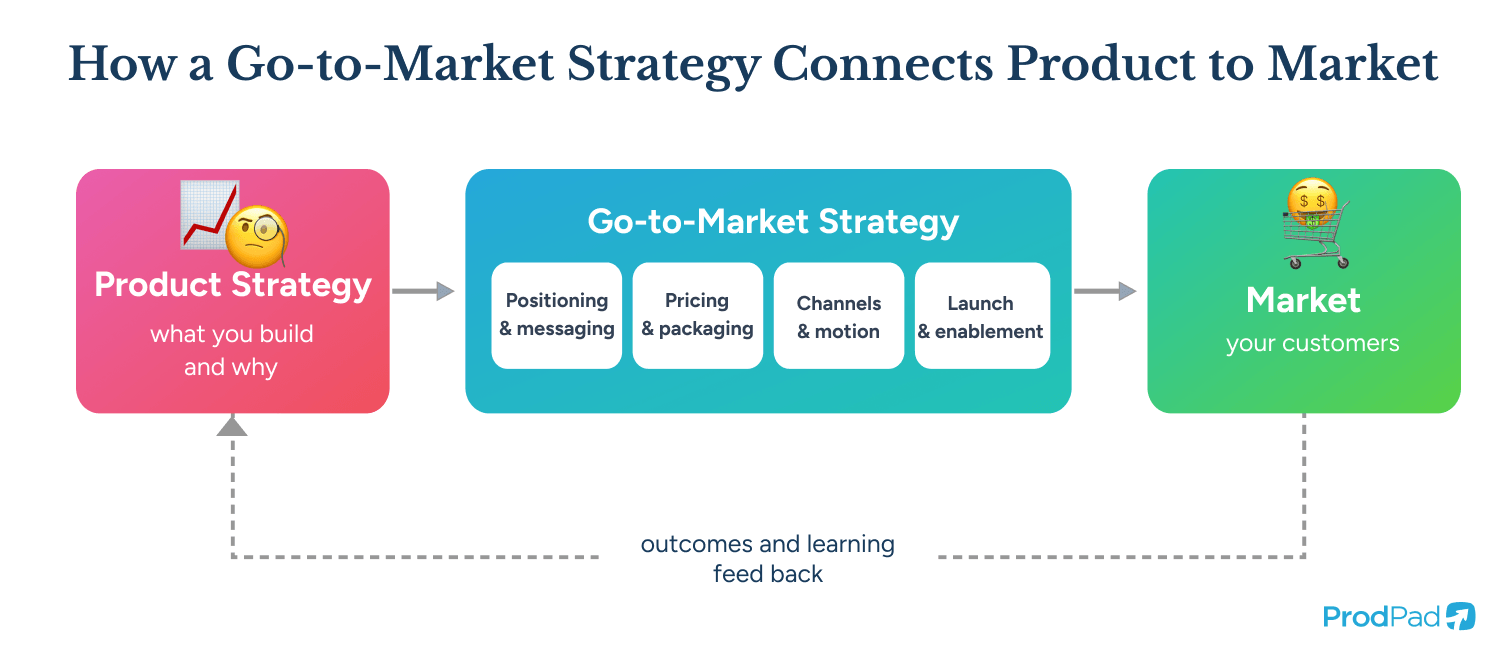
A useful way to think about it: product strategy answers what you are building and why. The go-to-market strategy answers how that product reaches the people who need it and how you get paid for it. The two are tightly linked. A go-to-market strategy built on top of a weak product strategy will struggle, because no amount of clever distribution fixes a product that solves the wrong problem. Equally, a strong product with no coherent route to market tends to stall.
Why Does a Go-to-Market Strategy Matter for Product Teams?
A go-to-market strategy matters because launching is the riskiest moment in a product’s life, and most launches do not go to plan. Failure rates for new products are debated and vary wildly by industry. The frequently repeated claim that ninety percent of products fail is largely a myth, but the more careful research is still sobering. A widely cited 2021 study published in Marketing Letters found that around twenty-five percent of new consumer packaged goods stopped selling within their first year. That figure rose to roughly forty percent by the end of the second year. The reasons are rarely about the engineering. They are about preparation, positioning, and timing.
Harvard Business Review made this point bluntly in Why Most Product Launches Fail. The authors argued that the biggest problem they saw was a lack of preparation. Companies pour everything into designing and building the product, then leave the hard work of getting it to market until far too late. The go-to-market strategy is where that preparation lives. It is the work of figuring out the market before the market figures out you.
For Product teams specifically, the go-to-market strategy is the bridge between discovery and commercial reality. You can run flawless product discovery, validate a real problem, and ship a beautifully crafted solution. It can still underperform. Sales did not know how to talk about it, pricing scared off the buyers you wanted, or the launch landed in a channel your audience never visits. The strategy forces those conversations to happen early, while there is still time to act on them.
Plan launches against outcomes, not deadlines. ProdPad lets you connect the work behind a launch to the goals it is meant to move, so your go-to-market strategy stays tied to measurable results.
What Are the Core Components of a Go-to-Market Strategy?
A complete go-to-market strategy is more than a launch checklist. It is a coordinated set of decisions across several areas, each of which depends on the others. Skipping one tends to undermine the rest. The components below are the ones that matter most for software and product-driven businesses.

Target Market and Ideal Customer Profile
Everything in a go-to-market strategy starts with knowing who you are for. A vague answer here (“product managers” or “B2B companies”) almost guarantees diffuse messaging and wasted spend. A sharp Ideal Customer Profile names the segment, the company size, and the role of the buyer. It also names the problem they feel acutely and the trigger that makes them go looking for a solution. The narrower and more specific this is at launch, the easier every downstream decision becomes.
This is also where Product and commercial functions often disagree, and the disagreement is healthy. Product teams tend to see the broadest possible set of people who could use the product. Sales and Marketing need the smallest set of people most likely to buy it soon. A go-to-market strategy resolves that tension deliberately rather than leaving it unspoken.
Positioning and Messaging
Positioning defines how your product is different and better than the alternatives for a particular set of customers. It is the single decision that the rest of the go-to-market strategy depends on, because it sets the context in which buyers evaluate you. April Dunford has built her career on this problem. In her quickstart guide to positioning, she argues that strong positioning is the starting point for messaging, branding, lead generation, and sales strategy. Get it wrong and you invest in a black hole.
Messaging is positioning made concrete. It is the language Sales uses on a call, the words on the landing page, the framing in the demo. When positioning and messaging drift apart, prospects hear one story from Marketing and a different one from the account executive, and trust erodes quickly. This is part of why the Product Marketing Manager role exists: to own the connective tissue between what the product does and how the market understands it.
Pricing and Packaging
Pricing is a positioning signal as much as a revenue lever. The number you put on a product tells buyers what category you belong in and what to compare you against. Packaging, meaning how you bundle features into tiers and what you gate behind which plan, shapes who can buy, how they expand, and how predictable your revenue becomes. These decisions are commercial, but they are downstream of product choices, which is why they belong in the go-to-market strategy rather than being treated as a finance afterthought.
Channels and Sales Motion
Channels are how you reach buyers, and the sales motion is how you convert them. A high-touch enterprise sale through a direct Sales team is a different machine from a self-serve signup flow, and each demands a different go-to-market strategy. The motion you choose dictates your cost of acquisition, your team structure, and the kind of marketing you need. Choosing a motion that does not fit your price point or buyer is one of the most expensive mistakes a company can make. It shapes hiring and spend for years.
Launch and Cross-Functional Enablement
A launch is a coordination problem before it is a marketing event. Sales needs to be trained on the new offering. Customer Success needs to understand how to support it. Documentation needs to exist, and the timing across all of these has to line up. This is the area HBR singled out as most neglected, and it is where many otherwise sound strategies fall apart. Enablement turns a plan on paper into a launch the whole company can actually execute.
Metrics and Feedback Loops
A go-to-market strategy without metrics is a guess. Before launch, you decide what success looks like: adoption targets, conversion rates, activation milestones, revenue goals. After launch, you measure against them and feed what you learn back into the product and the strategy. This is where many teams stop short, treating launch as a finish line rather than the start of a learning loop. The strongest go-to-market strategies are built to be revised based on what the market actually does.
Want to map your launch metrics to real outcomes? Explore 18 product OKR examples to see how teams turn launch goals into measurable objectives.
What Types of Go-to-Market Strategy Exist?
There is no single correct go-to-market strategy. The right approach depends on your product, your price point, your buyer, and how customers prefer to discover and adopt software. Most strategies lean toward one of a few dominant motions, though many mature companies blend them.
Sales-Led Go-to-Market Strategy
In a sales-led motion, a direct Sales team drives revenue through outbound, demos, and negotiation. This fits products with high price points, complex buying committees, or heavy customization, common in enterprise and regulated industries. The go-to-market strategy here invests heavily in Sales enablement, account targeting, and the materials that support a long, considered purchase. The upside is control and the ability to land large contracts. The cost is a higher cost of acquisition and a slower path to scale.
Product-Led Go-to-Market Strategy
A product-led go-to-market strategy puts the product itself at the center of acquisition and conversion. Users sign up, experience value directly, and convert to paid plans with little or no human intervention. Free trials, freemium tiers, and self-serve onboarding are the mechanics that make it work. ProdPad’s own guide to product-led GTM describes it as the more hands-off approach, where a good product is built to sell itself by reducing time to value. It suits products that are easy to try, deliver value quickly, and have a price point that makes self-serve viable.
Marketing-Led and Community-Led Go-to-Market Strategy
Some companies lead with content, education, and community to build demand before a sales conversation ever happens. This go-to-market strategy works when the buyer does extensive independent research, when the category requires education, or when trust is the main barrier to purchase. It is slower to show direct attribution and demands patience, but it can produce durable, low-cost demand once it compounds. Many of the strongest software companies combine this with one of the motions above rather than relying on it alone.
How Does a Go-to-Market Strategy Fit Into the Product Management Workflow?
A go-to-market strategy is not a separate track that runs parallel to product work. It is woven through the entire workflow, from discovery to delivery to measurement. The Product Manager is often responsible for planning and executing a product’s introduction to the market, working closely with Marketing to generate awareness, interest, and adoption. That responsibility does not end at the major launch. It applies every time a significant new feature ships.
The connection becomes clearest when you look at how strategy translates into a plan. Your product strategy sets the direction. Your roadmap communicates what you are working on and why. A lean, outcome-focused format like the Now-Next-Later roadmap keeps the plan honest by organizing work around the problems you want to solve rather than fixed delivery dates. The go-to-market strategy then attaches to the items on that roadmap that involve a market-facing change, so the launch is planned alongside the build rather than after it.

This is also where the recurring objection from stakeholders shows up. People want to know when something will launch, and an outcome-based roadmap can feel like it dodges that question. The answer is to pair the roadmap, which is your plan, with OKRs, which are your commitment to specific results. Reviewing how OKRs work alongside a roadmap shows how the two layers cover both the strategic direction and the measurable promise. A go-to-market strategy lives in the space where those two meet: it is the commercial expression of an outcome you have committed to.
See it in practice. Try the ProdPad sandbox to explore how roadmaps, OKRs, and launch planning connect in one place, no signup required.
What Are the Most Common Go-to-Market Strategy Mistakes?
Knowing the components is the easy part. The failures tend to come from how teams execute, and the same patterns show up across companies of every size. Recognizing them early is often more valuable than any single best practice.
Treating Launch as an Event Instead of a Motion
Teams pour energy into the launch day, hit their announcement targets, then move on to the next build. The market keeps reacting after launch, and a strategy that stops measuring on day one cannot respond to what it learns. The launch is the beginning of the feedback loop, not the end of the project.
Starting the Go-to-Market Work Too Late
When positioning, pricing, and enablement are squeezed into the final sprint, there is no time to act on what you discover. By then the product is frozen, and any insight about the market becomes a regret rather than an input. The teams that launch well start the commercial conversations while the product is still malleable.
Letting the Strategy Drift From the Product Work
A go-to-market plan in a static deck drifts out of date the moment the roadmap changes, and the people executing the launch end up working from different versions of the truth. This is the same anti-pattern as bolting strategy onto a delivery tool: the work and the reasoning behind it live in separate places, so the link between them quietly breaks. The healthiest setups keep the strategy, the goals, and the roadmap in one connected system, so a change to the plan is visible to everyone who depends on it.
Confusing the Launch Segment With the Whole Market
Picking a narrow Ideal Customer Profile at launch is not the same as limiting your ambition. It is how you concentrate force where it converts fastest, then expand. Teams that try to launch to everyone usually land with no one, a lesson that the Startup Product Manager learns quickly when chasing the first thousand customers.
Where Go-to-Market Strategy Breaks Down in Practice
A go-to-market strategy is only as good as the system that holds it together. The components are well understood. The hard part is keeping them connected as the product evolves, the roadmap shifts, and the launch date moves. When the target customer, the positioning, the pricing, the launch plan, and the success metrics each live in a different tool owned by a different team, the strategy fragments. Marketing is working from one version, Sales from another, and Product from a third, and the launch that results is a compromise between three disconnected plans.
This fragmentation is rarely anyone’s fault. It is a structural problem with how product information flows. Delivery tools anchor teams in output, tracking tickets and sprints, which is exactly what they are built for. They were never designed to hold the reasoning behind a launch: the customer problem, the strategic goal, the experiment you are running, the outcome you are measuring. So that reasoning ends up scattered, and the go-to-market strategy loses the thread that connects a build to the commercial result it is supposed to produce.
Keeping the Strategy in One Place
The fix is to give the strategy a home. When the product roadmap, the goals it serves, the customer feedback that justified the work, and the outcomes you measure all live in one connected place, the go-to-market strategy stops being a document. It becomes part of how the team works. ProdPad exists to be that strategic hub. It sits alongside the tools you already use, including Jira, Notion, and your slide decks. It connects the why behind the work to the what. When a product reaches its market, the whole organization is reading from the same plan. A go-to-market strategy built on that foundation is one you can actually keep current, and a current strategy is the only kind worth having.