Devops

DevOps is one of the most overloaded terms in modern product delivery. It can mean an operating model, a set of engineering practices, a toolchain, or a job title, depending on who is asking and which problems they are trying to solve. The practical value shows up when DevOps turns product decisions into small, safe, measurable changes in production at a sustainable pace. For Product Managers and product leaders, DevOps matters because it determines the cost of learning, the speed of iteration, and whether reliability is treated as a product promise or an afterthought.
What is DevOps?
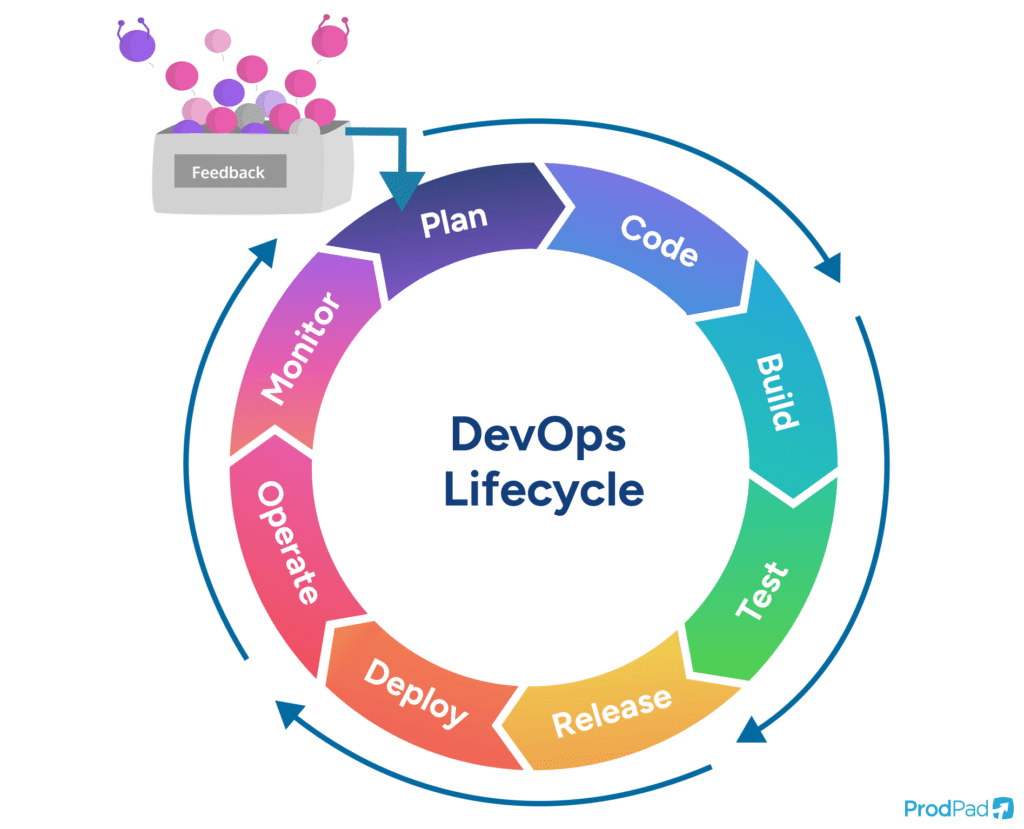
DevOps is an operating model that treats software delivery and reliability as one system: the same teams plan, build, ship, run, and improve services using automation and rapid feedback. It collapses the distance between “deciding” and “running” by changing ownership, automating routine work, and measuring outcomes that reflect real customer impact. If it does not change incentives and ownership, it is not DevOps; it is paperwork.
The strongest definitions of DevOps emphasize a blend of culture (shared responsibility), process (small batches and fast feedback), and technology (automation and observability). Academic and practitioner communities acknowledge there is no single universal definition, which is why working descriptions matter more than slogans.
Microsoft describes DevOps as uniting “people, process, and technology” across application planning, development, delivery, and operations, explicitly calling out coordination across formerly siloed roles. Amazon Web Services defines DevOps as a combination of “cultural philosophies, practices, and tools” that increases an organization’s ability to deliver at high velocity versus traditional processes. The Scaled Agile Framework frames DevOps as a mindset, culture, and set of technical practices that enable integration, automation, and collaboration to develop and operate a solution.
A practical synthesis that works across product organizations: DevOps is a lifecycle-spanning operating model. Work is designed so it can flow from idea to production and back to learning quickly. DevOps is not only a toolchain; tools enable the behavior, but the behavior depends on ownership and incentives. DevOps is not a single role; many organizations use “DevOps engineer” as a job title, but that usage is contentious because it can either support the operating model or accidentally reintroduce a new silo.
How did DevOps evolve and why does it matter for Product Management?
DevOps emerged as a response to a recurring organizational failure: development optimized for shipping change, operations optimized for minimizing risk, and customers paid the price for the gap between them. The early DevOps movement pulled together agile thinking, infrastructure automation, and production learning into a single narrative about flow and feedback.
Key milestones that shaped DevOps
John Allspaw and Paul Hammond helped popularize the pain of Dev-Ops separation with their 2009 presentation on deploying 10+ times per day at Flickr, showing how frequent deployments require collaboration and risk reduction rather than heroic change windows. The first devopsdays conference in 2009 in Ghent, Belgium, is widely cited as a key catalyst for shared vocabulary and community practice.
Patrick Debois is closely associated with early community formation through the devopsdays conference series. John Willis and Damon Edwards introduced CAMS (Culture, Automation, Measurement, Sharing), later expanded to CALMS by Jez Humble, as a practical checklist for DevOps transformations. Gene Kim helped socialize the “Three Ways” as a conceptual foundation: flow, feedback, and continual learning.
Nicole Forsgren and colleagues advanced measurement and evidence-based practice through DORA research and the book “Accelerate,” reinforcing that delivery performance can be measured and improved systematically. The DORA research is particularly important for product leaders because it demonstrated that speed and stability can enable each other rather than trade off, contradicting a persistent misconception that teams must choose between releasing quickly and operating reliably.
Why these origins still matter to product organizations
DevOps history is not trivia; it explains why DevOps keeps resurfacing in enterprise product delivery. DevOps started as workflow repair. The original problem was organizational throughput and reliability, not “which CI tool to buy.” DevOps matured through measurement. The shift from anecdotes to performance metrics moved conversations from opinion to evidence, especially in large organizations with many teams. DevOps keeps expanding because complexity keeps expanding. Cloud services, distributed systems, and fast-changing customer expectations make production learning a continuous requirement.
What are the core mechanics of DevOps?
Most DevOps implementations converge on a few repeatable mechanics, regardless of industry or company size. These mechanics represent the minimum viable behaviors that make DevOps work in practice.
Small batch delivery
Changes are kept small enough to test, deploy, and roll back safely. This is perhaps the single most important mechanic because it reduces the risk per change and makes debugging faster when something goes wrong. Small batches also shorten feedback loops, allowing teams to learn more quickly about what works and what does not.
Continuous integration and continuous delivery
Change is kept in a releasable state and pushed through a repeatable pipeline. David Farley emphasizes feedback loops as the core idea behind continuous delivery, which aligns with DevOps’ goal of shortening time from change to validated customer impact. Teams design work so it can be released on demand, which reduces pressure to bundle features into risky releases.
Shared operational ownership
Teams that build services participate in running and improving them. This is where DevOps differs most sharply from traditional organizational structures. When the same people who write code are also responsible for production incidents, they naturally write more operable code.
Measurement and learning loops
Performance and reliability are tracked using metrics that reflect both speed and stability. DORA popularized a balanced view of delivery performance using four key metrics: lead time for changes, deployment frequency, change failure rate, and time to restore service. High-performing teams perform better across all four metrics rather than trading one off.
ProdPad integrates with Azure DevOps, Jira, and other delivery tools, so your ideas stay connected to customer feedback and objectives while your dev team stays focused on execution.
How does DevOps work in real product teams?
DevOps works best when it is treated as a product operating model rather than an engineering initiative. In practice, it reshapes team boundaries, clarifies ownership of “run” work, and makes telemetry a first-class input into prioritization. Real teams vary in structure, but the patterns repeat: reduce handoffs, reduce batch size, and tighten feedback loops from production to planning.
The operating model most aligned with product outcomes
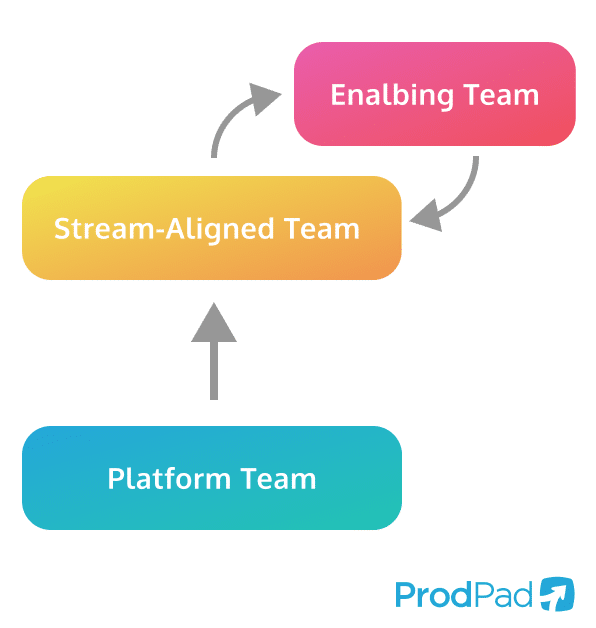
A dependable DevOps-friendly structure tends to include stream-aligned teams oriented around a value stream that can deliver and operate what they build, platform teams that provide paved roads (self-service infrastructure, pipelines, standards) that reduce cognitive load for delivery teams, and enabling teams that raise capability by coaching and unblocking rather than becoming permanent gatekeepers.
This framing is strongly compatible with Team Topologies, associated with Matthew Skelton and Manuel Pais. The key insight is that team structure affects both delivery speed and operational reliability. When teams own the full lifecycle of their services, they make better trade-offs because they live with the consequences of their decisions.
Day-to-day DevOps behaviors that show up in delivery
These behaviors are widely observed across teams that actually “do DevOps,” regardless of toolchain:
Production readiness is designed in. Operability, monitoring, rollout strategy, and recovery paths are part of the definition of done. On-call and incident learning exist without blame. Blameless postmortems and shared responsibility reduce fear and speed up recovery. Work is decomposed into deployable slices. Feature flags and progressive delivery reduce the risk per change. Release work is automated and repeatable. Pipelines, infrastructure as code, and deployment automation make releases routine rather than exceptional. Success metrics balance speed and stability. Teams watch lead time, deployment frequency, change failure rate, and time to restore.
Where does product leadership fit inside the DevOps loop?
DevOps is sometimes discussed as “engineering’s job,” but the most effective implementations pull product leadership into reliability and learning decisions. Google Cloud’s SRE guidance on how SRE relates to DevOps frames service level objectives (SLOs) and the trade-offs they imply as cross-team debates that include product and the business, not only engineering functions.
A pragmatic product leadership footprint in DevOps looks like defining acceptable risk (aligning on reliability targets so teams can make sensible release trade-offs), prioritizing enablement work (investing in test automation, deployment automation, and observability when they reduce the cost of change), and using telemetry as strategy input (treating incident trends, adoption metrics, and performance regressions as product signals to act on).
What changes for roadmap, backlog, and release planning
In a DevOps-enabled product organization, roadmaps shift from dates to intent. Delivery becomes continuous, so roadmaps make more sense as themes, outcomes, and directional priorities rather than hard calendar commitments. This is exactly what the Now-Next-Later roadmap format enables: time horizons rather than deadlines, with flexibility to experiment and learn.
Backlogs split by purpose instead of by function. Product backlog expresses customer value, hypotheses, and constraints. Delivery backlog expresses executable work that supports safe deployment and operation. This separation matters because it prevents delivery tools from becoming cluttered with half-baked ideas and unvalidated experiments.
Release planning becomes risk management. The question becomes “how to reduce risk per change” using automation, progressive delivery, and observability, not “how to coordinate a big-bang launch.” When releases are small and reversible, the conversation shifts from “when will this be done?” to “what have we learned?”
Ready to see how outcome-focused roadmaps work in practice? Explore the ProdPad sandbox to see Now-Next-Later roadmaps connected to OKRs, customer feedback, and product objectives.
What are common DevOps anti-patterns and breakdowns?
DevOps breaks when organizations adopt its vocabulary but keep their old incentives. The failure modes are fairly consistent across enterprises: the work becomes visible, but the decision-making stays fragmented; automation increases, but learning does not; deployment frequency rises, but customer experience does not. Research on DevOps adoption challenges highlights organizational support, awareness, and process adaptation as recurring hurdles, not only tooling gaps.
The most common DevOps anti-patterns in product organizations
“DevOps team” as a permanent silo: A separate group becomes the new gate between build and run, recreating handoffs with different job titles. The intent behind DevOps was to remove this boundary, not rename it.
“DevOps engineer” as a catch-all role: One or two people become responsible for pipelines, reliability, infra, and security, which can create fragility and burnout rather than capability. This pattern often emerges when organizations want DevOps benefits without restructuring ownership.
Automation without intent: CI/CD exists, but the batch size remains large because work is still planned as big releases. Pipelines become faster, but the cultural and planning changes that make small batches possible never materialize.
Measuring outputs instead of outcomes: Teams track tickets closed, story points, or pipeline runs while ignoring incident impact, adoption, or customer-facing reliability. This is perhaps the most insidious anti-pattern because it feels like progress while missing the point entirely.
Security bolted on late: DevOps produces faster delivery, but DevSecOps practices are not integrated, so risk accumulates until release time. Security reviews become bottlenecks precisely because they were not designed into the flow.
Change control becomes a bottleneck: Governance is treated as manual approvals instead of automated controls and clear policies, which slows delivery and encourages risky batching. Organizations that require CAB meetings for every deployment often end up with larger, riskier deployments that need more scrutiny.
Typical root causes and what they look like in the work
Misaligned incentives show up as observable patterns. Development is rewarded for shipping; operations is punished for outages; both optimize locally. Incident reduction work loses prioritization to feature delivery until a major outage forces attention.
Ownership confusion shows up when “run work” is treated as unplanned interruption instead of part of the product lifecycle, or when no one owns deployment pipelines end to end, so recovery is slow when they break.
Tool-driven process design shows up when the organization models work as tickets because the tool expects ticket flows, not because ticket flows match the product system. This is why bolting strategy onto Jira or Azure DevOps rarely works; delivery tools optimize for execution traceability, not for strategic decision-making.
How do tools shape DevOps behavior?
Tooling does not create DevOps by itself, but it shapes what teams notice, what they optimize, and what they ignore. Traditional enterprise tools tend to optimize for predictability and control, while modern DevOps toolchains tend to optimize for repeatability and feedback speed. Neither approach is universally correct; the difference is the assumptions encoded in the tool and whether those assumptions match the organization’s learning and risk needs.
What “traditional” tools optimize for
In most enterprises, “traditional” delivery and service-management tooling implicitly optimizes for predictability over learning (stable plans and controlled change windows are treated as success), handoffs over end-to-end flow (work moves across queues between specialized functions), and traceability over autonomy (approvals, documentation, and audit trails dominate the workflow).
This is why DevOps transformations often feel political: they change not only tools, but what “good work” looks like.
What DevOps-oriented toolchains optimize for
DevOps toolchains tend to encode different assumptions: repeatability over heroics (pipelines make changes routine rather than emergency events), small batch change (frequent deployments are treated as a risk reducer, not a risk increaser, because each change is easier to inspect and reverse), automation of “how” (infrastructure and delivery become defined as code so teams can review, test, and audit them), and observability and feedback (production signals are treated as part of engineering work, not an afterthought).
How specific tool categories influence DevOps behavior
ALM and work tracking platforms: Azure DevOps is designed as an integrated platform for planning work, collaborating on code, building, testing, and deploying to production. Teams can connect work items to code and pipelines, which supports traceability, but can also encourage “ticket-completion” metrics unless paired with outcome measures.
Continuous delivery foundations: The emphasis on feedback loops as the core idea behind continuous delivery aligns with DevOps’ goal of shortening time from change to validated customer impact. Teams design work so it can be released on demand.
Infrastructure as code and GitOps: Infrastructure as Code, concisely defined by Martin Fowler as treating infrastructure definitions as source code, subject to version control and testing, enables environments and deployments to become reviewable changes. GitOps, as defined by the CNCF, originated with Weaveworks in 2017 and has evolved in the cloud-native ecosystem. The behavioral effect is that changes become auditable and reversible in fast-moving contexts.
Platform engineering: CNCF describes platform engineering teams as internal providers with a “platform as a product” mindset, enabling developers to operate more independently by abstracting complexity. The behavioral effect is that teams can scale DevOps by reducing cognitive load and providing paved roads, but only if the platform is treated as an internal product with real users and feedback.
Delivery tools anchor teams in output; ProdPad anchors teams in outcomes and decision context. Connect your product strategy to execution with two-way integrations to Jira, Azure DevOps, and more.
How does DevOps support product strategy in enterprise contexts?
Enterprise product leadership often worries that DevOps conflicts with governance. In practice, DevOps tends to force clarity about what governance is trying to achieve. There are two fundamentally different governance orientations: governance for safety (reduce disruption and regulatory risk using clear policies and repeatable changes) and governance for learning (shorten feedback loops and make real outcomes visible, even in regulated contexts).
DORA research reports that performance improvement is possible across industries and that heavy process and tightly coupled architectures can contribute to lower performance among large enterprises, reinforcing the need to treat DevOps as a change to systems and constraints, not just a tooling upgrade.
For Product Managers, this has strategic implications. DevOps reduces the cost of learning by making changes smaller, safer, and easier to observe. This supports product discovery, faster iteration, and treating reliability as a product promise. When releases are cheap and reversible, product teams can run more experiments, validate more assumptions, and respond more quickly to customer feedback.
The connection to OKRs becomes clear here. When your objectives include metrics like adoption, activation, or customer satisfaction, DevOps provides the operational foundation to measure and act on those signals in near real-time. Your roadmap becomes a living strategy document rather than a delivery schedule.
How does ProdPad support DevOps-enabled product teams?
For product teams using Azure DevOps or Jira for delivery execution, the integration pattern that avoids “context loss” is to keep product rationale (feedback, objectives, personas, validation notes) in a product system of record, then push only the approved, development-ready spec into the delivery system with status syncing back.
The Azure DevOps integration supports pushing product specs as tickets with custom field mapping and two-way status syncing for cross-team transparency. Ideas and user stories flow from ProdPad to Azure DevOps when they are validated and ready for development, not before. This keeps the delivery backlog clean and focused while preserving the product thinking that led to each decision.
This separation matters because DevOps works best when delivery teams can focus on execution without being distracted by unvalidated ideas and premature feature requests. ProdPad becomes the place where strategy, objectives, and customer feedback live, while delivery tools handle the execution.
The workflow acts as the connection between your strategy and your development process. You can see your discovery-driven workflow stages, product-driven workflow stages, and post-implementation work all in one place.
Try ProdPad and see how Now-Next-Later roadmaps connect to your OKRs and delivery tools.
The Missing Link in Modern Product Management
DevOps succeeds when it becomes a decision system, not a deployment system. The missing link in many organizations is not another pipeline step; it is a shared, traceable chain from customer context to product intent to delivery execution to production learning, with clear ownership of what happens when reality disagrees with the plan. That chain is organizational behavior made visible: what gets measured gets prioritized, and what gets owned gets improved.
A forward-looking product organization treats DevOps as a way to institutionalize three things. Decision quality improves because product bets are easier to refine when releases are small, reversible, and measurable, which makes strategy more adaptive and less performative. Reliability becomes a product promise because availability and recovery are not “ops metrics”; they are customer experience, and they deserve product-level trade-off decisions. A durable system of record emerges because the organization needs a stable place to store rationale, objectives, and validation alongside delivery status, so teams can learn over time instead of re-litigating the same assumptions every quarter.
This is where a product system of record naturally complements delivery execution systems. Atlassian-style work tracking or Azure DevOps can optimize for execution traceability, while ProdPad can retain the product narrative and connect it to outcomes, with integrations that keep status aligned without forcing product thinking into ticket fields. The goal is not to replace delivery tools; it is to give product thinking a proper home so that DevOps can do what it does best: turn decisions into safe, measurable, repeatable changes that improve customer outcomes.
Explore the ultimate guide to lean roadmapping and learn how to connect your product strategy to delivery execution without getting trapped in date theater.
Enjoy a single source of truth for every product idea
Start a free trial and see how easy your Product Management life could be with ProdPad