Customer Acquisition Cost

Every SaaS company tracks customer acquisition cost. Few actually use it well. The number itself is straightforward: divide your sales and marketing spend by the number of new customers you gained. But the way teams interpret that number, react to it, and let it shape product decisions is where things go sideways. Customer acquisition cost gets reduced to a marketing problem when, in reality, it reflects the entire operating model: how the product onboards users, how feedback loops inform the roadmap, how pricing aligns with value delivery, and whether the organization is building for retention or just for the next signup.
Product teams that treat customer acquisition cost as someone else’s problem end up building features that are expensive to sell and hard to retain. Understanding what drives this metric, and what it actually tells you about the health of your product, is foundational work for any Product Manager.
What is Customer Acquisition Cost?
Customer acquisition cost is the total cost of converting a prospect into a paying customer, calculated by dividing all sales and marketing expenses over a given period by the number of new customers acquired in that same period. It includes paid advertising, content production, sales salaries and commissions, tooling, events, and any other spend directly tied to winning new business. A healthy customer acquisition cost reflects efficient go-to-market motion, strong product-market fit, and an onboarding experience that converts interest into commitment without burning cash.
The formula looks clean on paper:
Customer Acquisition Cost = Total Sales and Marketing Spend / Number of New Customers Acquired
In practice, calculating customer acquisition cost is messier than it appears. Teams argue about what counts as “sales and marketing spend.” Should you include the salaries of Solutions Engineers who support demos? The cost of your free tier infrastructure? Content marketing that serves both acquisition and retention? These debates matter because they determine whether the number reflects reality or a convenient fiction.
The fully loaded calculation
The most useful version of customer acquisition cost includes every dollar that contributes to acquiring a new customer, even if some of those dollars also serve other purposes. A Product Manager working alongside a Growth team needs to understand the fully loaded figure, because it affects how much room exists for experimentation, new features, and strategic investment. If the sales cycle requires three demos, two custom integrations, and a month-long pilot, the customer acquisition cost will be high regardless of how clever the ad spend is.
Blended vs. new customer customer acquisition cost
Many SaaS companies track a blended customer acquisition cost that mixes new customer acquisition with expansion revenue from existing accounts. Benchmarkit’s 2025 SaaS Performance Metrics report found that the median new customer acquisition cost ratio hit $2.00 for every $1.00 of new annual recurring revenue (ARR), a 14% increase year over year. The blended figure, which includes expansion ARR, looks better because selling more to existing customers is dramatically cheaper. Separating these two numbers is critical. Blended figures can mask a deteriorating acquisition engine behind a strong expansion motion.
Want to track product metrics that actually matter? Download The Complete List of Product Management KPIs, ProdPad’s free guide covering 34 metrics across usage, engagement, revenue, and more.
Why Does Customer Acquisition Cost Matter for Product Teams?
Customer acquisition cost sits at the intersection of product, marketing, sales, and finance. For Product Managers, it serves as a signal about the efficiency of the entire system they operate within, not just the campaigns that drive signups.
Customer acquisition cost as a product-market fit indicator
A rising customer acquisition cost often signals weakening product-market fit. When the product solves a clear, urgent problem for a well-defined audience, acquisition gets cheaper: word-of-mouth increases, conversion rates climb, and sales cycles shorten. When product-market fit erodes, or when the product drifts toward a broader (less urgent) audience, the opposite happens. Marketing has to work harder to explain the value. Sales needs more touchpoints. The customer acquisition cost creeps up, and teams scramble to optimize campaigns when the real issue is upstream.
The relationship between customer acquisition cost and retention
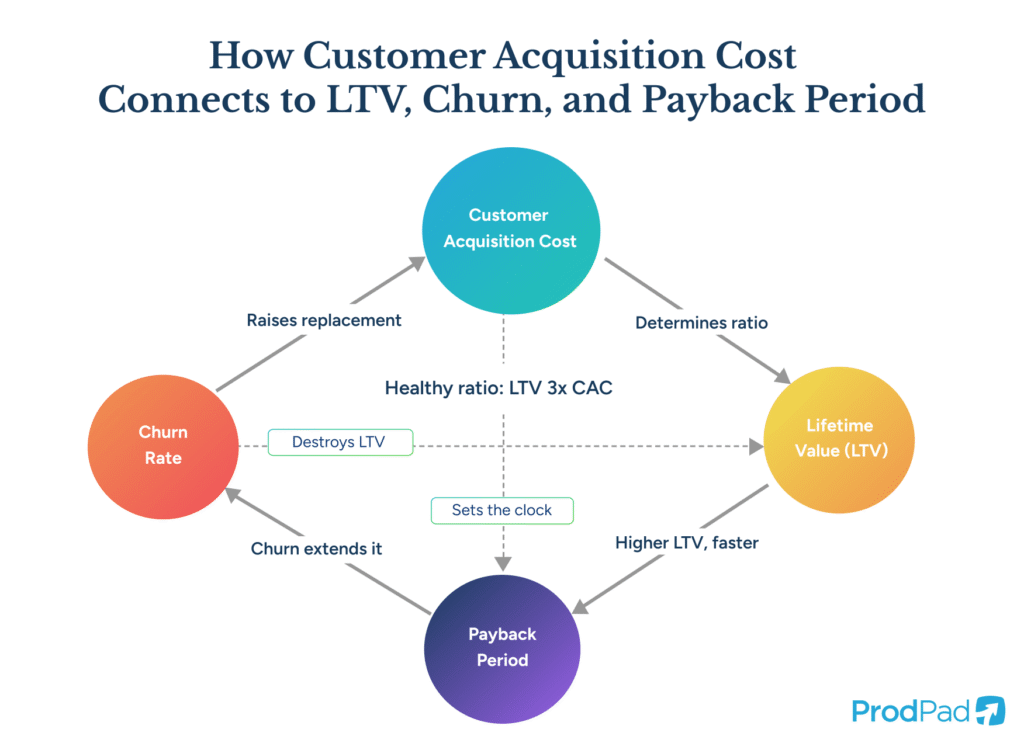
Acquiring a customer who churns within three months is not cheaper than acquiring one who stays for three years. The customer acquisition cost number on its own is incomplete without understanding customer churn and customer lifetime value (LTV). The widely cited 3:1 LTV-to-CAC ratio represents a minimum threshold for sustainable unit economics. Companies tracking toward an IPO or significant funding round typically need to demonstrate this ratio consistently across multiple quarters.
The product implications are significant. If customer acquisition cost is high but retention is strong and LTV is growing, the economics may still work. If customer acquisition cost is low but churn is eating the customer base, the company is just filling a leaky bucket more efficiently.
Customer acquisition cost and roadmap decisions
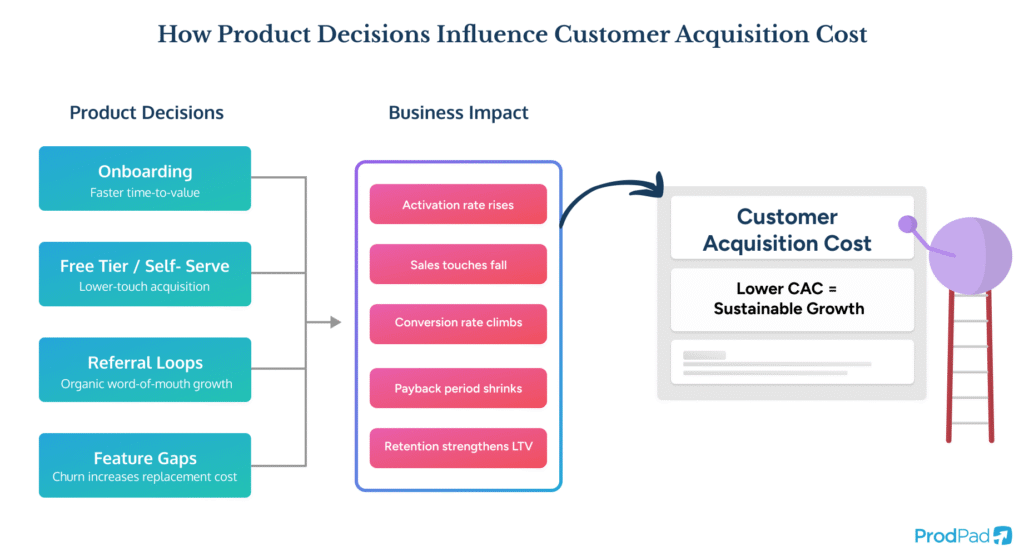
Roadmap priorities directly influence customer acquisition cost, even though the connection is rarely made explicit. A self-serve onboarding flow that gets users to value quickly reduces the need for sales-assisted conversion. A well-designed free tier acts as a marketing channel. In-product referral mechanics create a loop where the product itself does acquisition work. All of these are Product decisions, and all of them show up in the customer acquisition cost number.
Product teams that connect their OKRs to acquisition efficiency metrics create a feedback loop between what they build and the commercial outcomes the business depends on. In ProdPad, this connection becomes explicit: objectives tied to reducing time-to-value or improving activation rates are linked directly to roadmap initiatives, so Product teams can trace the impact of their work on metrics like customer acquisition cost.
How Do You Calculate Customer Acquisition Cost?
Calculating customer acquisition cost requires clarity about three things: what you count as cost, who counts as a new customer, and what time period you measure.
Step 1: Define your cost inputs
Start with the obvious categories: paid advertising, content marketing production costs, marketing automation tooling, sales team compensation (including commissions), CRM and sales enablement tools, and event spend. Then consider the less obvious ones: time spent by Product Managers on sales enablement, customer success resources dedicated to onboarding new accounts, infrastructure costs for free tiers or trial environments.
The goal is an honest accounting. Many teams inadvertently make their customer acquisition cost look better by excluding costs that genuinely contribute to acquisition.
Step 2: Agree on what “a new customer” means
For subscription SaaS businesses, a new customer is typically an account that converts to a paid plan. Free users, trial signups, and freemium accounts are not customers until they pay. This distinction matters enormously for product-led growth companies where thousands of users may be on a free tier while only a fraction convert.
Step 3: Choose your measurement period
Monthly or quarterly calculations are standard. The period should be long enough to account for sales cycle length. If your average deal takes 90 days to close, a monthly customer acquisition cost figure will be noisy because the spend in January may not produce customers until April. Quarterly or rolling averages smooth this out.
The formula in practice
A B2B SaaS company spending $300,000 per quarter on sales and marketing that acquires 150 new paying customers in that quarter has a customer acquisition cost of $2,000 per customer. Whether that number is “good” depends entirely on the lifetime value of those customers and the company’s growth stage.
What is a Good Customer Acquisition Cost?
There is no universal answer. Customer acquisition cost varies dramatically by industry, deal size, go-to-market model, and company maturity. Context determines whether a given figure represents efficiency or a problem.
Customer acquisition cost benchmarks by industry
Research from First Page Sage and other analysts tracking B2B SaaS benchmarks shows significant variation. B2B SaaS companies average roughly $1,200 per customer across all channels, though this number spans a wide range depending on annual contract value (ACV). Fintech companies face some of the highest acquisition costs, particularly at the enterprise level. Consumer-focused SaaS products see much lower figures, with ecommerce and retail software averaging under $100 per customer.
Customer acquisition cost benchmarks by channel
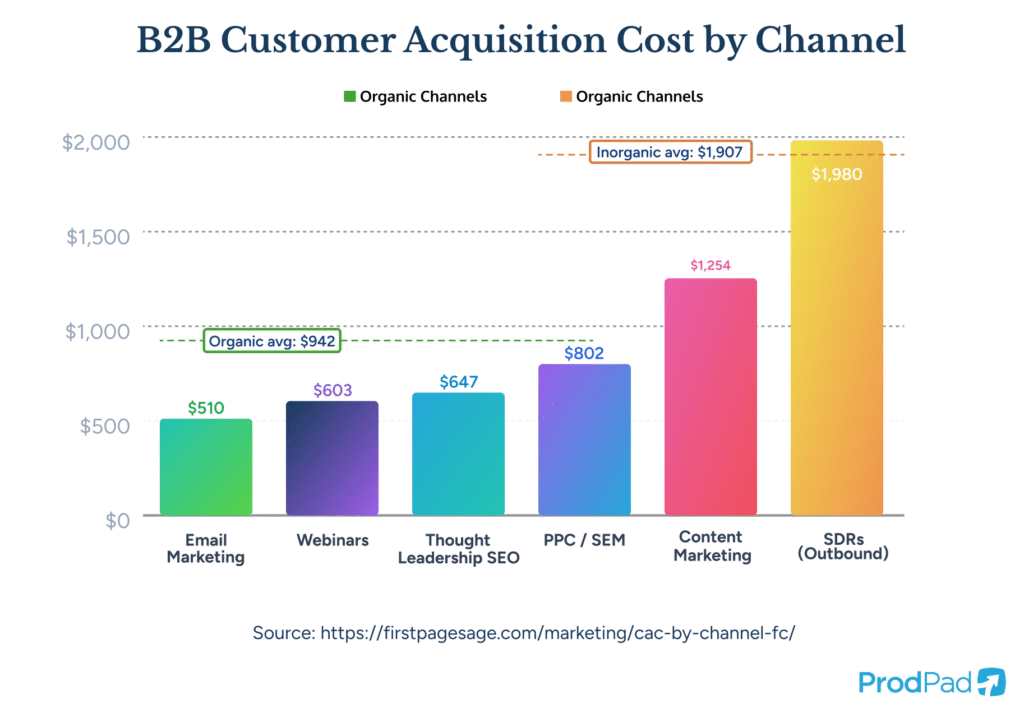
Channel selection has an outsized impact on customer acquisition cost. First Page Sage’s CAC by Channel benchmarks (drawn from ~120 firms between 2022 and 2024) show organic channels averaging $942 per B2B customer, while inorganic channels average $1,907. Within organic, email marketing ($510), webinars ($603), and thought leadership SEO ($647) sit at the low end. On the inorganic side, PPC/SEM averages $802, while SDR-driven outbound runs $1,980 per customer.
These numbers reinforce a pattern: channels that build trust over time (email, content, community) are structurally cheaper than channels that rent attention (paid ads, outbound). Product-led growth strategies, where the product itself drives acquisition through free tiers, trials, and word of mouth, tend to compress customer acquisition cost over time because the product replaces some of the work that marketing and sales would otherwise do.
The LTV:CAC ratio
The customer acquisition cost figure is meaningless in isolation. What matters is the relationship between how much you spend to acquire a customer and how much that customer is worth over their lifetime.
A 3:1 ratio (LTV three times the customer acquisition cost) is the generally accepted minimum for a viable SaaS business. A ratio below 2:1 signals a structural problem. A ratio above 5:1 may indicate under-investment in growth; the company could be acquiring customers faster with more spend.
Customer acquisition cost payback period
Payback period measures how many months it takes to recover the cost of acquiring a customer. The KeyBanc Capital Markets / Sapphire Ventures Private SaaS Survey tracked median CAC payback at roughly 20 months for private SaaS companies in 2024, down from 25 months in 2022 as companies shifted toward more efficient growth motions. Companies with sub-12 month payback are in excellent shape but may be leaving growth opportunities on the table.
Product Managers should care about payback period because it affects the company’s ability to invest in new capabilities. Longer payback periods mean less cash available for R&D, which constrains the product roadmap.
Need to prove that product work moves commercial metrics? Download How to Prove the ROI of Product Management, ProdPad’s free guide to putting hard numbers against the business value your Product team delivers.
How Can Product Teams Reduce Customer Acquisition Cost?
Reducing customer acquisition cost is not solely a marketing optimization exercise. Many of the most effective levers are product decisions.
Improve onboarding and time-to-value
The faster a user reaches the moment where the product delivers clear value, the less hand-holding (and associated cost) they need. Every friction point in onboarding is a cost driver. Confusing setup flows, missing integrations, and unclear value propositions all extend the sales cycle and increase the resources required to convert a prospect into a customer.
Product teams that measure activation rate and time-to-value as key results within their OKRs create a direct link between product work and acquisition efficiency. When ProdPad teams set an objective like “Reduce time-to-value for new trial users,” the initiatives on the roadmap become visible contributors to lower customer acquisition cost.
Build product-led acquisition loops
Products that generate their own demand are structurally cheaper to grow. Referral programs, viral collaboration features, public-facing dashboards, and embeddable widgets all create acquisition loops where users bring in other users. ProdPad’s own model includes several of these loops: unlimited free contributor seats mean every paying user can invite their entire team at no extra cost, published roadmaps create shareable URLs that introduce new prospects to the tool, and branded feedback portals turn customers’ end users into indirect acquisition channels. Product-led growth companies consistently report lower customer acquisition costs because the product itself does the work that sales and marketing would otherwise need to fund.
The AARRR framework (Acquisition, Activation, Retention, Referral, Revenue) gives Product teams a structured way to identify which stage of the customer journey is the bottleneck. If activation is strong but referral is weak, the product may be delivering value without making it easy for users to share that value with others.
Invest in retention to improve unit economics
Customer acquisition cost and user retention are two sides of the same coin. Every retained customer reduces the pressure to acquire new ones. Benchmarkit’s 2025 SaaS Performance Metrics report shows that existing customers generate 40% or more of new ARR for mature SaaS companies (and over 50% for companies above $50M ARR). That expansion revenue comes at a fraction of the cost of new customer acquisition.
Product decisions that improve retention (better feature adoption, stronger customer feedback loops, outcome-based roadmapping) directly improve the LTV:CAC ratio, even if they do not change the customer acquisition cost number itself.
Align product positioning with the right audience
April Dunford’s positioning work emphasizes that acquiring the wrong customers is more expensive than acquiring fewer of the right ones. When a product tries to be everything to everyone, marketing messages become generic, sales cycles lengthen, and conversion rates drop. Product teams that help sharpen positioning by clearly articulating what the product does best, and for whom, reduce customer acquisition cost by making it easier for the right buyers to self-select.
Want to go deeper on the retention side of the equation? Read Churn Prevention: A Product Manager’s Guide for practical strategies to keep customers and protect the LTV that makes your acquisition investment pay off.
What Are Common Customer Acquisition Cost Mistakes?
Customer acquisition cost is one of the most frequently miscalculated and misinterpreted metrics in SaaS. Several patterns consistently lead teams astray.
Ignoring fully loaded costs
The most common mistake is excluding costs that genuinely contribute to acquisition. Free tier infrastructure, Solutions Engineering time, partner commissions, and conference sponsorships all drive acquisition. Leaving them out produces a flattering but misleading number.
Confusing low customer acquisition cost with efficiency
A low customer acquisition cost can indicate efficiency, or it can indicate under-investment. Companies that cut marketing spend to reduce customer acquisition cost often find that growth slows disproportionately. The metric needs to be evaluated alongside growth rate, conversion rate, and market opportunity.
Optimizing customer acquisition cost without watching churn
Cheaper acquisition means nothing if retention falls apart. Teams that optimize for the lowest possible customer acquisition cost sometimes attract lower-quality customers who churn faster. A slightly higher customer acquisition cost that brings in customers with strong fit and high lifetime value is almost always the better trade.
Treating customer acquisition cost as a marketing-only metric
When customer acquisition cost rises, the reflexive response is to blame marketing. But as covered earlier, product experience, onboarding quality, sales cycle length, and competitive positioning all influence the number. Organizations that treat customer acquisition cost as a cross-functional metric, owned jointly by Product, Marketing, and Sales, make better decisions about where to invest.
How Does Customer Acquisition Cost Connect to Product Strategy?
Customer acquisition cost is a downstream outcome of dozens of product and business decisions. Understanding that connection is what separates Product Managers who build commercially valuable products from those who ship features and hope for the best.
Customer acquisition cost in the AARRR funnel
Dave McClure’s pirate metrics framework places acquisition at the top of the funnel, but every subsequent stage affects whether the acquisition investment pays off. A product with strong acquisition but weak activation burns cash. A product with strong activation but no referral loop misses the compounding benefit of organic growth. Product teams that track metrics across the full AARRR funnel can identify exactly where value is leaking.
OKRs and customer acquisition cost
Connecting customer acquisition cost to OKRs forces uncomfortable but productive conversations. An objective like “Improve acquisition efficiency” might have key results around trial-to-paid conversion rate, time-to-first-value, or self-serve signup completion rate. Each of those key results points to specific product work, not just campaign optimization.
ProdPad’s approach to linking OKRs directly to the roadmap makes this connection explicit. When a key result targets “Reduce average sales cycle from 45 days to 30 days,” the initiatives on the Now-Next-Later roadmap that support it are visible to everyone: Product, Sales, Marketing, and leadership.
Product-led growth and the future of customer acquisition cost
The 222% increase in customer acquisition cost across e-commerce over the past eight years (documented by SimplicityDX) reflects a structural shift that extends well beyond retail. Paid digital channels are more competitive and more expensive. Privacy regulations have made targeting less precise. AI-generated content has made organic differentiation harder.
Product-led growth represents the strongest counter-trend. Companies where the product itself drives acquisition, activation, and expansion can operate with fundamentally different unit economics. ProdPad’s own model, with a sandbox that lets prospective users explore the tool without a sales conversation, is an example of product-led acquisition in action.
Where Product Teams Go Wrong with Customer Acquisition Cost
The biggest failure pattern around customer acquisition cost is organizational: Product, Marketing, and Sales each optimize their piece without seeing the whole picture. Marketing drives traffic. Sales closes deals. Product ships features. Nobody owns the question of whether the whole system is getting more or less efficient at turning market interest into paying, retained customers.
This is exactly the kind of problem that outcome-based Product Management is designed to solve. When a product team works backward from an objective (reduce customer acquisition cost, improve LTV:CAC ratio, shorten payback period) rather than forward from a feature request, the roadmap becomes a tool for commercial strategy. Initiatives are evaluated based on their likely impact on acquisition efficiency, not just user satisfaction or engineering effort.
Tools shape behavior. Delivery-focused tools anchor teams in output: tickets closed, features shipped, sprints completed. A strategic Product Management platform like ProdPad anchors teams in outcomes: objectives met, key results moved, customer problems solved. When the roadmap connects to goals like customer acquisition cost, the entire organization gains visibility into how product work drives business performance.
The companies getting this right are the ones that treat customer acquisition cost as a product metric, not just a finance metric. They instrument their product to measure activation, retention, and referral. They connect those signals to their roadmap through OKRs. And they build products that are genuinely easier to buy, easier to adopt, and easier to recommend, because that is the most durable way to bring customer acquisition cost down.
ProdPad’s OKR management links objectives directly to your roadmap, so your team can trace every initiative back to the outcomes that matter, including acquisition efficiency.
Enjoy a single source of truth for every product idea
Start a free trial and see how easy your Product Management life could be with ProdPad