When Stabilization Becomes Strategy

Every product org has a version of the same backlog graveyard: a list of known bugs, performance issues, and architectural problems that have been sitting untouched for months, sometimes years. They’re tagged low priority, slotted into a “someday” column, and quietly ignored while the team pushes forward on the next big thing. The reasoning sounds logical. We’ll come back to it. There are bigger fish to fry. We need to ship.
But that reasoning has a compounding cost. And at some point, the cost of avoidance becomes the single biggest drag on a team’s ability to do anything strategic at all. Fixing what’s broken isn’t a detour from product strategy. For most teams, at some point in the product lifecycle, it is the strategy.
The Hidden Cost of “We’ll Deal With It Later”
Every deferred fix carries an interest rate. Roman Pichler describes this well in his writing on technical debt and product success: the messier the code and the less modular the architecture, the longer and more expensive every future change becomes. That’s true at the code level, and it’s equally true at the product level.
When teams accumulate unresolved bugs and instability, the cost shows up in places that are hard to see from a quarterly planning view. Cycle times get longer because engineers are working around fragile systems. Support ticket volume creeps up, pulling Engineering into reactive mode. Deployments become riskier, so teams batch more changes together, which makes each release slower and higher stakes. The Protiviti survey data on this is striking: nearly 70% of organizations say technical debt is significantly impacting their ability to innovate, and the average business spends 30% of its IT budget dealing with it.
The compounding dynamic is the critical part. A small bug left alone for six months doesn’t stay small. Other code gets built around it. Workarounds get baked into the product. New features have to account for the broken thing, adding complexity. What started as a quick fix becomes a structural problem, and now it’s genuinely expensive to address.
The planning trap
There’s a deeper systems-level problem too. When a team operates with significant instability, planning itself becomes unreliable. Estimates inflate because everyone knows that a certain percentage of every sprint will be eaten by unplanned work. Product Managers stop being able to forecast what can actually ship in a given time horizon, and so roadmap conversations devolve into hedging and caveats. John Cutler has written extensively about how product teams lose trust when engineers and designers can’t see the impact of their work, and chronic instability is one of the most common reasons that impact becomes invisible.
The “deal with it later” posture also creates a credibility gap with stakeholders. When the same bugs keep appearing in customer calls, and the roadmap keeps showing new features instead of fixes, Sales and Customer Success lose confidence in the product narrative. Leadership starts to question whether Product has a grip on the situation. And the Product team, ironically, ends up spending more time explaining and defending the roadmap than actually executing against it.
Your roadmap should show what you’re working on and why, whether that’s a new capability or a critical fix. ProdPad gives you the structure to make stabilization work visible and strategic. Try it in the sandbox
Cultural Damage Caused by Ignored Bugs
The technical costs of deferred stabilization are well understood. The cultural costs are less discussed, but they’re often more damaging and harder to reverse.
Engineers know
Engineering teams have a finely tuned sense of the state of their codebase. They know where the landmines are. They know which services are held together with duct tape. And when those problems get surfaced and then consistently deprioritized, it sends a clear signal: we don’t actually care about quality; we care about shipping features.
That signal erodes morale in a specific and predictable way. Engineers stop raising issues because they’ve learned that raising them doesn’t lead to resolution. They stop investing discretionary effort in code quality because the system doesn’t reward it. The best engineers, the ones with options, start looking elsewhere. Teams don’t usually describe this as a culture problem. They describe it as a retention problem, or a velocity problem, or a quality problem. But the root cause is the same: the operating model is telling people that stabilization work is second-class.
The trust erosion loop
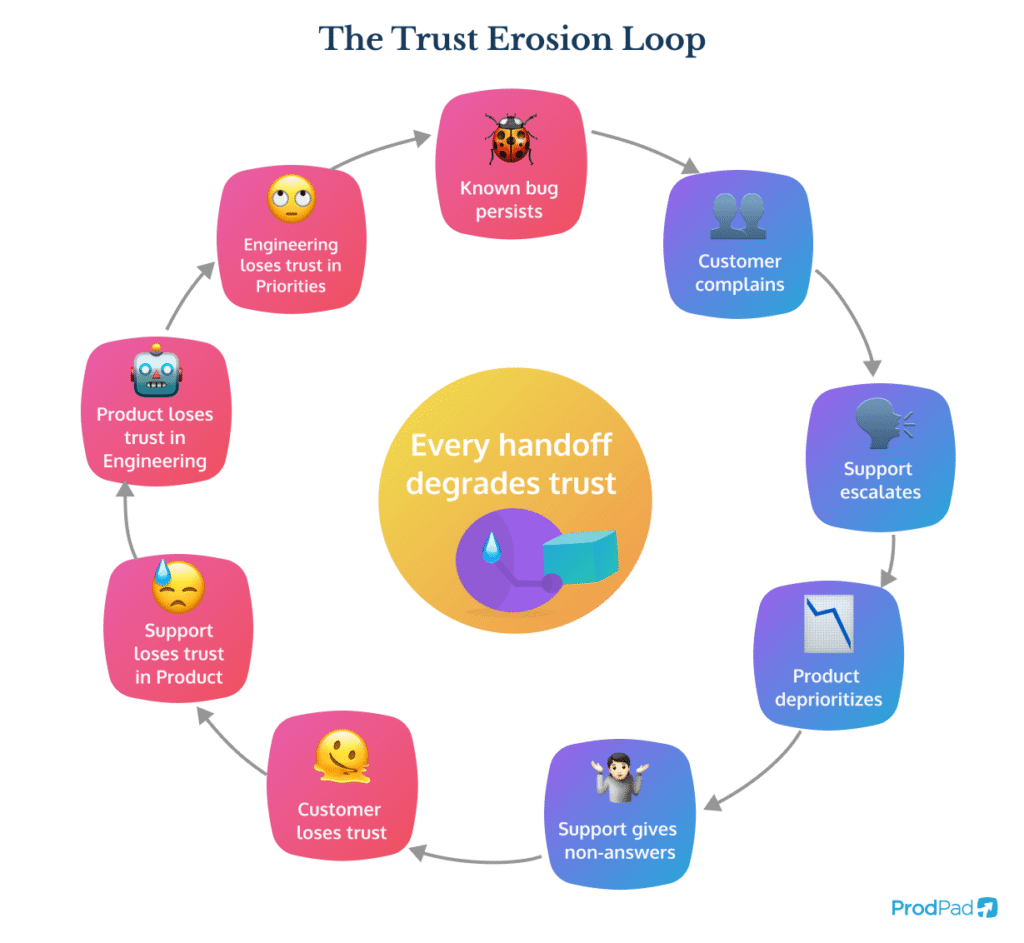
There’s a cascading effect that’s worth tracing. When known bugs persist, customers complain. Support escalates those complaints to Product. Product acknowledges the issue but prioritizes something else. Support goes back to the customer with a non-answer. The customer loses trust. Support loses trust in Product. Product loses trust in Engineering’s estimates (because unplanned bug work keeps disrupting plans). Engineering loses trust in Product’s prioritization. Cutler’s product enablement principles put it simply: trust is nurtured through promises regularly kept. When a team consistently promises to address quality issues and consistently doesn’t, every relationship in the chain degrades.
The innovation theater problem
Paradoxically, teams that refuse to stabilize often end up producing less innovation, not more. The features they ship land on an unstable foundation. Adoption suffers because users are already frustrated. Usage data is polluted by bugs, making it harder to interpret whether a new feature is genuinely solving a problem or being avoided because the surrounding experience is broken. Teams end up doing more rework, more customer-appeasement shipping, and less genuine discovery. The pursuit of novelty without stability produces a kind of innovation theater: new things announced, but real user value stagnating.
The False Binary of Innovation vs. Maintenance
Most product organizations operate with an implicit assumption: time spent on stabilization is time not spent on innovation. The two are treated as competing priorities, and since innovation is what gets celebrated, funded, and promoted, stabilization consistently loses.
This framing is fundamentally wrong.
Stability is a prerequisite for speed
Keith Eich, VP of Product and Technology at Harbor Compliance, frames it well: technical debt is really just deferred decisions, and unmanaged debt eventually kills innovation. The real question isn’t whether to innovate or stabilize. It’s what level of stability your system needs in order to sustain the pace of learning you’re trying to achieve.
Consider the mechanics. A team doing continuous discovery needs to ship experiments quickly, measure results, and iterate. Every step in that cycle gets slower when the system is unstable. Experiments take longer to build because engineers are working around fragile code. Results are harder to interpret because noisy baselines obscure signal. Iteration is riskier because each change could trigger cascading failures in unrelated parts of the product. The team that refuses to stabilize isn’t choosing innovation over maintenance. It’s choosing slower, less reliable innovation.
Portfolio allocation, not binary choice
The most effective product organizations treat stabilization and new capability work as parts of a single portfolio, not as a binary trade-off. Some teams formalize this with capacity allocation: a declared percentage of engineering time dedicated to paying down technical debt, fixing bugs, and improving system health. Others use dedicated stabilization sprints at regular intervals. The specific mechanism matters less than the principle: stabilization work needs to be planned, visible, and protected from being the first thing cut when timelines get tight.
ProdPad’s own approach to managing technical debt in the product flow reflects this: the product team doesn’t own 100% of dev capacity, and that should be by design. A certain amount of slack needs to be built in to account for code quality work, and the more slack there is, the less likely you’re going to end up with rushed code, missed bugs, and the accumulation of new debt.
The best roadmaps include both innovation and stabilization work, tied to strategic objectives.
Where the language goes wrong
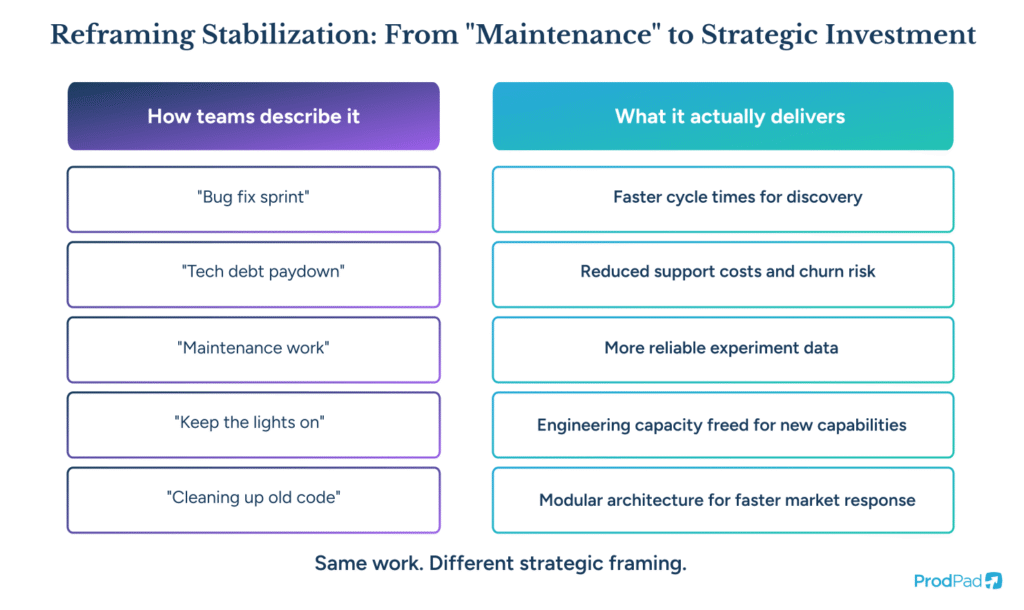
Part of the problem is linguistic. When organizations label stabilization work as “maintenance” or “keep the lights on,” they’re implicitly devaluing it. These labels frame the work as custodial rather than strategic. They make it harder to get executive buy-in, harder to attract strong engineers, and harder to celebrate when it’s done well.
A reframe helps. Stabilization work that enables faster cycle times is a strategic investment in delivery capability. Reducing support ticket volume through stabilization is a strategic investment in customer retention. And making the codebase more modular is a strategic investment in the team’s ability to respond to market changes. The work itself hasn’t changed. The framing has. And framing matters, because it determines whether stabilization gets the resources, visibility, and executive support it needs to actually happen.
How Stabilization Unlocks Better Discovery
The connection between a stable product and effective product discovery is direct, measurable, and consistently undervalued.
Cleaner signal, better decisions
Product teams make decisions based on data. Usage patterns, conversion funnels, experiment results, customer feedback. Every one of those data sources becomes less reliable when the product is unstable. Bugs create noise in behavioral data. Performance issues cause drop-offs that look like feature rejection. Workarounds change user behavior in ways that obscure actual preferences.
A team running a pricing experiment on a product with chronic checkout bugs can’t tell whether low conversion is a pricing problem or a reliability problem. A team measuring adoption of a new workflow can’t distinguish between genuine friction and intermittent errors. The discovery process depends on being able to trust the signal, and instability poisons the signal.
Faster experiment cycles
Teresa Torres popularized the idea that continuous discovery should be a sustained practice informing product decisions at every stage. That practice requires fast feedback loops: build something small, ship it, measure, learn, iterate. Every part of that loop gets slower on an unstable platform.
Risky deployments lead to lower deployment frequency. Fragile code forces teams to scope experiments more conservatively. And when QA is overwhelmed with regression issues, new features wait in the queue longer. The team that prioritizes stabilization isn’t taking time away from discovery. It’s removing friction from the discovery process itself.
Creating space for genuine learning
There’s a psychological dimension too. Teams mired in firefighting operate in a reactive mindset. They’re triaging, escalating, patching. There’s no cognitive space for the kind of open-ended exploration that discovery requires. Product Managers spend their time managing stakeholder frustration instead of talking to customers. Engineers spend their time on workarounds instead of building experiments. Designers are constrained by the limitations of a fragile system rather than imagining what the experience could be.
Stabilization creates breathing room. And breathing room is where the most valuable product insights tend to emerge, because teams finally have the headspace to notice things they’ve been too busy to see.
Product discovery only works when you can trust your data. See how ProdPad connects customer feedback to ideas to roadmap decisions
Turning Survival Work Into Strategic Leverage
The shift from treating stabilization as a necessary evil to treating it as a strategic lever requires changes at the operating model level. It requires different ways of planning, communicating, and measuring success.
Make stabilization work visible on the roadmap
The single most important step is getting stabilization initiatives onto the roadmap, with the same level of strategic framing as any new capability. That means tying them to objectives. Not just “fix the checkout bug” but “reduce friction in the purchase flow to improve conversion rate.” Not just “refactor the notification system” but “improve system reliability to support the scale of our Q3 growth target.”
When stabilization work is framed this way, it’s no longer in competition with feature work. It’s contributing to the same strategic objectives through a different mechanism. A Now-Next-Later roadmap is well suited to this because it organizes work around problems to solve, not features to ship. A stabilization initiative fits naturally as a “Now” item: a validated, high-priority problem that needs to be addressed before the team can confidently move forward.
Set OKRs that value stability
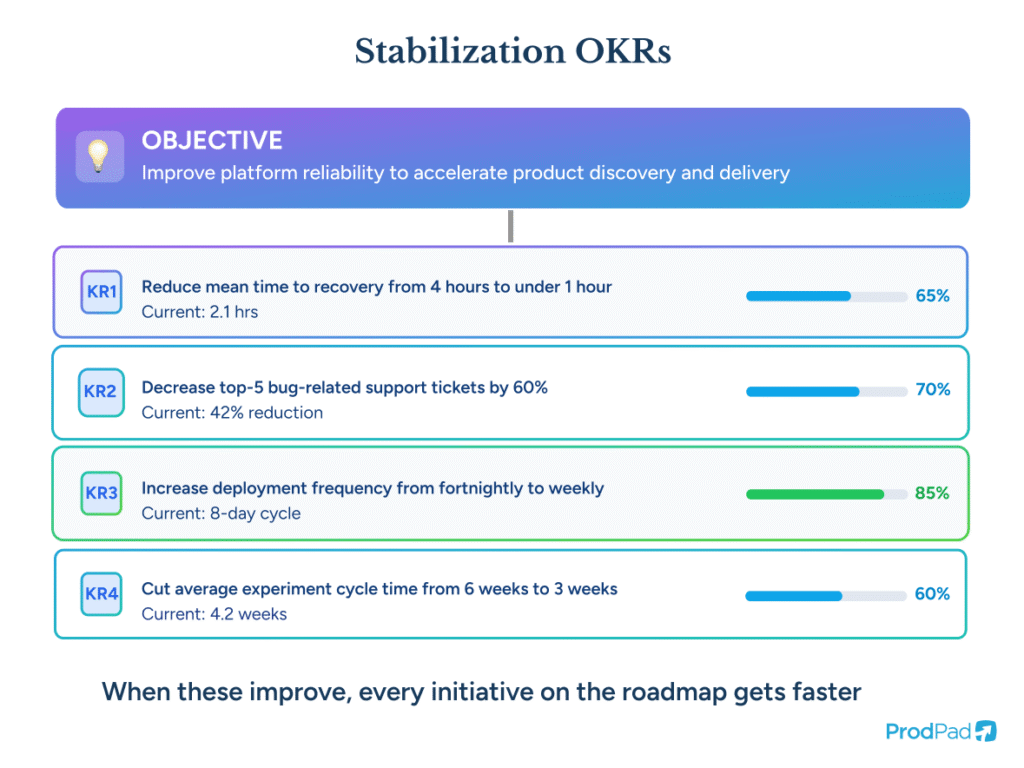
If your OKRs only measure new feature adoption and revenue from new capabilities, stabilization will always be the underdog. Consider what stability-focused key results could look like.
Reduce mean time to recovery by 40%. Decrease support ticket volume for top 5 reported issues by 60%. Improve deployment frequency from fortnightly to weekly. Cut average experiment cycle time from 6 weeks to 3. These are outcome-oriented, measurable, and directly tied to the team’s ability to deliver value faster. They’re the kind of key results that, when achieved, make everything else on the roadmap more achievable too.
Communicate stabilization as investment, not apology
When a Product leader presents stabilization work to the board or to stakeholders, the temptation is to frame it defensively: “We need to take some time to pay down debt before we can get back to building.” That framing invites the wrong response. It positions the team as having made mistakes that now need correcting, and it frames the stabilization period as dead time.
A better frame: “We’re investing in platform capability to accelerate our delivery pace for Q3 and Q4. The work we’re doing now will reduce cycle times by [X], free [Y] hours of engineering capacity per sprint, and give us more reliable data for our upcoming pricing experiments. This positions us to ship [Z initiative] faster than we could if we continued on the current trajectory.”
That’s the same work. Described in terms of what it enables rather than what it cleans up. And it’s more accurate, because the strategic benefit of stabilization isn’t retrospective. It’s forward-looking.
Build stabilization into the operating rhythm
The organizations that handle this best don’t treat stabilization as an event or a phase. They build it into the cadence. A consistent allocation of engineering capacity goes toward quality work every sprint. Stabilization objectives appear in every quarterly planning cycle. Metrics that track system health (deployment frequency, incident rate, mean time to recovery) sit alongside feature metrics in leadership dashboards.
This approach prevents the boom-bust cycle that most organizations fall into: ignoring quality until it becomes a crisis, then doing a panicked “stability sprint” that disrupts the roadmap, then going back to ignoring quality until the next crisis. The steady approach is less dramatic but far more effective, because it prevents debt from accumulating to the point where it requires a disruptive intervention.
Building an outcome-driven roadmap means connecting every initiative, including stabilization, to a strategic objective. ProdPad helps you do exactly that
Why the Best Product Teams Treat Stability as a Competitive Advantage
The distinction between product organizations that thrive and those that stagnate rarely comes down to how many features they ship. It comes down to how fast they can learn, adapt, and respond to what they discover. That speed is a function of system health.
A stable, well-maintained product is one where experiments ship in days instead of weeks. Customer feedback can be acted on quickly because the codebase is modular enough to change without cascading risk. Engineers spend their energy on creative problem-solving instead of firefighting. The roadmap reflects actual priorities instead of being held hostage by urgent but avoidable crises.
Nokia’s story is a cautionary one. The company dominated mobile phones for years, but years of deferred decisions around their Symbian operating system created an architecture so rigid that when the iPhone arrived, Nokia couldn’t respond fast enough. The debt wasn’t just a technical problem. It was a strategic one. The inability to move quickly meant the inability to compete.
Product leaders who understand this don’t treat stabilization as a detour. They treat it as the foundation that makes every other strategic initiative possible. They frame it, fund it, measure it, and celebrate it with the same seriousness as any new market-facing capability. Because a team that can move fast on a solid foundation will always outperform a team that moves fast on a shaky one. Speed on an unstable platform isn’t velocity. It’s vibration.
Ready to build a roadmap that balances new capabilities with the stabilization work that makes them possible? Watch our webinar on making product decisions without long-term debt
Great article, Janna. I particularly like the reframing tips because, while it’s relatively easy for one team to try and make this shift, selling the change to the rest of the organisation is the challenge!