Product Life Cycle Management – The 4 Stages and How to Manage Them

Product Life Cycle Management is the practice of adjusting your product strategy based on the stage your product is in. It brings together product development, marketing, pricing, customer insight, and roadmap planning so you can make the right decisions at the right time. A good PLM system helps you reduce wasted effort, focus your resources, and guide your team through each phase of a product’s evolution.
If you think about it, products grow up much like people do. When they are new, everything is experimental and full of possibility. In the teenage phase, they can reinvent themselves every five minutes and get away with it. Eventually they reach adulthood and become more stable and predictable. And later in life, they need more careful attention and realistic expectations.
The point is that products change, the market changes, and your approach needs to change with them. Product managers who treat a decade-old product like a brand-new one end up with chaos. Product managers who treat a brand-new product like a mature one end up with tumbleweeds.
Product Life Cycle Management gives you the framework to avoid both mistakes. And below, we unpack exactly how each stage works and how you can adapt your strategy for it.
Why Product Life Cycle Management matters
Product Life Cycle Management matters because treating every product the same way, no matter how old it is, is how teams burn time, money, and energy without realizing it. The work your product needs when it’s brand new is nothing like the work it needs when it’s ten years old, but plenty of teams act as if every stage deserves the same playbook.
PLM helps you stop doing that. It gives you a clear picture of where your product actually is so you can make decisions that match reality, not assumptions or wishful thinking.
With a solid PLM approach, you can:
- Focus your effort where it makes the biggest impact
- See clearly when the product is growing, plateauing, or declining
- Decide when to invest, when to optimize, and when to sunset
- Catch risks while they’re still cheap and simple to fix
- Give marketing, sales, and leadership a shared understanding of what’s happening
- Avoid stuffing your roadmap with ideas that no longer make sense
Without PLM, everything feels reactive. You’re always scrambling. You’re fighting today’s problems with last year’s tactics, or trying to scale something that hasn’t earned it yet. With PLM, you have a straightforward framework that helps you prioritize what matters and guide the product into its next stage instead of letting the market do the steering for you.
A quick history of Product Life Cycle Management
The idea behind Product Life Cycle Management has been around longer than most modern product teams. The earliest version dates back to 1931, when Otto Kleppner outlined how products move through predictable phases. In the 1950s, consulting firms like Booz, Allen and Hamilton refined those phases into the lifecycle model everyone still recognizes today: introduction, growth, maturity, and decline.
The most famous early example of PLM in the wild comes from the 1980s automotive world. AMC used emerging CAD tools to manage the Jeep Cherokee through its later stages while designing its successor, the Grand Cherokee. They used everything they learned from the mature product to speed up development of the new one. Chrysler eventually bought AMC and rolled PLM out across the company.
The origins might be industrial, but the lesson still hits home for SaaS: you can’t treat every product the same way.
A mature product can teach you how to build something new. A declining product can show you where the market is heading next. And an early product can tell you what customers actually care about today, not three years ago.
If you want to get a sense of the roots of this thinking, Harvard Business Review has an article from 1965 (!) on how to exploit the product life cycle.
What are the stages of product lifecycle management?
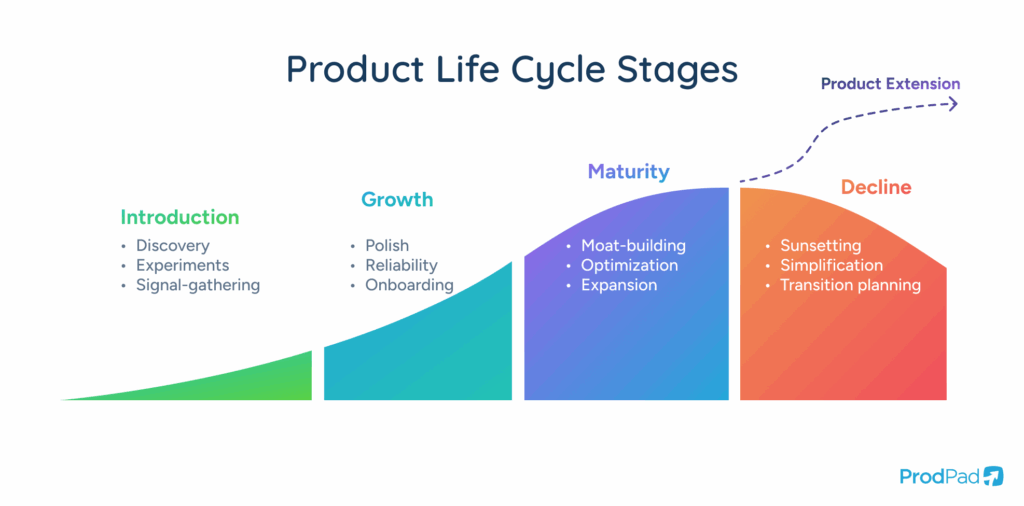
Most products move through four predictable stages: introduction, growth, maturity, and decline. The specifics look different from company to company, but the underlying patterns are the same. Each stage comes with its own risks, its own opportunities, and its own version of “you really shouldn’t be doing that right now.”
Let’s break them down.
1. Introduction phase
This is the newborn stage. Your product is out in the wild for the first time, and customers are poking at it to see if it actually does what you say it does. You’re learning just as much as they are.
What matters now:
- Validating that the problem is real
- Watching how early adopters actually behave
- Tightening your value proposition
- Keeping your roadmap flexible
- Shipping improvements quickly and openly
This stage is all about discovery. You’re not scaling yet. You’re proving the product deserves a future. If you ignore the signals here, you end up scaling something that doesn’t work. And that is a very expensive mistake to unwind.
What is continuous product discovery and are you doing it right?
2. Growth phase
Growth is the messy teenage phase. The product is gaining users, the market is paying attention, and demand can spike before the product is truly ready for it. Early adopters are replaced by mainstream customers who expect things to “just work”, and the bar for quality goes up fast.
What matters now:
- Improving reliability and stability
- Polishing rough edges in the UX
- Strengthening onboarding and activation
- Understanding why customers picked you
- Staying ahead of competitors who are suddenly very interested in you
Your goal in growth is simple: evolve the product fast enough that it appeals to a broader audience without losing the thing that made it compelling in the first place. This is where you really “cross the chasm,” and plenty of products don’t make it.
Stuck in the awkward growth phase? Read the guide on writing a kick-ass product-led growth strategy.
3. Maturity phase
Maturity is the comfortable middle age of the product lifecycle. You have predictable revenue, strong brand recognition, and a large customer base that relies on you every day. This is also the point where teams can get complacent. Competitors pile in. Customers raise their expectations. Technical debt creeps out from the shadows.
What matters now:
- Defending your position in the market
- Reducing friction in core workflows
- Improving reliability and performance
- Innovating without destabilizing your foundation
- Managing technical debt before it turns into a sinkhole
This is usually the most profitable stage, but also the easiest place to accidentally drift into decline. You need a deliberate strategy to keep the product relevant without overwhelming your existing customers.
Read more on how to make the most of your maturity stage product.
4. Decline phase
Every product eventually hits a point where growth slows and the market moves on. New technologies emerge. Competitors absorb your core functionality. Maintenance becomes more expensive, and customers start migrating to other options.
What matters now:
- Deciding whether to reinvest, reposition, or retire
- Avoiding unnecessary feature bloat that drags the product down
- Simplifying the offering if needed
- Creating the path to whatever comes next
- Moving customers thoughtfully and transparently
Decline isn’t a failure. It’s a signal. The smartest companies recognize it early and use it to redirect energy into the next product that will carry the business forward.
How to manage each stage of the product lifecycle
Knowing the stages is helpful, but it’s not enough. The real value of Product Life Cycle Management comes from adjusting your approach as your product evolves. Each stage asks something very different from you, and ignoring those shifts is how teams waste months chasing the wrong problems.
Let’s look at what effective management actually looks like.
How to manage the introduction stage
The introduction stage is your reality check. You might have a strong hypothesis about the problem you’re solving, but this is the first time the market gets to weigh in. Your job now is to learn quickly and stay brutally honest.
What to do:
- Watch real user behavior, not what you hoped they would do
- Validate the problem and the value proposition
- Run small, fast experiments to test assumptions
- Ask good questions and listen carefully
- Keep the product simple so users can show you what matters
- Be willing to pivot or kill ideas that aren’t landing
Most teams get in trouble here by assuming early enthusiasm equals long-term demand. It doesn’t. You’re still figuring out whether this thing can support a business, not trying to scale it to the moon.
How to manage the growth stage
Growth is the balancing act. You’re gaining traction, but you’re also attracting scrutiny. Early adopters are forgiving. The mainstream isn’t. This stage is about evolving the product quickly enough to serve a broader audience without losing your identity in the process.
What to do:
- Improve stability and performance as usage increases
- Smooth out the user experience
- Strengthen onboarding and activation paths
- Study your early adopters to understand what drew them to you
- Identify the gaps that prevent mainstream adoption
- Keep an eye on competitors who suddenly think your idea is brilliant
The biggest trap here is feature frenzy. Teams want to add everything the market asks for. Resist that. Growth is about sharpening, not bloating.
How to manage the maturity stage
The maturity stage is where your product makes the most money and carries the most risk. You’re established, but so is your competition. Your customers rely on you. And technical debt is no longer theoretical; it’s a very real drag on your ability to move.
What to do:
- Invest in performance, quality, and reliability
- Remove friction from key workflows
- Modernize the product experience in thoughtful, incremental ways
- Explore expansion opportunities without destabilizing your core
- Address technical debt proactively before it turns into a brick wall
- Watch for early signs of decline such as shrinking engagement or rising churn
The maturity stage rewards teams that stay curious and disciplined. If you coast, the market will overtake you. If you panic and reinvent everything, your customers will revolt. The sweet spot is intentional, well-paced evolution.
If your product is in the maturity stage, keep an eye out for extension opportunities. A well-timed reinvention can reset the curve and give the product a second life before decline sets in.
Everything you need to know about the maturity phase of product life cycle managment.
How to manage the decline stage
Decline happens to every product if it sticks around long enough. The trick is recognizing it early and treating it as a strategic moment rather than a funeral.
What to do:
- Decide whether to reinvest, reposition, or retire
- Avoid piling on more features in a desperate attempt to “save” the product
- Simplify where possible to reduce maintenance cost
- Identify the new problems your customers are bumping into
- Design the transition to your next product long before you sunset the old one
- Communicate clearly and give customers time to adapt
A declining product isn’t a dead end. It’s a signal that something new needs your attention. The companies that handle decline well tend to be the ones that launch the next great thing.
Is your product nearing the end of its life? Learn how to tell and what to do next
Roadmapping across the product lifecycle
A roadmap only works if it reflects where your product actually is in its lifecycle. Treat an early-stage product like a mature one and you’ll smother it. Treat a mature product like it’s still in discovery and you’ll confuse your customers and burn your team out.
The roadmap needs to evolve just as the product evolves.
In the introduction stage, your roadmap should stay loose. You’re learning, not scaling. You’re testing ideas, watching how customers behave, and adjusting quickly when you learn something new. A rigid, date-driven roadmap here only boxes you in before you understand what customers really want.
Once the product enters growth, the roadmap needs more shape. You’re serving a broader audience now, and the rough edges matter. Onboarding, stability, and quality become just as important as new capabilities. You still need flexibility, but you also need clarity about which improvements unlock the next level of adoption.
By the time you reach maturity, the roadmap becomes more strategic. You’re keeping the product competitive while making sure the core experience stays reliable. Innovation still matters, but so does protecting what your customers count on every day. This is where roadmapping becomes a balancing act: evolve with intention, not shock value.
And in decline, the roadmap’s job shifts again. Adding more features won’t reverse the trend. Instead, the roadmap becomes a tool for simplifying, stabilizing, and planning the transition to whatever comes next. It’s about helping the product exit gracefully while creating space for the next opportunity.
This is exactly why Now-Next-Later roadmapping works so well across the entire lifecycle. It gives you structure without locking you into commitments that no longer fit. Whether you’re experimenting, scaling, optimizing, or winding down, NNL keeps the focus on priorities, outcomes, and evidence instead of arbitrary timelines.
And this is where ProdPad shines. Because your ideas, feedback, and objectives all sit in one place, the roadmap naturally shifts as the product shifts. The signals you see in introduction look nothing like the signals in maturity, and ProdPad surfaces those differences so you can make decisions that match where the product is right now, not where it used to be.
The end result is a roadmap that stays honest, adaptable, and aligned with the lifecycle instead of fighting against it.